Hornsea One Offshore Wind Farm. Image Credit: Ørsted
Building just one-third of the offshore wind capacity currently proposed for the Gippsland zone off the coast of Victoria would cut household energy bills by $150 a year, avoid around 900 km of new onshore transmission, and slash the state’s dependence on gas, a new report has found.
The study, conducted by Jacobs, models two scenarios: one in which 7 gigawatts (GW) of offshore wind projects are connected to Victoria’s grid by 2040, and one in which offshore wind does not factor in the state’s energy mix at all.
Currently, there are nine proposed offshore wind projects with active feasibility licences in Victoria’s Gippsland zone, with a combined generation capacity of more than 20 GW.
While none of these projects is anywhere close to being fully approved or financed yet, the Victorian Labor government is aiming to meet offshore wind generation targets of at least 2 GW of capacity by 2032, 4 GW by 2035, and 9 GW by 2040.
But even the full backing of offshore wind by the state and federal Labor governments has failed to convince many industry watchers and naysayers that installing turbines in the sea is the right way forward for Australia, when onshore renewables are so much cheaper and easier to build.
The Jacobs study, which was commissioned by the Star of the South – one of the Gippsland neon licence holders and the leading contender to become Australia’s first operational offshore wind farm – hopes to settle this debate.
Using data from the Australian Energy Market Operator’s step change scenario in its Integrated System Plan, as well as from CSIRO’s GenCost report, the study finds that the savings and avoided costs delivered by offshore wind more than offset its high cost of capital.
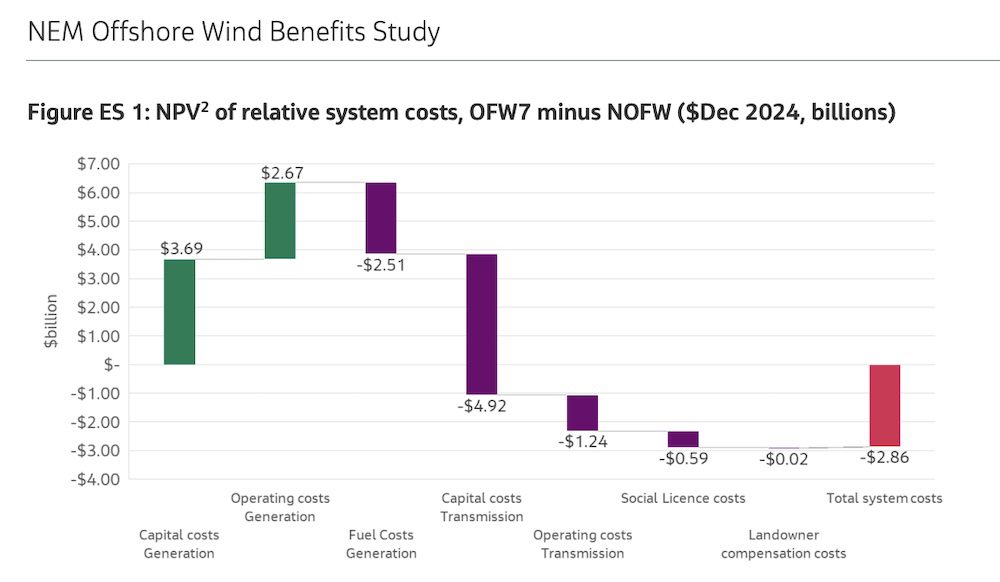
That is, while the capital and operating costs of the Offshore Wind scenario are higher than the scenario with no offshore wind ($3.7 billion and $2.7 billion higher, respectively) – much bigger savings are made on transmission, fuel, and social licence and landowner compensation.
Without offshore wind, for example, the study finds that the National Electricity Market would need an additional 8.3 GW of onshore wind capacity by 2040, primarily built in increasingly constrained Renewable Energy Zones (REZs) in Victoria, New South Wales, and Queensland.
To connect all of this new onshore wind would require around 7.7 GW of REZ transmission capacity augmentations, the study finds, including between around 934 km of new poles and wires, with an estimated capital and operating cost of $4.9 billion and $1.2 billion, respectively.
Add to the bill an extra 3.4 terawatt-hours (TWh) of gas, costing $2.5 billion, and $0.6 billion in social licence and landowner compensation costs, and the cost of offshore wind starts to look a lot more reasonable.
Source: Jacobs
“Although offshore wind is not the cheapest option from a standalone capital cost perspective, offshore wind reduces overall system costs, through reduced transmission investment, lower fuel expenditure (less gas peaking generation), and avoided social licence costs,” the report says.
On top of the avoided costs, Jacobs says the addition of offshore wind to the generation mix would cut wholesale electricity prices across the NEM, because of the increased energy supply during the evening peak and the filling of gaps during winter and summer peaks to meet seasonal electricity demand.
The report finds offshore wind would deliver a $5 per megawatt-hour (MWh) reduction in wholesale prices on average across the entire National Electricity Market between 2033-2040, rising to a $15/MWh by 2040 (a $5.2 billion total saving).
This would lower household energy bills by $151 a year per typical Victorian household, the report says, and $84 a year per typical east coast household from 2040 onwards.
“Our study found Gippsland offshore wind can reduce the need for new transmission and gas while helping lower electricity prices,” says Jacobs senior director of energy and power APAC, Aaron Hochwimmer.
“With strong evening and winter generation and proximity to major demand centres, offshore wind can play an important role in supporting a reliable and affordable electricity system.”
Verity Morgan-Schmidt, the CEO of Farmers for Climate Action, says that for the agriculture industry, the promise of less transmission lines dissecting farms and dividing communities is becoming increasingly attractive.
“While many farmers are eager for the diversified and drought resilient income that hosting solar and wind projects provides, transmission presents unique challenges,” Morgan-Schmidt said on Wednesday.
“Gippsland’s offshore wind zone is close to existing transmission in a region where coal is closing over the next decade. If offshore wind means we build less transmission and get projects built faster, then great.
“We need big-scale generation in the mix to replace coal and gas during the dinnertime energy use peak and into the night, and, done well, offshore wind is really well suited to that.”
Panelists at energy summit in Sydney warn the impact of losing bipartisan support for big…
A four-hour big battery proposed for construction in state's south-east is seeking a federal green…
The Octopus Investments battery has approval for up to 2 GWh, making it one of…
AGL chief nixes the idea that the company would ever be building coal-fired power stations…
One of Australia’s oldest continuously working wind farms, and a vital ingredient of a world-leading…
New funding will help establish manufacturing facilities for two automated technologies – robots that install…