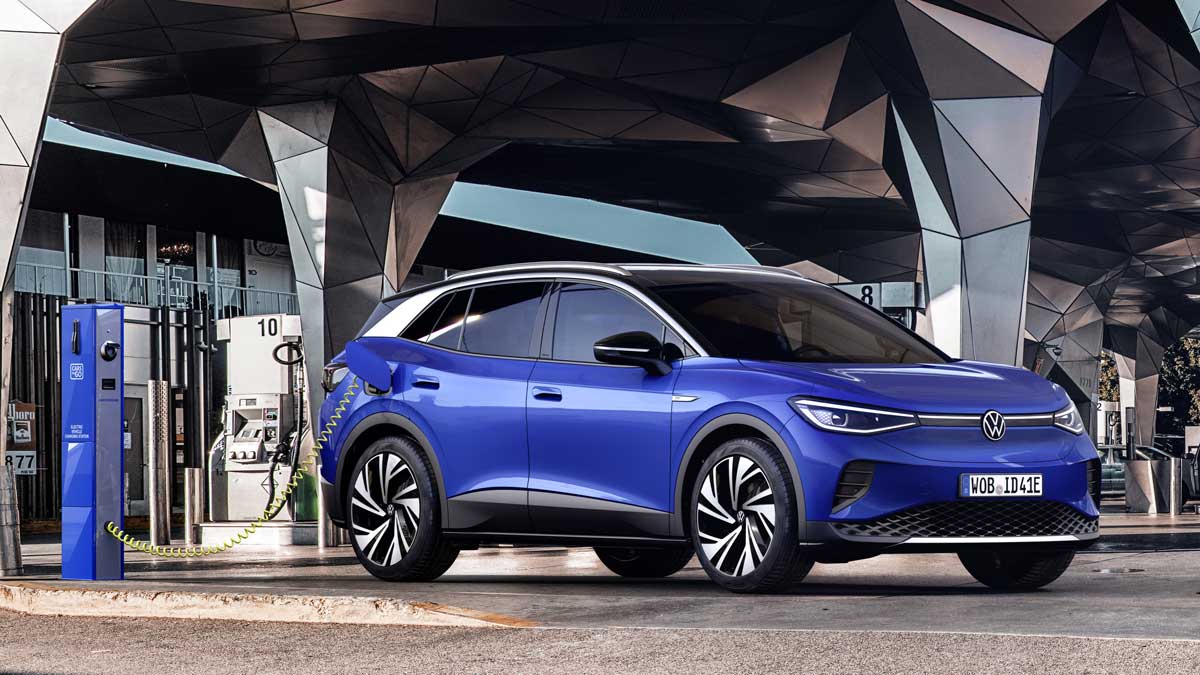
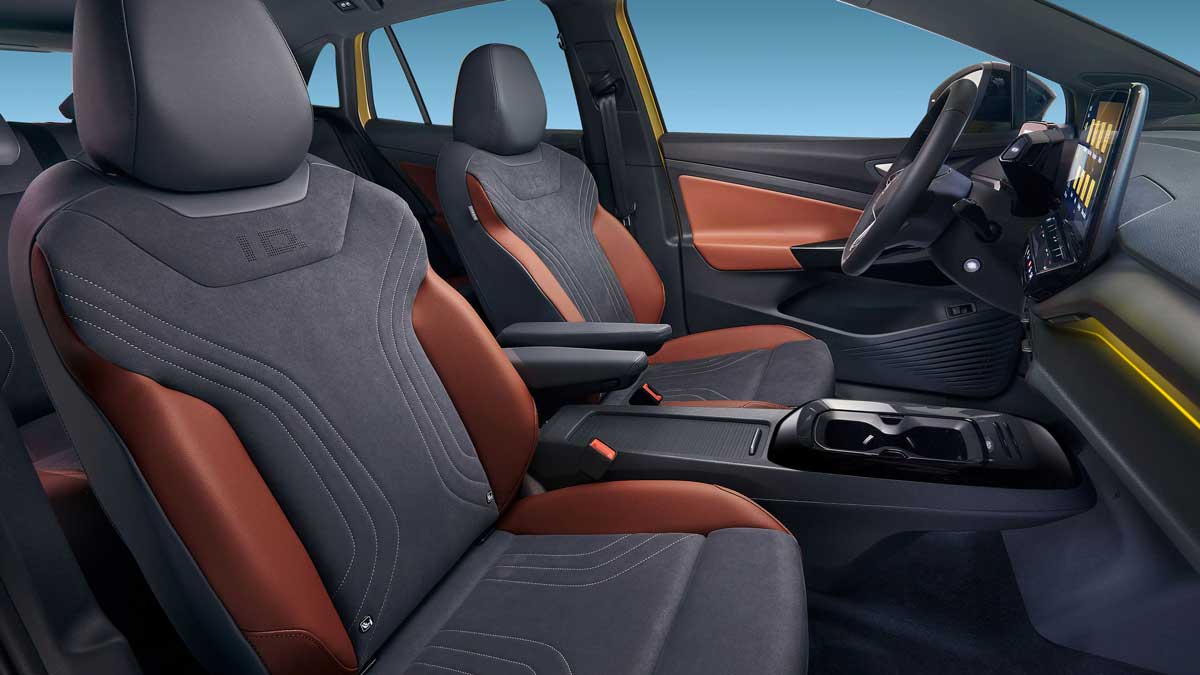
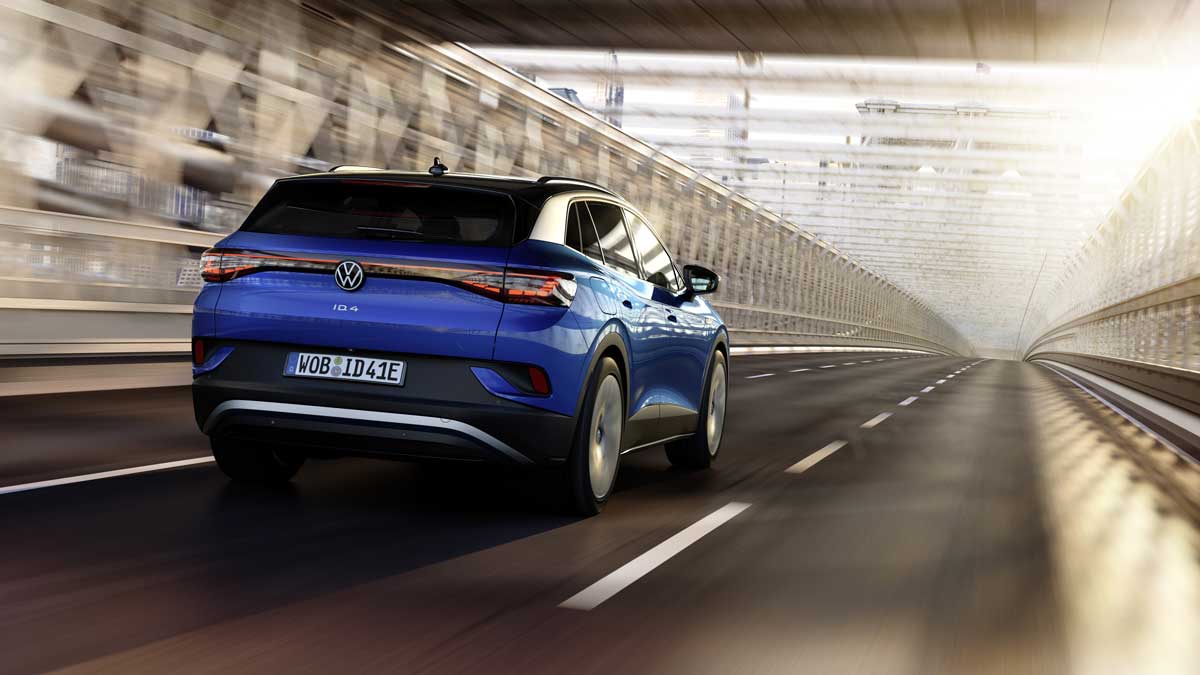
ID.4 electric SUV. Source: Volkswagen
Volkswagen has launched the new ID.4 electric crossover, just as it starts deliveries of its smaller stablemate, the ID.3 electric hatch.
As the largest market segment in the automotive industry, the transition of SUVs to electric drivetrains has a greater potential for reduction of transport-related emissions than smaller hatches and even sedans.
Volkswagen is betting that the VW ID.4 will hit the mark with families, and it is the first of the German car maker’s all-electric ID series that is pegged for Australia.
First, however, it will be released to dealerships in Europe by the end of 2020, priced from 49,950 euros ($A82,551 converted) and 59,950 euros ($A99,078 converted) respectively for two first edition models. These will be followed by a basic version next year for around 37,000 euros ($61,149 converted).
After the ID.3, the ID.4 is VW’s second electric car based on the car maker’s modular electric drive kit (MEB).
In contrast to the ID.3, the ID.4 is intended for a global market, built first in Germany, then in China and later in the US.
“The ID.4 is an emotional all-rounder which will impress many customers with its efficient electric drive, generous amount of space, modern assist systems and powerful design,” says Ralf Brandstätter, CEO of Volkswagen brand in a statement.
“As the first global electric car, this model will roll out our modular electric drive matrix platform that has been developed specifically for electric mobility the world over. Volkswagen is thus once again demonstrating its leading role in innovation, technology and quality on the high-volume market.”
Volkswagen intends to produce a total of two million units of the ID.4 – calculated over the life cycle of seven years. Internally, the electric SUV represents something like the “strategic milestone” of the Group’s e-offensive.
The VW ID.4 will be available in several powertrains and battery capacities, as is the ID.3.
Battery capacity will be available up to 77 kWh (usable) to offer up to 520 km driving range based on the WLTP cycle, with two more options expected of 45 kWh (for 300km approximate driving range), and 58 kWh (for 400km approximate driving range).
On launch, the ID.4 has same engine Volkswagen offers in the ID.3: an electric motor of 150 kW (204 hp) and 310 Nm of torque, housed in the rear axle (saving space) for acceleration from 0 to 100 km/hr in 8.5 seconds for a top speed of 160 km/hr.
Thanks to the MEB platform, the wheelbase of the ID.4 is longer than that of vehicles of the same size (2.77m), and Volkswagen says that from 2021 the ID.4 will be offered with a tow hitch 4WD dual motor version, although it did not add how much it might be able to pull.
The electric ID.4 has a maximum charge rate of 125kW, also like the ID.3, that can be achieved at DC fast chargers when out and about adding 300-320km range in around 30 minutes.
It can also be charged at home with a maximum 11kW AC charge rate for everyday driving.
The ID.4 measures 4.58m in length, but thanks to its electrical architecture, it offers significantly more space in the interior than is usually the case in this class.
Add to that the expansive panoramic glass roof (an optional extra), and sense of space is even more pronounced.
The ID.4 also scores points when it comes to cargo space, thanks to the battery which sits beneath the floor leaving plenty of room in the back – 543 litres in fact, and with the rear seat backs folded down, up to 1,575 litres.
As is now standard in this segment, the tailgate can be opened electrically or with a swivelling foot. There is also a luggage net, a net partition and a variable loading floor.
To read the full story on RenewEconomy’s electric vehicle dedicated sister site, The Driven, click here…
Veteran energy and climate reporter Peter Hannam is joining Renew Economy, returning to journalism after…
Consultant Shane Quinnell on the many hurdles we force renewable projects to jump over –…
Ark Energy becomes the fifth developer in just one week to announce a major investment…
The developer behind Victoria’s Mortlake Energy Hub has secured around $A245 million from a global…
Plans to build a wind farm near one of country's youngest coal plants win all-important…
Researchers says realignment of wind turbines away from the wind can boost output. "Wake steering"…