The United States Senate has passed a landmark $US370 billion ($A540 billion) climate spending bill, which is being hailed as a landmark for the US efforts against runaway climate impacts, and will supports its goal of cutting emissions by 40 per cent by 2030.
The bill which was renamed the Inflation Reduction Act of 2022 (IRA) – to make it both palatable to Democrat holdouts such as Joe Manchin, and also to highlight the cost benefits of the switch to green energy – tightens tax loopholes and will use the revenue for climate action, drought relief and the Affordable Care Act.
A huge share of the climate spending will be used to fund tax credits and rebates for a range of renewable technologies including solar panels, wind turbines, heat pumps, energy efficiency, and electric vehicles.
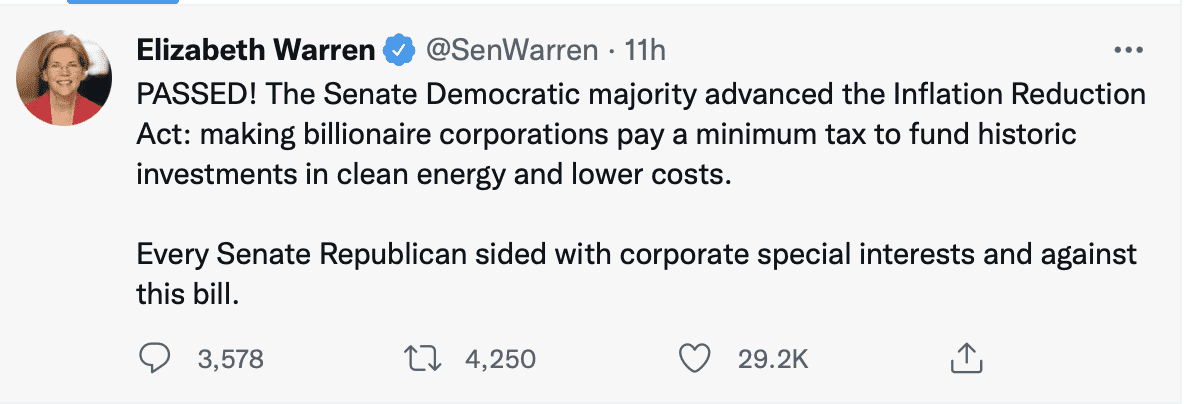
As Democrat Senator and former presidential candidate Elisabeth Warren described it: “The Senate Democratic majority advanced the Inflation Reduction Act: making billionaire corporations pay a minimum tax to fund historic investments in clean energy and lower costs.”
President Joe Biden said of the legislation: “It addresses the climate crisis and strengthens our energy security, creating jobs manufacturing solar panels, wind turbines, and electric vehicles in America with American workers. It lowers families’ energy costs by hundreds of dollars each year.”
The bill also includes incentives for companies to manufacture more of their technology in the US to meet Biden’s promises of more jobs at home, and creates a $US1.5 billion program to address methane emissions.
Unsurprisingly, the bill was also warmly welcomed by the United States renewable energy sector.
“This is the vote heard around the world,” said Heather Zichal, CEO of the American Clean Power Association.
“It puts America on a path to creating 550,000 new clean energy jobs while reducing economy-wide emissions 40% by 2030. This is a generational opportunity for clean energy after years of uncertainty and delay.
“This unprecedented investment in clean energy will supercharge America’s clean energy economy and keep the United States within striking distance of our climate goals.”
But the road to the passing of the IRA was long and convoluted, and required a number of concessions to bring hold out Democratic senators Joe Manchin, from coal country West Virginia, and Kyrsten Sinema of Arizona.
The impasse wasn’t resolved until after a surprise agreement between Manchin and Senate Majority Leader Charles Schumer and a deal that late last week received the support of Sinema.
The compromises – apart from shrinking the Biden’s original goal of a $US2 trillion package – include making it easier to approve new energy projects – including coal projects and expediting a gas pipeline proposed for Manchin’s West Virginia.
However, despite the implications of such compromises, many experts are highlighting the long-term gain over the short-term pain of these backwards deals.
Some of the specific initiatives include $US7,500 for new electric vehicles and about $US4,000 for a used vehicle until 2032, although there are limits relating to the where the batteries were made and incomes.
There is also a $US9 billion home energy rebate program to focus on retrofits and electrifying home appliances, another $US1 billion to make public housing more energy-efficient, and $US 27 billion to create a National Green Bank, similar to Australia’s Clean Energy Finance Corp, which can leverage private funding for clean projects.
This week in Palau, the Pacific will ask for funding for wind-assisted cargo ships that…
As plug-in solar hits stores in the UK, lobby groups are reminding governments and regulators…
Sabiene Heindl from The Energy Charter on the need for strong regional leaders for transition…
Big battery developers are facing increasing scrutiny from local communities about their projects. Some of…
Record levels of solar, wind and battery use are pushing down emissions in Australia but…
As the NT government fights to power future data centres with gas, its publicly-owned utility…