Pumped hydro energy storage (PHES) provides very cheap energy storage (gigawatt-hours). On the other hand, batteries are cheap for storage power (gigawatts). Hybrid storage comprising PHES plus batteries provides very cheap energy storage AND cheap storage power.
Normally, solar and wind are used to recharge PHES and batteries. However, at times it is valuable to allow storage to “trickle-recharge” storage (despite additional losses).
For example, Snowy 2.0 (350 gigawatt-hours (GWh) of energy storage + 2.2 gigawatts (GW) of storage power) can be coupled with 5 GW of four-hour batteries located at grid strong-points.
Now we have cheap high-power (7 GW) and very cheap large-scale energy storage (370 GWh). The total cost of this highly capable system is $20.5 billion ($12 billion for Snowy 2.0 + $8.5 billion for the batteries according to GenCost).
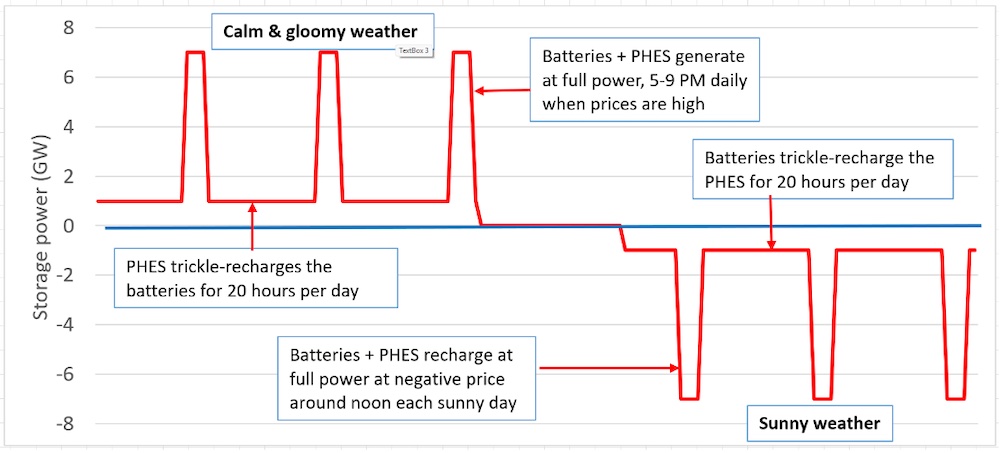
During calm and cloudy weather when energy prices go high, this hybrid system can meet a 7 GW load from 5pm to 9pm. For the following 20 hours, the PHES can trickle-recharge the batteries. It can do this for 12 days in a row before the PHES is empty, whereas a battery-only system would be empty after the first day.
Batteries can also capture negative prices from 10am to 2pm and trickle-recharge Snowy 2.0 for the next 20 hours and repeat each day during a succession of 12 sunny days. This hybrid system captures negative prices with a power of 7 GW, whereas Snowy 2.0 can only pump at a rate of 2 GW.
A trickle-recharging hybrid system allows us to get rid of gas backup. Gas cannot compete with a hybrid system capturing peak prices at 7 GW and getting recharged at negative cost.
About 95% of the energy storage (GWh) in the NEM is supplied by PHES while batteries provide a majority of the storage power (GW). Snowy 2.0 provides very cheap energy storage that lasts for 100 years at a capital cost of A$34/kWh ($12B/350GWh). A 350 GWh battery energy storage system would cost about 10X more than Snowy 2.0 (GenCost data).
The marginal capital cost of premium-quality PHES is A$10-30 per kWh which is far below the cost of batteries. Doubling PHES energy storage is cheap: double the stored water by scooping more rock from the bed of the reservoirs to make higher dam walls.
Class AA or AAA off-river PHES has large height difference between the reservoirs (600-1600m), short tunnels, and stores lots of water behind small dam walls.
The global PHES potential is 86 million GWh, which is equivalent to 2 trillion EV batteries. This is spread across 820,000 sites listed in ANU’s global pumped hydro atlas. Our new paper here describes in detail how PHES and hybrids solve energy storage.
Andrew Blakers is professor of engineering, Australian National University
Fossil-fuel proponents have used a 'drop in the ocean' argument over their impact on the…
Australian households have installed a record number of rooftop solar systems and home batteries so…
Trump administration appears to have bet on the wrong horse, with renewables surging and coal…
Few home battery owners have signed up to join virtual power plants, with concerns about…
Zenith Energy’s Michael Buzzard on the remarkable energy transitions achieved in off-grid mines, and plans…
It is 10 years since South Australia's state-wide blackout: Far from being the end of…