The new Queensland government abandoned the Pioneer Burdekin Pumped Hydro Energy Storage (PHES) system. Strange claims were made by the premier that its capital cost is $37 billion.
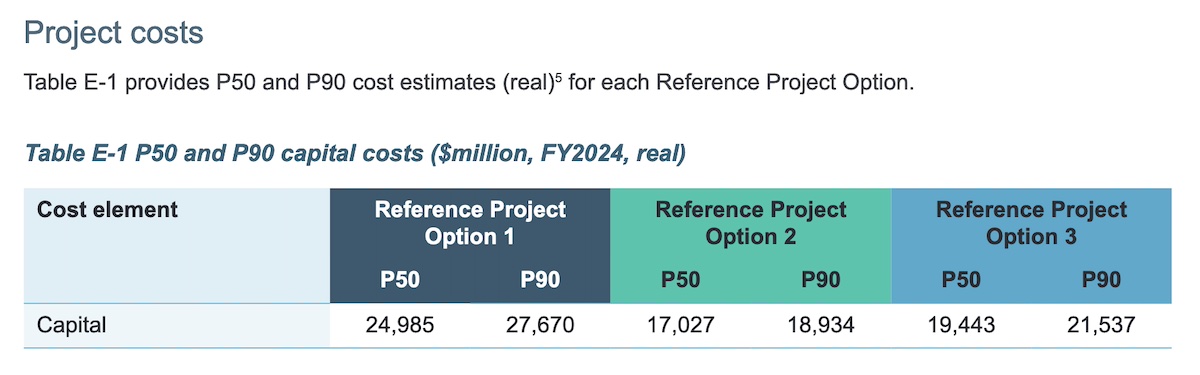
However, the cost of Option 2 (single tunnel, 120 GWh, 2.5 GW) in the costing report for this project is $17 billion (Table E1, below). Option 2 has a positive net present value. Option 1 (double tunnel, 120 GWh, 5 GW) is costed at $25 billion but has a negative NPV and is not recommended.
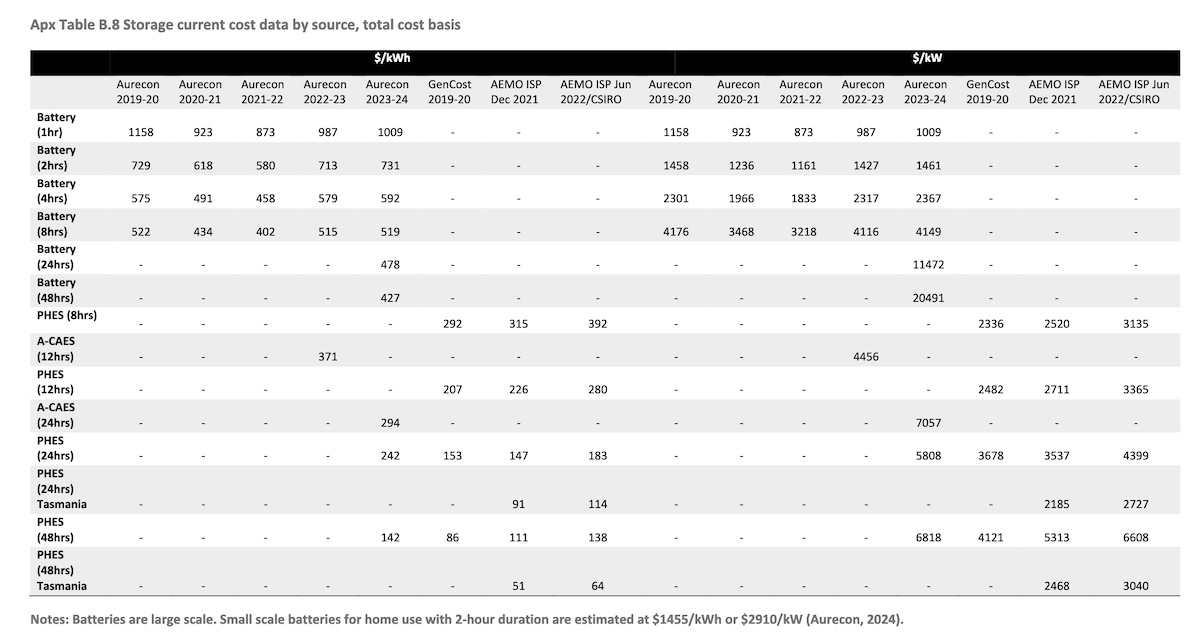
For perspective, according to GenCost estimates (Table B8, below), the current capital cost of a battery-equivalent of Option 2 is $51 billion. PHES has a much longer lifetime than batteries.
Australia is likely to have less transmission and less wind energy and more solar than optimum due to delayed approvals. Thus, a larger amount of storage for overnight and several days will be required. This is the role of PHES which is cheap for energy storage and provides more than 95% of energy storage in the NEM.
The new Queensland Premier suggests that the 50 GWh Borumba PHES system will proceed, and that alternative sites to Pioneer Burdekin will be considered. There are hundreds of good PHES sites in Queensland. Our recent Conversation article lists 15 high quality Queensland PHES sites in the size range 50-5,000 GWh.
Snowy 2.0 (350 GWh, 2.2 GW) will operate for 100 years or more and has 50 times more energy storage than the combined Australian utility battery fleet.
It will cost about $12 billion and its capacity is equivalent to 6 million EV batteries. That’s roughly equivalent to $2,000 for a 100-year-lifetime EV battery. The GenCost estimate for a battery-equivalent of Snowy 2.0 is $150 billion.
Australia has dozens of Class AA PHES sites that match Snowy 2.0, as marked by triangles in the Global Pumped Hydro Atlases. These Atlases contain 820,000 sites with combined storage of 86 million GWh, which is equivalent to 2 trillion EV batteries.
Hybrid storage systems combine batteries and PHES and are much better than either alone.
Australia has large-scale hybrid energy storage comprising existing hydroelectric dams, three existing PHES systems (Tumut 3, Wivenhoe, Kangaroo Valley), two more under construction (Snowy 2.0 and Kidston), another dozen under serious consideration, and many GW of new batteries.
Storage is a solved problem via PHES and batteries. Batteries are relatively inexpensive for storage power ($/GW) but are expensive for energy storage ($/GWh). PHES is more expensive than batteries for storage power ($/GW) but much cheaper for energy storage ($/GWh). A hybrid system has both cheap energy storage and cheap storage power.
In a hybrid system, storage can charge storage. A large PHES reservoir can trickle charge batteries 24/7 during a week of calm and cloudy weather.
For example, a PHES system with 350 GWh of energy storage and 2.2 GW of generation power can trickle charge twelve 4-hour batteries (48 GWh) every day for a wet and windless week. This hybrid system effectively has energy storage of 400 GWh and storage power of 12 GW. A battery-only system would run out of energy after the first day, while a PHES-only system would be underpowered.
An additional advantage is that the batteries can harvest negative prices for four hours around noon on sunny days with a power of 12 GW, and trickle charge the PHES system for the next 20 hours – and do this every day for a week before the PHES system is full.
In other words, this 400 GWh hybrid system can harvest peak power prices at 12 GW and get recharged at negative prices.
PHES and batteries get rid of the need for gas from the NEM altogether. PHES stores large amounts of energy at low cost while batteries take care of high-power requirements.
Snowy 2.0 at a cost of $12 billion needs annual revenue of $720 million (using the GenCost discount rate of 6%). It only needs to cycle six times per year (or twelve half-cycles) assuming an arbitrage price spread of $350/MWh. Ancillary service payments provide additional revenue to Snowy 2.0, thus reducing the required number of cycles per year.
The cost of gas backup is $350 per MWh for a duty cycle of 4% (using GenCost data and gas price of $11/GJ). Two thirds of this cost is capital and only one third is gas. Shadow carbon pricing around $100/MWh makes gas even less competitive.
Andrew Blakers is professor of engineering, Australian National University
Energy market specialist Tim Ryan says retailers are gaming everything from Solar Sharer and VPPs…
Arena has marked the installation of 100 community batteries and announced a further $23.2 million…
Victoria group takes wind project to court, says public servants are next if successful.
Electricity retailers with their own version of Solar Sharer offer bigger power bill savings than…
Sea surface temperatures are now way ahead of previous levels at this time of the…
When Greens elder Bob Brown addressed a throng of forest campaigners on Saturday, he did…