AGL's Liddell coal plant in the Hunter region of NSW.
Many of Australia’s coal-fired generators are facing unplanned and early retirements as revenues fall to unsustainable levels, according to a new analysis that finds a surge in wind and solar investment is pushing coal out of the electricity market.
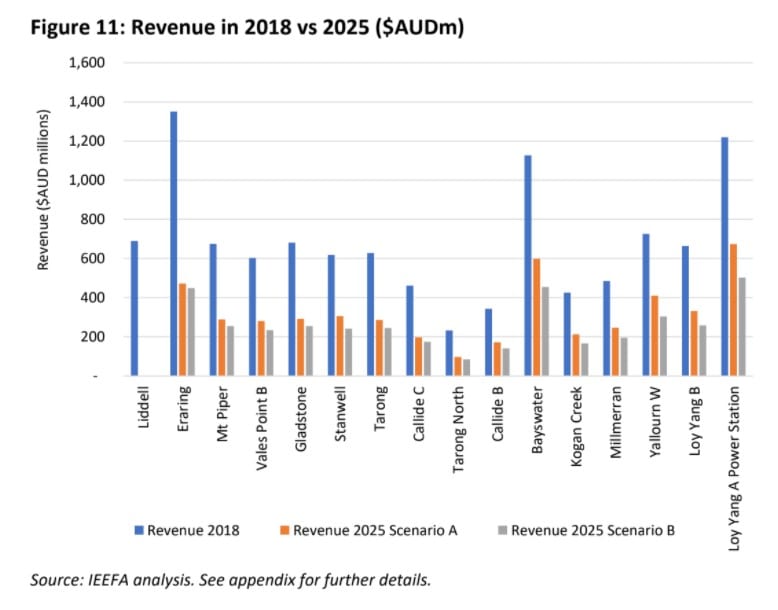
The findings have been detailed in a joint analysis completed by the Institute for Energy Economics and Financial Analysis (IEEFA) and Green Energy Markets, which found that revenues for coal-fired generators could fall by as much as two-thirds by 2025.
The analysis found that the amount of new wind and solar investment entering the Australian energy market could exceed many recent projections, and a lack of flexibility on the part of ageing coal generators could see them retired sooner than anticipated.
“The market is facing a tidal wave of new supply, much greater than anything government authorities or market analysts forecast or even contemplated just two years ago,” Green Energy Markets’ Tristan Edis said.
“The supply added from 2018 to 2025 equates to over a third of the entire demand in the NEM, and more than eight times the annual generation of the Liddell coal-fired power station in NSW.”
The amount of added electricity generated by new wind and solar projects added between 2018 and 2025 could grow to 70,000GWh, which the report noted was more than the annual consumption of New South Wales.
The report, published by IEEFA on Wednesday, estimates that the increase in renewable energy generation will meet virtually all of the growth in expected electricity demand and will fill almost all of the gap to be left by the Liddell power station when it closes in 2023.
The report estimated that as much as 8GW of utility scale solar, 12GW of wind, and 22GW of rooftop solar would be operating across the National Electricity Market by 2025, accelerating the exit of some of the state’s oldest coal generators.
The growth in low marginal cost wind and solar generation will see generators with more expensive fuel costs, like coal and gas, pushed out of the market due to the National Electricity Market’s merit order effect.
“They will be displaced because wind and solar have no fuel cost and typically bid into the market with prices close to zero,” IEEFA analyst Johanna Bowyer said.
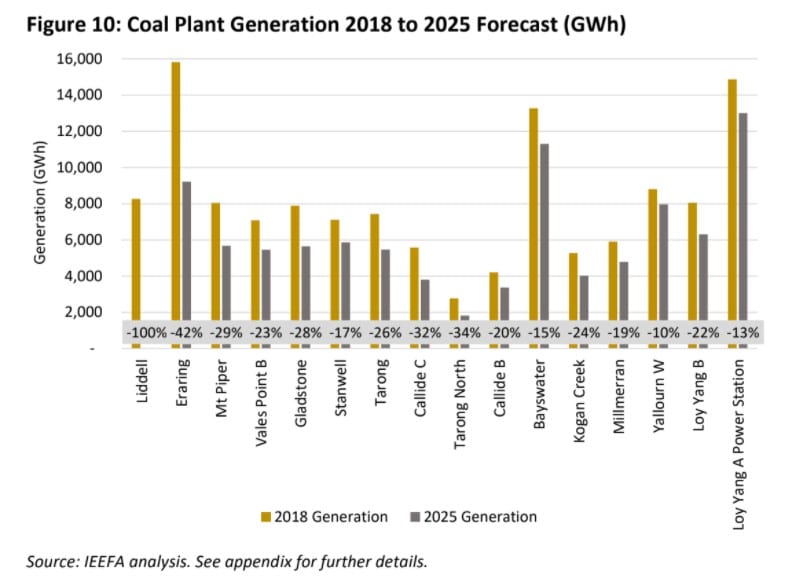
“We predict that gas power station output will fall by 78% and coal output by 28% by 2025 compared to 2018 levels.”
The good news for consumers is that the effect will also see less generation being provided by the more expensive sources of electricity and will help drive electricity prices lower for consumers.
“The extra competition from wind and solar plants will also have a deflationary impact on wholesale electricity prices, as more expensive gas and coal generators will be needed far less. While prices will be more volatile, on average they are likely to return back to the kinds of levels that prevailed in 2015,” Bowyer added.
The analysis echoes similar warnings by other energy market analysts, including RenewEconomy contributor David Leitch, chair of the Energy Security Board Kerry Schott, and Origin Energy, which warned during its half-year results announcement that it was anticipating a ‘messy’ exit for a number of coal fired generators in New South Wales.
Origin Energy CEO Frank Calabria noted that the company’s Eraring Power Station was already suffering from the recent fall in wholesale electricity prices, which have dropped to a level that Calabria described as ‘unsustainable’ and could become a trigger for early retirements.
The analysis undertaken by IEEFA and Green Energy Markets found that the looming closure of the Liddell Power Station in New South Wales is unlikely to be enough to prevent a squeeze on the remainder of the coal fleet.
“Three to five of the remaining 15 coal power stations in the NEM will be under financial stress by 2025 according to our analysis,” Bowyer said.
“In addition to Liddell’s 2023 closure, at least one coal power station exit is likely to occur far sooner than authorities are planning for.”
Edis said that governments should focus on the development of new dispatchable and flexible supplies of electricity that can respond to variable wind and solar supplies, noting that coal generators are generally unable to provide sufficiently flexible supplies.
“The fundamental problem for coal is that solar and wind is here to stay, and coal plants just aren’t flexible enough to manage around them. Efforts to keep inflexible coal plants afloat, let alone build new coal power plants, are likely to be counter-productive,” Edis said.
“Rather than propping up these plants, which are getting very old, we need new government policies that supports private-sector investment in dispatchable power plants that will be viable over the long term. To be viable they need to be highly flexible to work around changes in wind and solar output. And they need to be low emission if we are to deliver on our climate change obligations.”
As plug-in solar hits stores in the UK, lobby groups are reminding governments and regulators…
Sabiene Heindl from The Energy Charter on the need for strong regional leaders for transition…
Big battery developers are facing increasing scrutiny from local communities about their projects. Some of…
Record levels of solar, wind and battery use are pushing down emissions in Australia but…
As the NT government fights to power future data centres with gas, its publicly-owned utility…
Bowen says transmission projects are key, including the VNI West link now under threat from…