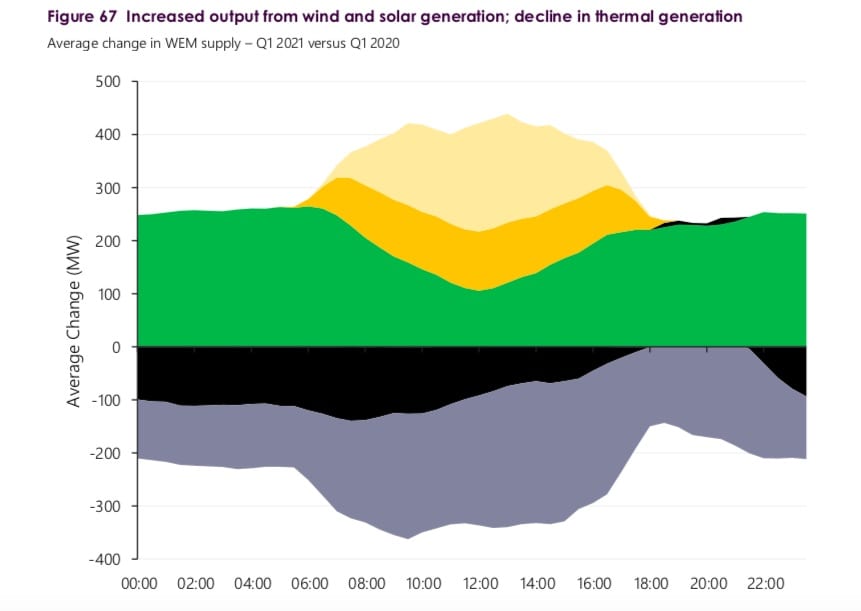
Source: WA DER Roadmap.
Rooftop solar has hit a new record level of a 65.2 per cent share of Western Australia’s main grid, following a year where the amount of new solar panels installed on the state’s homes and business nearly equalled the capacity of its largest coal generator.
The Australian Energy Market Operator on Wednesday confirmed that the new record was set at 1.20 local time on Saturday, March 13, when about 1,250MW was being generated from the near 1,500MW installed on the main grid, known as the South West Integrated System (SWIS).
Of this, just over one third, or slightly more than 400MW was not being consumed on site and was being fed back into the grid, most of it in Perth, where newer suburbs such as Burns Beach and Iluka in north west and Canning Vale in the south east are showing the highest rates of penetration.
It was a big day for renewables on that day. As RenewEconomy reported at the time, the W.A. grid also experienced a record share of renewables, including large scale wind and solar, just before midday.
The record share of rooftop solar does not match the 100 per cent share recorded in South Australia, but the WA SWIS is an isolated grid, with no links to other states to export excess power. So it is likely a world record rooftop solar benchmark in a grid of that size.
The news came as state energy minister Bill Johnston noted that 300MW of rooftop solar had been installed in the SWIS in 2020, nearly equal to the 340MW capacity of the biggest coal generator located at Collie.
He hailed the work of the Distributed Energy Resources Roadmap, which has achieved new milestones in its 36-point plan to bring some control to rooftop solar, battery storage and EVs in the grid.
“These new distributed energy facilities are rapidly transforming the energy mix away from traditional thermal baseload generation facilities on which our power system has been designed,” the roadmap says.
The new initiatives includes new inverter standards that will allow “remote control” of rooftop solar systems by the local network owner, similar to the arrangements now in place in South Australia.
The Roadmap has also resulted in 10 new PowerBank community batteries to be installed around the grid, the launch of new time-of-use tariffs that offers cheap power in daytime hours to encourage consumers to soak up the “solar sponge”, and the introduction of “virtual power plants” that will include batteries and appliances.
The state government is committing $218 million to provide more than 1,000 standalone power systems in regional WA and a $57.4 million investment into renewable technology as part of the WA Recovery Plan.
These new distributed energy facilities are rapidly transforming the energy mix away from traditional thermal baseload generation facilities on which our power system has been designed.
“The McGowan Government is commited to progressing our State towards a cleaner, greener energy future and ensuring renewable energy sources are supported by our grid,” Johnston said in a statement.
In the latest quarter, average gas generation decreased by 182MW and coal-fired generation decreased by 76MW, due to displacement by wind and solar output and because of increased outages, which reduced the availability of coal to 88.4 per cent from 100 per cent a year earlier.
Wind generation increased by 211MW on average, due to the addition of two wind farms (Yandin and Warradarge), rooftop PV generation increased by 58MW on average due to the 24 per cent lift in installed capacity, and large scale solar increased by an average 48MW due to the addition of 140MW of new solar capacity, including Merredin Solar Farm, and the expansion of the Greenough River Solar facility.
CSIRO says data centre demand in US has helped inflate cost of gas turbines, and…
Climate scientists are astonished by the scale and speed of the developing El Nino. "We…
Firmed solar and wind still lowest-cost pathway for Australia to reach net zero emissions, new…
State and federal governments aim for 7,000 green and industrial jobs under new master plans…
Key changes have been made to renewable tenders to ensure that the winning projects can…
Soaring syncon costs and supply issues, along with delays to coal closures, is opening up…