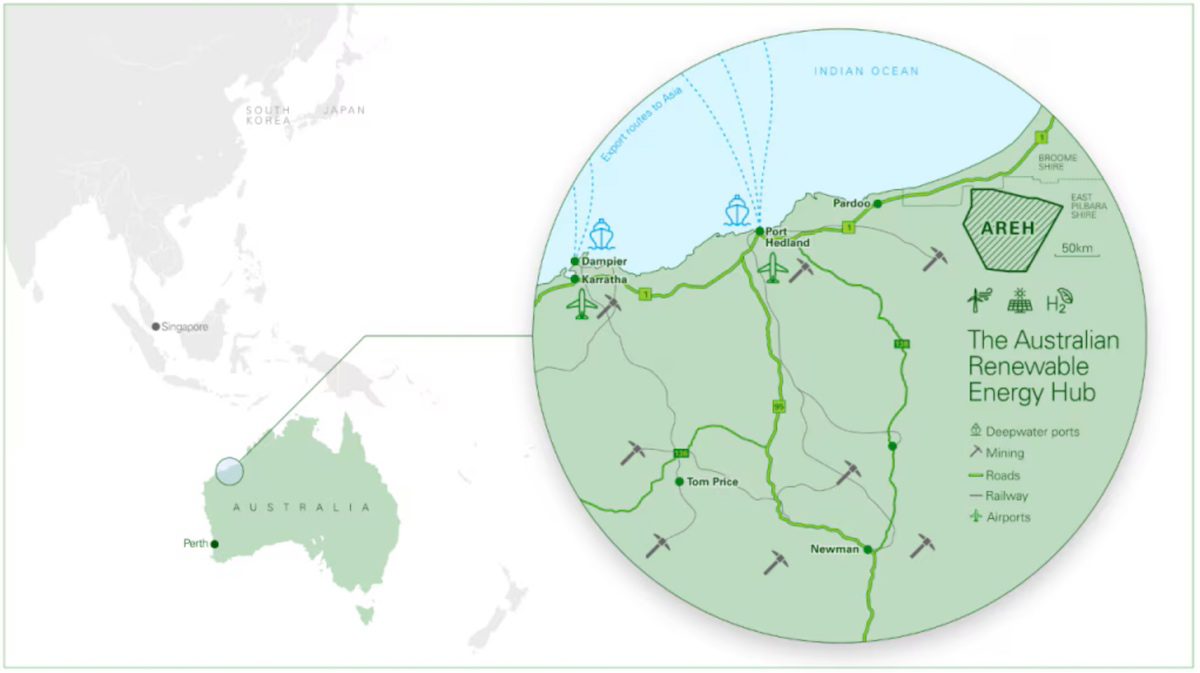
A massive, Big Oil-backed renewable hydrogen project that proposes to install up to 26 gigawatts of solar and wind in Western Australia’s Pilbara region has been awarded major project status by the federal government, putting it on the fast-track for regulatory approvals.
Federal minister for industry, Ed Husic, has formally announced selection of the Australian Renewable Energy Hub (AREH) by the Major Projects Facilitation Agency, alongside the 6GW Murchison Green Hydrogen project, which is proposed for construction near Kalbarri by Danish giant Copenhagen Infrastructure Partners.
The huge AREH project, one of the biggest being planned for Australia, is now majority owned by oil major, bp, which has a 63.57% stake and “operatorship” of the project alongside joint venture partners CWP Global and Intercontinental Energy.
The more than $53 billion project proposes to produce around 1.6 million tonnes of green hydrogen or 9 million tonnes of green ammonia a year from up to 26GW of wind and solar farms that would be developed in stages across a 6,500-square kilometre site in the Pilbara.
As the project website says, AREH “intends to supply renewable power to local customers in the largest mining region in the world and also produce green hydrogen and green ammonia for the domestic Australian market and export to major international users.”
To do this requires the separate development of the Pilbara Green Link, a series of shared-use high voltage 330 kV transmission lines that would link AREH and other renewable energy developments to the huge mining region, and power both existing and new industries.
Last month, Australian civil engineering giant GHD was tapped to deliver the preliminary design of the transmission lines and substations, with this preliminary engineering phase scheduled to be completed by March 2025.
An update on the transmission project issued just this week by the Western Australia government said good progress was being made on development of the Maitland-Karratha-Burrup line.
WA premier Roger Cook says the transmission project is also firming up to get concessional finance from the federal Rewiring the Nation fund, up to $3 billion of which has been allocated to WA.
“Development of the planned Maitland-Karratha-Burrup line represents the first major step in decarbonising the Pilbara and will help drive my government’s plans to make WA a green energy powerhouse,” Cook said this week.
“This project has strong potential to unlock additional job-creating opportunities on the Burrup Peninsula, while meeting growing demand for clean, reliable energy.”
In an address to the 2024 Pilbara Summit last month, AREH project director Sarah Carter said a project of this size and scale could not be achieved in isolation, with common user infrastructure having a “fundamental role to play.”
“Transmission is one example where the benefits of collaboration are clear. That is why AREH is working with Horizon Power to support its Pilbara Green Link project to develop an integrated energy grid to support the decarbonisation of the Pilbara,” Carter said.
CIP’s smaller, but still multi-gigawatt scale project, Murchison Green Hydrogen, proposes to install up to 6GW of onshore wind and solar capacity and produce around 2 million tonnes of green ammonia a year.
Documents submitted to the WA Environmental Protection Authority in 2022 detailed plans for roughly 1.5GW of solar PV and hundreds of onshore wind turbines with an installed capacity of around 3.7GW.
According to the project’s website, it will also feature a desalination plant and green hydrogen production facility. The green hydrogen will be converted into green ammonia for export to global markets.
CIP said in a statement last week that gaining major project status for Murchison Green Hydrogen (MGH) – alongside its Lead Agency Status from the WA government – recognises its “national significance” to Australia’s decarbonisation efforts.
“MGH also becomes eligible for assistance with navigating complex regulatory regimes, through facilitation and coordination of approval process by the Major Projects Facilitation Agency (MPFA),” the project’s website says.
Already, MGH has been shortlisted for a share in more than $2 billion in funding under the federal government’s landmark Hydrogen Headstart program.
One of the main buildings at key Tasmania hydro power stations will need to be…
Western Australia risks losing jobs and investment in its two most prized industrial regions without…
Spending on home energy upgrades such as insulation and solar panels is on the rise…
Environmental authorities will be faced with a wave of new e-waste as data centre industry…
Australia’s first grid-connected, industrial-scale sodium-sulfur battery will support materials processing plant and demonstrate novel long-duration…
Australia's most powerful battery injects a massive and unprecedented amount of power into the grid…