The Australian Energy Regulator has given final approval for the payments to be made for the giant Waratah Super battery – the largest “shock absorber of its type in the world – but won’t reveal the costs to the consumers who will pay for it.
The Waratah battery will likely cost up to $1 billion, or even more given recent price hikes, and be one of the biggest in the world – at 850MW and 1680MWh – and will be built at the site of the shuttered Munmorah coal generator on the central coast of NSW.
It will also play a critical role in the maintenance of grid security and reliability in NSW, particularly after the anticipated closure of the country’s biggest coal generator, the 2.8GW Eraring facility owned by Origin Energy.
But the details and costs of what is a unique, and no doubt expensive, contract – and likely to be the largest of its type in the world – will not be released.
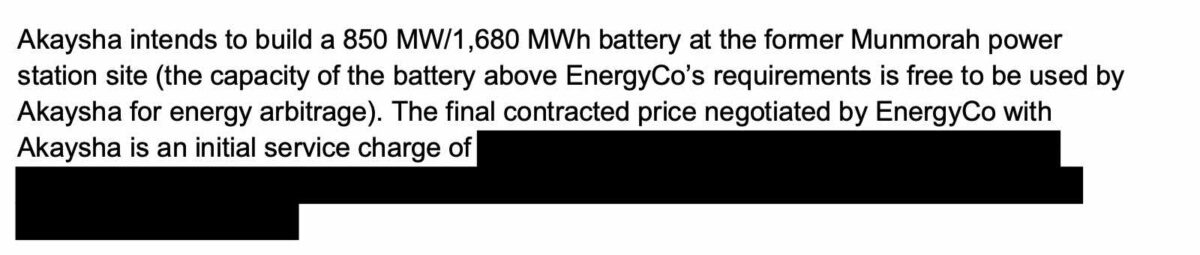
The regulator’s 49-page document approving the payments – after variations were requested – includes 13 pages that are entirely blacked out, as they include details of the contracts negotiated between project developer Akaysha Energy, EnergyCo, and Transgrid, the transmission company.
See image above, and below.
RenewEconomy first reported on this situation when the original revenue proposal was approved. See: Blacked out: Contract for world’s most powerful battery to be kept secret for now.
Now that the contract has been updated to take into account foreign exchange movements – to allow for variations in the cost of the imported battery components – it will remain secret. The AER says that under the various acts it operates within, it is not allowed to publish a Network Operator’s revenue proposal.
Which is a shame: The electricity market is secretive enough, and this secrecy doesn’t help. Two of the country’s landmark battery contracts – for the original Tesla Big Battery, aka the Hornsdale Power Reserve, and the Victoria Big Battery – were revealed.
Since then, many battery contracts negotiated by governments or government owned facilities, or the Australian Energy Market Operator – including the Big Canberra Battery secured by Eku Energy, and the Collie battery to be built by Neoen – have been hidden from public view and scrutiny.
And so it is with Waratah, even though the nature of its contract (known as SIPS, or System Integrity Protections Scheme) is similar to those negotiated for Hornsdale and the Victoria Big Battery.
Akaysha Energy has negotiated a unique format that it calls a “Seasonal Sculpted Core Service”, where it makes up to 700MW and 1400MWh of capacity to act as a giant shock absorber, allowing transmission lines into the state’s big demand centres to operate at full capacity.
It will provide at least 700 MW and 1400 MWh of battery capacity between 5am and sunset, when power system demand and paired generation availability levels are relatively high.
It will provide at least 500 MW and 1000 MWh of battery capacity reserved between sunset and 2am, when power system demand and paired generation availability levels are relatively lower.
And it will provide at least 300 MW and 600 MWh of battery capacity between 2am and 5am, when power system demand is at its lowest.
Which is wonderful. But why aren’t we told the price of the quarterly payments?
Households and businesses affected by the staged decommissioning of a private gas WA network can…
One state stands head and shoulders above the others when it comes to bragging rights…
A final flurry of energy policy initiatives ranging from rooftop solar rebates to community batteries…
Second stage of Australia's biggest wind farm reportedly sold for $2 billion, but the buyer…
Plans for what will be the largest wind farm in Aotearoa New Zealand have taken…
From swimming pools to factories, heat pumps are proving their worth, but getting off gas…