Waratah Super Battery. Image: Akaysha Energy
Observers of Australia’s electricity markets are used to the sight of wind and solar farms dialling down their output, or switching off completely, when wholesale prices fall well into negative territory.
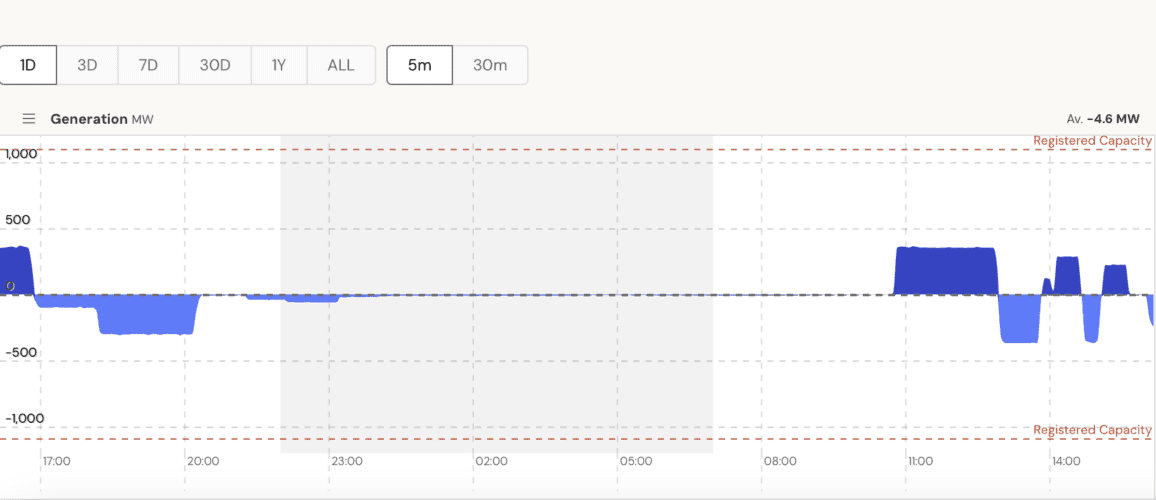
On Friday, for the first time, two wind and solar farms shut down briefly for an entirely different reason – to test their roles as part of an elaborate scheme to have Australia’s most powerful battery act as a giant shock absorber for the grid.
The battery in question is the 850 MW, 1680 MWh Waratah Super Battery, which is being built by Akaysha Energy at the site of the shuttered Munmorah coal fired power generator on the the central coast of NSW.
Its contract as a giant “shock absorber” allows transmission lines feeding into the state’s major load centres in Sydney, Newcastle and Wollongong to operate at or near full capacity.
The role of the battery – and this is believed to be the largest contract of its type in the world – is to step in to support the grid should a problem arise.
As part of this contract, two wind and solar farms, the Metz solar project and Sapphire wind farm in northern NSW, also have a key role.
They are paid to dial down their output should the battery have to discharge to help stabilise the grid, and so keep the overall supply and demand equation in balance. (See graph above).
On Friday afternoon they put this into practice for the first time as the Waratah battery – already the biggest in the country even though it is still not operating at full capacity – continued through its commissioning process.
Just after 2pm, and again just after 3pm, output at both the Metz and Sapphire facilities were dialled down to zero as the Waratah battery injected power into the grid. (See graphs below).
It is believed to be the first example of “paired” generation that has been seen in the Australian grid (please do let us know if we are wrong about that), and likely the first in the world, at least at this scale.
The Waratah battery actually has three “paired generators” – the Snowy Hydro owned Tumut pumped hydro plant was also dialled into the deal as a late addition – but it did not appear to be part of the testing on Friday.
When in full operation, the Waratah battery will be required to make 700 MW and 1,400 MWh of its capacity available for the “shock absorber” contract at certain times, and smaller amounts at others.
The battery is currently working through its various “hold points” – stepping stones to full output – that is the standard part of the often complex and difficult commissioning process required by the Australian Energy Market Operator and network providers on Australia’s electricity grids.
The battery was to have been in full production earlier this year under its original timetable, but the timeline slipped due to delays, largely caused by wet weather, the complexity of the early commissioning work, and possibly also by the financial issues and later collapse of its US-based battery provider Powin.
In any case, the urgency to meet the deadline relaxed when the state government agreed to underwrite a two-year delay to the closure of the country’s biggest coal generator, the 2.88 GW Eraring facility, that had been scheduled to shut down in August.
The Waratah battery is still expected to reach full commercial output later this year, and may also start delivering the first of its “shock absorber” abilities – under what’s known as a System Integrity Protection Scheme – within a few months.
Details of the contracts – the payments made to the Waratah Super Battery, and its paired generators, have been kept hidden from public view, although similar arrangements for other smaller SIPS schemes, including in South Australia (for the original Tesla big battery at Hornsdale) and in Victoria have been made pubic.
See also Renew Economy’s Big Battery Storage Map for more information.
Renewables met more than 80 per cent of total grid demand for first time on…
A new Consumer Energy Resources Technical Code will define the standards and capabilities required of…
Australian businesses looking to ditch gas and diesel can do the sums, find electrification will…
An abundance of rooftop solar generation has helped set a new record high for the…
Windlab's John Martin on the project that broke the investment drought for big wind, and…
Federal Labor's determination to power new data centres with renewables, and to minimise emissions and…