Source: Free Pik
Once the impact of facilities entering and exiting the scheme is excluded, aggregate annual emissions fell by less than four-tenths of one percent (0.4%) between the first and second years of the reformed scheme.
The emissions impact of movement in and out the scheme was more than five times the size of emissions reductions seen at ongoing facilities.
Between the first and second years of the reformed scheme, a fire at the Grosvenor underground coal mine near Moranbah reduced emissions by more than twice the aggregate emissions reduction seen at ongoing facilities.
Even the exceptionally small emissions reductions seen at safeguard facilities so far will not continue into later years. This may be the last inter-annual emissions reduction we see from safeguard facilities in the 2020
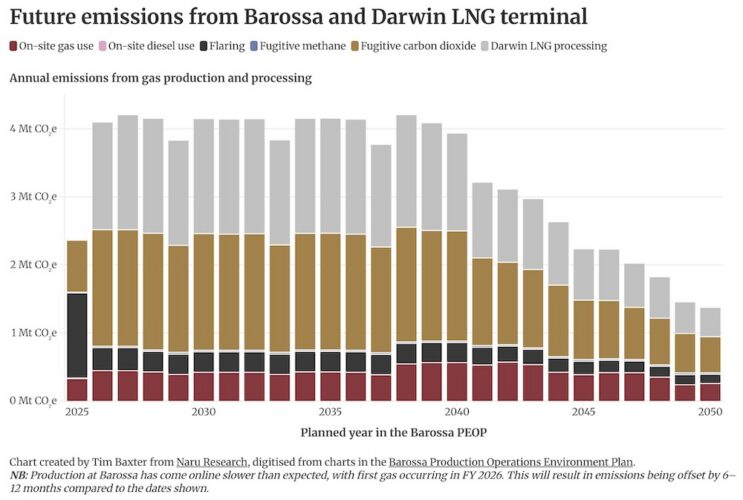
In late 2025, the first gas from Santos’s Barossa gas field was sent to the Darwin LNG terminal. Assuming that the operator can restrain emissions to the levels provided in its approval documents, at full production combined emissions will reach more than 4 million tonnes of greenhouse gas per year.
This is more than eight times the size of the 500,000 tonne reduction seen across ongoing safeguard facilities between the first two years.
While it is one of the larger new projects expected to come online, Barossa is just one of around 50 new coal and gas projects that are likely to begin production over the next decade.
Most of these new projects will avoid the more onerous requirements that apply to new safeguard facilities, sometimes via contrived means.
Rather than driving emissions reductions, the Safeguard Mechanism has driven extraordinary, increased and higher than anticipated demand for offset units. These have primarily come from methods with on-going, significant and unresolved integrity issues
Demand for credits from human-induced regeneration, landfill gas and avoided deforestation offset methods – each of which is subject to significant and as-yet-unaddressed integrity complaints – has increased between years.
These methods provided more than 80% of all ACCUs surrendered under the scheme in the second post-reform year. Between the first and second years, demand for offset units of all types increased by 50%.
While it is impossible to reliably quantify the total impact of these integrity issues, plausibly more than half of all offset credits issued under these methods provide low- to zero verifiable environmental benefit.
Counting these units at full value as if they represent real-world positive outcomes without qualification is simply not credible even before considering the meaningful false equivalences at play.
The Safeguard Mechanism will continue to primarily operate as a mandatory clearinghouse for low integrity offsets for at least the next decade. This is the scheme operating as designed
In official government projections, on-paper abatement delivered by offset credits is only overtaken by on-site emissions reductions after the next ten years have passed.
Expert assessment and third-party modelling indicate that the official projections likely paint an optimistic picture of the amount of on-site abatement might be driven by the Safeguard Mechanism in its current form.
Given that offset demand is primarily being met by credits with substantial integrity issues, this poses a very significant issue for any attempts to claim that the scheme is delivering positive environmental outcomes.
Those who would prefer to mute all criticism of the Safeguard Mechanism are quick to point out that the heavy reliance on offsets and limited delivery of on-site emissions reductions is not evidence that the scheme is failing. They are correct. This is the scheme working precisely as it was designed. But should it be designed differently?
Rather than asking whether the reformed Safeguard Mechanism is failing, it is better to ask whether the scheme should have been designed to do more, and whether the Review of the Safeguard Mechanism scheduled for later in 2026 is an opportunity to deliver it.
You can read my thoughts in full here.
Tim Baxter is a climate and energy consultant and the founder of Naru Research
The "35 by 35" electrification goal has an Australian origin that the government seems to…
If we fail to ensure data centres pay for new renewables and storage to cover…
Home batteries look like resetting the behaviour of households when it comes to responding to…
South Australia energy minister hints that the 100 pct net renewables target may not be…
Australia's first major transmission loop is now operating, and will be at full capacity by…
Former EDO boss and now Greens MLC Sue Higginson on the huge implications of the…