Image Credit: Clean Energy Regulator
The Cheaper Home Batteries scheme is changing. After 10 months and close to 350,000 installations – adding more than 6.5 gigawatt-hours (GWh) of distributed energy storage capacity behind the meter – new settings for federal Labor’s record-smashing rebate will kick in on Friday.
The changes are a combination of minor adjustments to the rebate settings that were written into the rules at the start, as well as some quite major design rethinks announced by federal energy minister Chris Bowen in December.
These are primarily designed to make the scheme last longer and go further – namely by gearing it towards much smaller systems.
The design rethink was in many ways a product of the rebate’s huge success; the appetite for home solar storage was enormous, as it turns out – and in more ways than one, with the subsidy being eaten up by systems sized at 50 kilowatt-hours (kWh) and above.
According to recent data, the average battery size of the more than 300,000 systems installed over the past 10 months sits at around 25 kWh, which is pretty big considering the average rooftop solar system size for most of the past decade has sat somewhere between 5-10 kilowatts (kW).
In March, as households scrambled to get a battery installed ahead of the May changes, the average size of residential energy storage systems registered over the month soared to a whopping 40 kilowatt-hours (kWh).
The data for April – or at least some of April – will likely tell a similar story when it comes out in the next week or two. But from May onwards, expect to see some new patterns emerge.
As Renew Economy has reported, from May 1, systems installed through the rebate will continue to receive the full, but slightly lower-rate, discount on the first 14 kWh of usable capacity. For batteries bigger than 14 kWh, the system will get 60% of the discount on capacity up to 28 kWh. Capacity between 28 kWh and 50 kWh will get 15%.
The rate that determines the upfront discount – which is dependent on the number of certificates each system creates under the Small-Scale Renewable Energy Scheme (SRES) – will also begin to start coming down, falling from 8.4 to 6.8 in May.
The annual decline rate in the small-scale technology certificate factor (STC Factor) will then decline every six months at a new rate. This is in keeping with the settings for the rooftop solar rebate under the SRES, and was flagged by Bowen at the launch of the battery rebate (see table below).
So what does this all mean? As the Clean Energy Regulator warned back in March, for batteries at the higher-capacity end of the spectrum, the changes could result in a discount price difference of thousands of dollars.
For batteries sized up to 14 kWh, the difference will more likely be in the hundreds-of-dollars range. But the resulting rebate remains very generous and well worth taking up.
The CER solar-battery calculator, which you can find here, gives some idea of the extent of the changes.
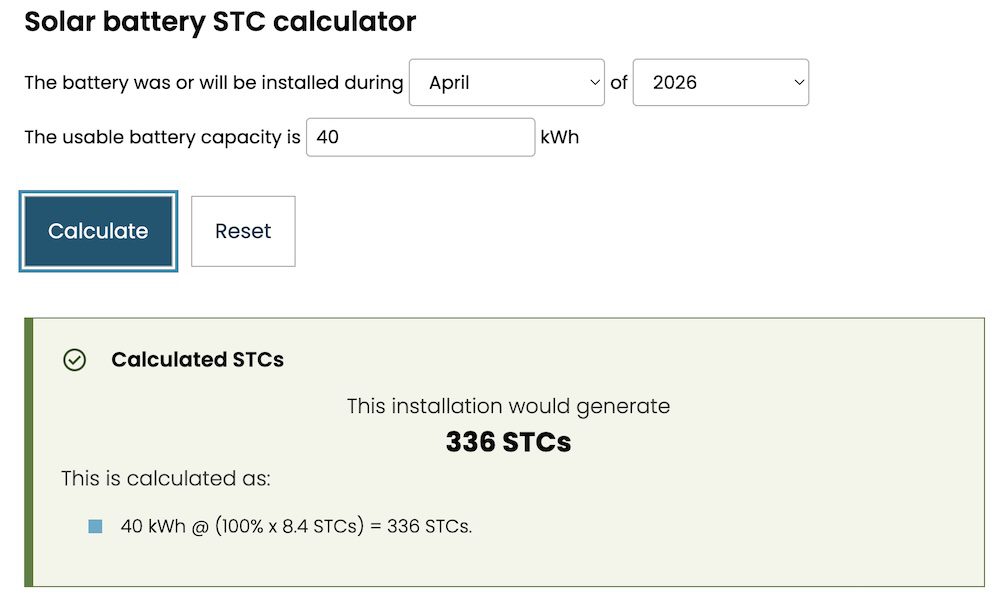
For example, a 40 kWh battery installed in April under the original settings might have generated 336 STCs at 100 per cent of the old STC factor of 8.4. Assuming an STC price of $37, this would have resulted in a discount of more than $12,400 from the cost of the battery.
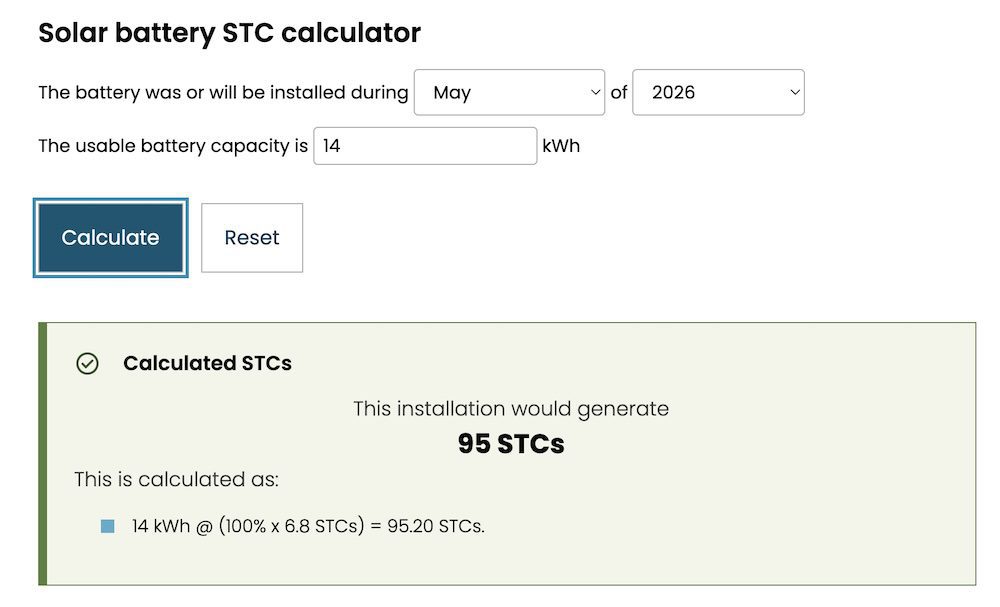
In May, under the new settings, a 40 kWh battery will generate roughly half the total number of STCs (you can see how the maths is done in the screenshot below) which adds up to a roughly half the discount, at just over $6,000.
For a 14 kWh battery installed before the rebate changes, the discount might have worked out at roughly $4,350.
While for a 14 kWh battery installed in May, under the new settings, the discount should work out at around $800 less, due to the change in the STC rate, at around $3,520 – still a good amount off the cost of what remains a decent-sized battery.
As Solar Quotes puts it, the main message is that signing up to the rebate to add a battery to your solar is still worth it for many households, but the key – now more than ever – is “sizing the system properly and understanding your energy use.”
There are many well-established battery and inverter options that meet the 14 kWh and under criteria to get the best bang for buck, and Solar Quotes has updated its battery comparison table with prices based on the post-May rebate settings.
There are also some state-specific rebates to factor in for the Northern Territory as well as for Western Australia and New South Wales depending on whether or not you sign your discounted battery up to a virtual power plant.
From the Clean Energy Regulator (CER), a reminder that rebates are based on the installation date, not the purchase date – and installers have been warned not to try and rush jobs to get them done before May 01.
“Safety is the number one priority, and installers can claim no more than two installations per day,” CER executive general manager Carl Binning said at the start of April.
“It’s very important that contracts entered into are honoured.
“If you agree to a solar battery installation before 1 May but can’t deliver, you may be liable to pay the difference.”
In an compliance update on Tuesday, the regulator said it has written to retailers and installers reminding them, again, of their contractual obligations.
“Retailers are responsible for providing accurate timelines on stock provision, accurate quotes that reflect the upcoming changes and for fulfilling the contracts to install batteries,” the notice says.
“Already, we see that many program participants are trying to get battery installations in as quickly as possible. We want to remind you of your obligations when quoting jobs to customers and providing stock for battery installations.
“Ensure your customers are informed of the correct discount rate, especially if installation dates have to change.”
CER says it has also written to state and territory fair trading agencies and ombudsmen, advising them to be on the lookout for poor consumer practices including misleading quoting.
If you’re interested in hearing more on what the changes mean for consumers and installers – and whether bigger is still better – you can sign up for our free webinar on Thursday, featuring SunWiz director Warwick Johnston and Leo Ye, product director at Fox ESS, and chaired by Renew Economy’s Giles Parkinson.
If you would like to join more than 29,000 others and get the latest clean energy news delivered straight to your inbox, for free, please click here to subscribe to our free daily newsletter.
South Australia unveils project proposals totalling 13 GW of new wind and solar which it…
Australian developer snaps up portfolio of operating and developing wind and solar projects as a…
A massive 244-tonne transformer has completed a 2,165 km road trip to the site of…
The battery industry is about to witness another change in chemistry and technology. Valo Energy…
Energy minister says imminent closure of coal is "indisputable," and "ideology-driven" policies to scrap transmission…
The supplier to the biggest battery currently being built in Australia expects to announce its…