Tesla Megapack units at the Bouldercombe Battery project. Image: Genex Power
Queensland has topped the charts for wind, solar and battery output in April, new data has revealed, including a 112 per cent year-on-year increase in wind energy generation for the month and a new first for big batteries.
According to the latest monthly data from Rystad Energy, a “very windy April” saw wind generation make year-on-year gains in all states of the National Electricity Market (NEM), but most notably in the Sunshine State, where 578 gigawatt-hours (GWh) of energy was generated by wind farms, compared to 273 GWh in April 2025.
Rystad analyst David Dixon says Queensland was also in top spot for large-scale solar and wind generation, combined, at 1,256 GWh, with solar contributing 678 GWh to the mix.
And it was a notable month in Queensland for batteries, too, being the first time utility-scale battery energy storage systems have discharged more than 100 GWh in a month for any NEM state.
“NEM intraday spreads have collapsed as batteries continue to ramp up,” Dixon said on LinkedIn on Monday. “The average two-hour intraday spread was less than $A110 per megawatt-hour (MWh) across all states, except South Australia ($A154 per MWh).
“Although it must be noted that April is a low demand time of year.”
All up, Rystad says April 2026 ends with all Australian utility PV and wind assets generating 4.7 TWh, up 24 per cent from 3.8 TWh in April 2025.
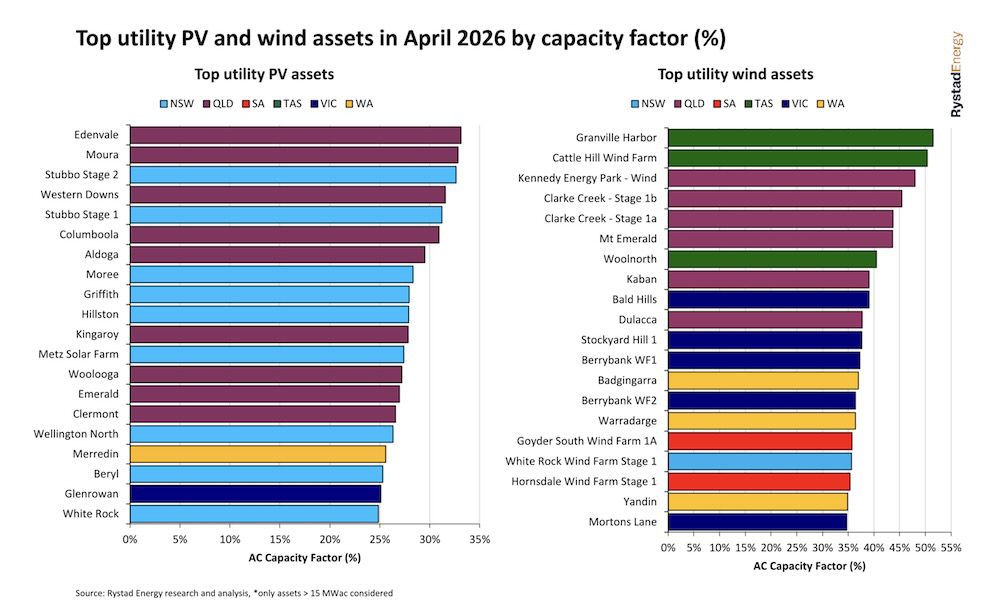
The top-performing wind assets were all in Queensland and Tasmania, headed up by the Granville Harbour wind farm in Tasmania’s Tarkine region, which operated at a capacity factor (CF) of 51.5 per cent.
The Cattle Hill wind farm, in the centre of Tassie, scored a capacity factor of 50.4 per cent and in Queensland the Kennedy Energy wind farm scored a capacity factor of 48 per cent.
Image: David Dixon, LinkedIn
For utility PV the best performing assets for the month were all in Queensland and New South Wales, Dixon says.
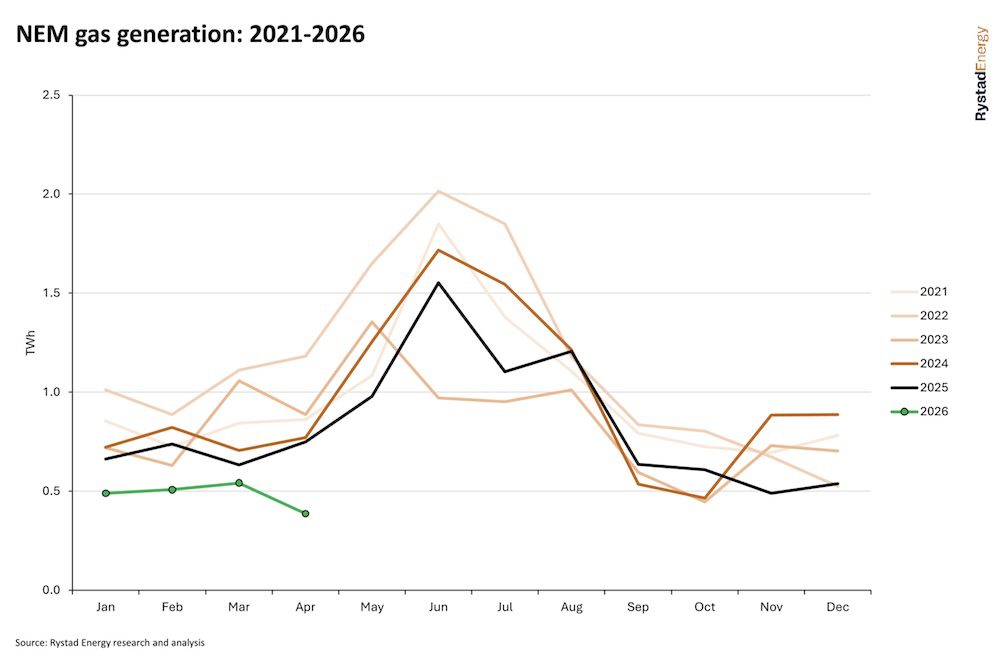
Gas generation across the NEM, meanwhile, was down 49 per cent on the 745 GWh generated in April last year, totalling 382 GWh for the month.
Image: David Dixon, LinkedIn
“This was the lowest monthly gas generation in over two decades,” Dixon said on LinkedIn, “as batteries continue to displace gas in the evening peak.”
If you would like to join more than 29,000 others and get the latest clean energy news delivered straight to your inbox, for free, please click here to subscribe to our free daily newsletter.
Western economists, journalists and analysts systematically underestimate China's technology leadership, especially on the decarbonisation of…
Work begins on $65 million network of eight community-scale batteries, which will support the grid…
Analysts and even state governments are trying to make sense of Albanese's backdown on data…
Planning rules have been changed to stop long distance and often repeat agitators hijacking wind,…
Australia faces a challenge in finding ships and ports capable of handling huge turbine parts…
A package of reforms proposed to avoid a gas network death spiral has been described…