Image Credit: China Three Gorges Corporation
It’s not H5N1, or ebola, or mad cow. It’s real, it has symptoms, and it’s potentially more dangerous. It blinds the West to who’s actually winning the energy transition – and much more.
Western Economists’ Disease, we define as a chronic underestimation of Chinese economic and industrial capability, dressed up as sober analysis. This has been around for some time but now features climate change politics.
Western economists, journalists and security analysts routinely downplay, dismiss or simply ignore China on a whole range of things, but especially on leadership in decarbonisation and renewables, the tools for net zero.
We are not suggesting China needs special treatment, just better understanding as providing climate change leadership is clearly something the world needs. Europe is burning now with an expected average increase in temperature of over 40C.
The data and evidence reveals the symptoms of the Western Economists’ Disease.
In March 2026, when the Iran war closed the Strait of Hormuz and triggered the world’s fourth oil shock, “petro-economists” predicted China’s clean-tech export machine would stall.
Instead, China’s solar exports doubled in a single month to a record 68 gigawatts, battery and EV exports jumped 38%, and clean-tech sales hit US$26 billion — the highest monthly total ever. Fifty countries set new records importing Chinese solar, led by nations hit hardest by the oil crunch, like India and the Philippines.
The Disease is illustrated powerfully by the common statement that the global economy was declining because oil was not being consumed like before. The scramble for oil is a stopgap only as its decline is well underway.
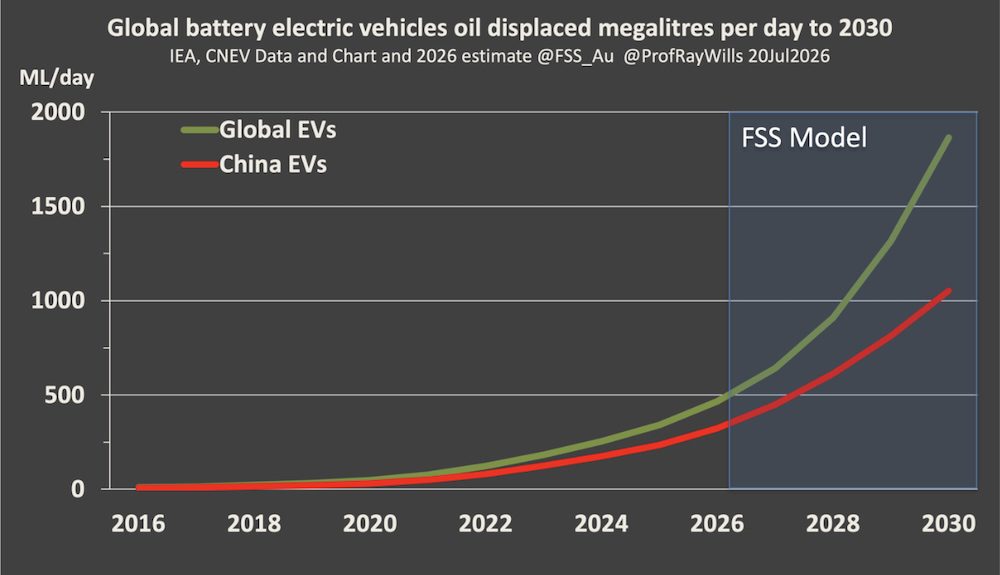
Cleantech is becoming the backbone of the whole global energy system: coal and gas were threatened first but now its oil (Figure 1) shows how rapidly is the growth of EV’s displacing oil.
Figure 1: Oil demand is being displaced by electrification of transport
China now controls roughly 80% of global solar, 80% of battery cells, 70% of EVs and over 90% of heavy electric trucks. Its new carbon-peaking plan requires new EVs (NEVs) to reach 30% of its entire national fleet by 2030 – implying over 100 million EVs on Chinese roads, more than double today’s level.
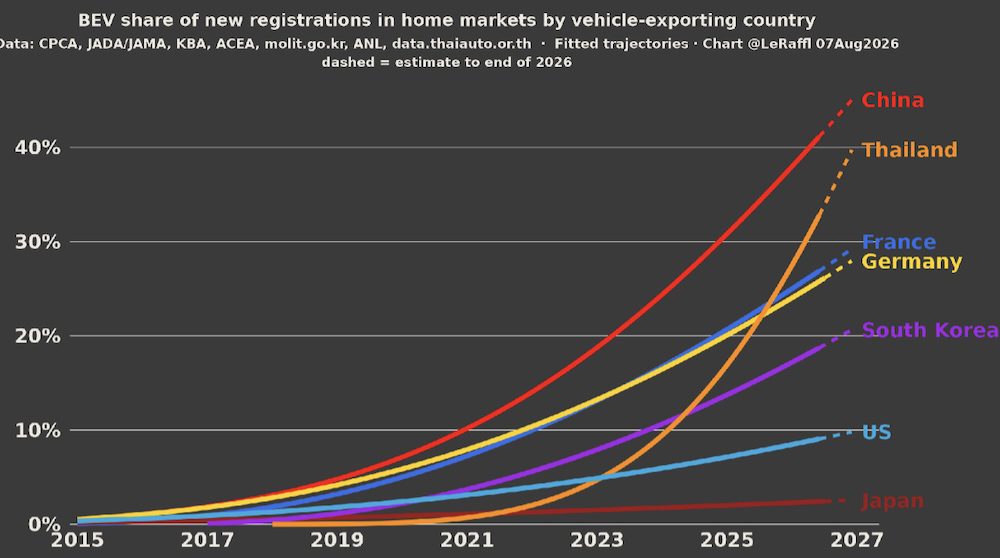
In June 2026, China exported over a million vehicles in a single month for the first time, with new-energy exports overtaking combustion exports. Thailand, following China’s playbook with BYD-led investment, is emerging as a second EV export powerhouse, the EU hangs somewhere in the middle with a fascination for more hybrids and less EVs, while Japan, the US and (to a lesser extent) stay anchored to hybrids and ICE (Figure 2).
Figure 2: Battery Electric Vehicle share in domestic markets
The lesson for policymakers, is clear: the speed of domestic electrification of new vehicles, is the leading indicator of future industrial competitiveness in the global car market — not export subsidies or slogans.
The same can be seen on all clean tech where China has established its own domestic market first then after mass production at home it can export cheaply to the world (Figure 3). Countries dragging their feet at home, however famous their brands on all tech, including car brands, are quietly ceding the 2030s.
Figure 3. China’s share of global clean-tech production
Western Economists’ Disease isn’t just an idle curiosity – it has a severe risk of leaving the West flat-footed on climate, trade and security policy, including the possibility that we are misjudging China’s strategic intent toward peace and stability.
It’s time we diagnosed it and treated it with the numbers, not the narrative.
The same failure of analysis can infect global reporting and hence security assessments: selectively noticing weakness, treating evidence of capability as somehow suspect, and reading every Chinese action primarily through an assumption of malign intent.
China is neither flawless nor beyond legitimate scrutiny — no major power is. But scrutiny that filters out inconvenient truth is not rigour; it is narrative management.
The Western Economists’ Disease is not confined to economics and security debates as its clearly attracting much commentary from the media (Figure 4).
When journalists report China’s economy as perpetually “about to collapse” because of “weak oil and gas demand” while overlooking the industrial scale of its diverse clean tech economy including solar, wind, battery, EV and grid build-out, audiences receive a distorted account of material reality. It is the Western Economists’ Disease feeding poor journalism.
Figure 4: A few headlines exhibiting Western Economists Disease* (*journalism variant).
When analysts in economics or security begin with the proposition that China must seek conflict due to their rapid growth in clean tech, they risk mistaking deterrence, economic interdependence and stated interests in stability, for mere camouflage. They also undercut political support for global climate change mitigation.
We are not naïve about global security or global economics, as such analysis on China is usually dismissed as naivety.
We are making a call for evidence-based assessment, reciprocal standards of scepticism, and an ability to distinguish capability from intent. It is a new narrative we are seeking.
The practical stakes are large. Global climate change like that now being seen in Europe is a much bigger security threat for everyone as it can destroy economies.
A West that misunderstands China’s decarbonisation capacity will make poorer climate and industrial-policy choices.
A West that misreports China will make poorer democratic choices.
And a West that assumes conflict is inevitable may help make it so.
Better analysis begins with a simple discipline: follow the data, report the facts in full, and assess security risks without allowing inherited geopolitical reflexes to do the thinking for us.
A new narrative please.
Construction of the "hydroelectric station the size of the Sydney Opera House" has started laying…
Leading solar expert says cost of recycling scheme should be paid by end-users, including solar…
A new report finds that monitoring of methane emissions can be significantly improved, particularly for…
Germany's cabinet approves roadmap to phase out oil, coal and gas across energy, industry, buildings and…
Eastern Australia is not yet in the grip of a terrible 2019-20-like drought but early…
Queensland has ripped up its renewables target and cancelled projects, but it remains a hot…