Left to right: Marinus Link Chair Sandra Gamble, Marinus Link CEO, Stephanie McGregor, Minister for Climate Change and Energy Chris Bowen, CEFC CEO Ian Learmonth, CEFC CIO Paul McCartney
The federal government’s green bank has closed the books on another 12 months of record investment, including finance to help break Australia’s wind energy drought, and to deliver a new undersea transmission link between Tasmania and Victoria – it’s biggest single loan yet.
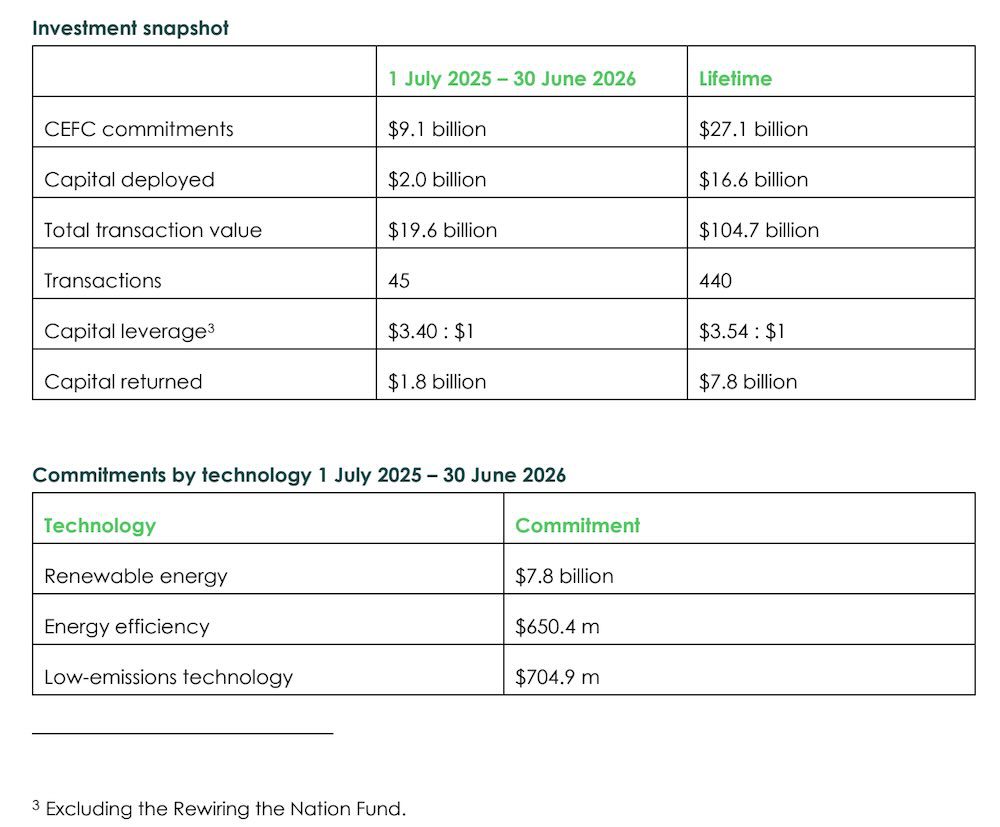
The Clean Energy Finance Corporation (CEFC) has reported committing a record $9.1 billion in discounted finance over the 2025-26 financial year, helping to drive $19.6 billion in total transaction value.
The ramp-up in activity has also taken the CEFC past a major new milestone: the mobilisation of projects worth a collective $105 billion since its inception almost exactly 14 years ago, in August 2012.
For 2025-26, the $9.1 billion of committed finance includes $7.8 billion to help underwrite wind, solar and storage as the pressure mounts to meet the federal renewable energy target of 82 per cent by 2030. The remainder of the spend was divided between energy efficiency and low-emissions technology.
Separately, through the $19 billion Rewiring the Nation (RTN) fund, the CEFC’s financing of transmission infrastructure – huge and costly projects considered critical to support enough new wind and solar to usher out coal – accounted for another $7.2 billion in commitments.
The big-ticket items in what outgoing CEFC chief Ian Learmonth describes as a “defining year” of investment activity include the record $3.8 billion committed to the first 705 megawatt (MW) stage of Marinus Link, an undersea electricity and data interconnector across the Bass Strait.
The concessional finance for Marinus Link, announced in September of last year, marked the green bank’s biggest investment yet and brought the $5 billion project linking north-west Tasmania to Victoria’s Latrobe Valley to financial close.
The cost of Marinus Link, and its role as an enabler of major new renewable energy generation projects in Tasmania – like the recently EPBC-approved and highly contentious Robbins Island wind farm – have been major points of contention on the island state.
Opponents to the huge project have argued that Marinus Link comes at a heavy cost to Tasmania – both economic and environmental – while delivering benefits mostly to the mainland.
The concessional loan from the CEFC, however, was able to take some of the sting out of the project’s cost to energy consumers.
Through the RTN Fund, the CEFC also committed $1.2 billion to Stage 1 of North West Transmission Developments, a project on the Tasmanian side of Marinus Link that will bolster the local grid and connect it to the undersea cable.
Outside of poles, wires and interconnectors, the CEFC has played a critical role propping up the nation’s flagging wind energy industry over the past 12 months, including lending to three of the four wind projects which reached financial close in December – the first in 2025 – with $247 million spread across the three.
In total, the CEFC financed more than $340 million of large-scale wind, solar and storage projects over the full financial year, representing 1.2 gigawatts of new renewable energy capacity added to the grid. The total amount committed to renewable energy technology over the period was $7.8 billion.
This means the CEFC has now committed $27.1 billion to Australia’s transition to renewables since 2012. And in 2025-26, every dollar committed by the CEFC attracted an additional $3.4 from co-investors.
“The past year has been a defining one for Australia’s transition to net zero,” said Learmonth in a statement on Tuesday. “Global energy markets have again highlighted the importance of reducing our reliance on fossil fuels and accelerating the shift to clean, renewable energy and electrified transport.
“While emissions reduction remains at the heart of the CEFC mission, recent events have reinforced that the clean energy transition is also about reducing costs, building a stronger, more resilient economy, improving energy security and creating long-term economic opportunity.
“The clean energy transition …[is] also about helping households reduce costs today. By lowering the upfront cost of technologies such as rooftop solar, batteries and efficient electric appliances, we’re helping Australians future-proof their homes while reducing pressure on household budgets.”
Learmonth is currently serving his final weeks as CEO of the CEFC, having been appointed to the role all the way back in 2017. New CEO, Paul McCartney, will take the reins on September 18, moving up from his current position as Chief Investment Officer, Rewiring the Nation.
“This will be my final CEFC Investment Update before I hand the baton over to my colleague and friend, Paul McCartney,” he said on Tuesday.
“The CEFC is playing a crucial role in Australia’s clean energy transition, and it has been a great privilege and pleasure to lead the organisation for almost a decade.
“This year’s performance reflects its importance and impact and I’m proud to have worked alongside the exceptional CEFC team to achieve such outstanding results.”
If you would like to join more than 29,000 others and get the latest clean energy news delivered straight to your inbox, for free, please click here to subscribe to our free daily newsletter.
Fossil-fuel proponents have used a 'drop in the ocean' argument over their impact on the…
Australian households have installed a record number of rooftop solar systems and home batteries so…
Trump administration appears to have bet on the wrong horse, with renewables surging and coal…
Few home battery owners have signed up to join virtual power plants, with concerns about…
Zenith Energy’s Michael Buzzard on the remarkable energy transitions achieved in off-grid mines, and plans…
It is 10 years since South Australia's state-wide blackout: Far from being the end of…