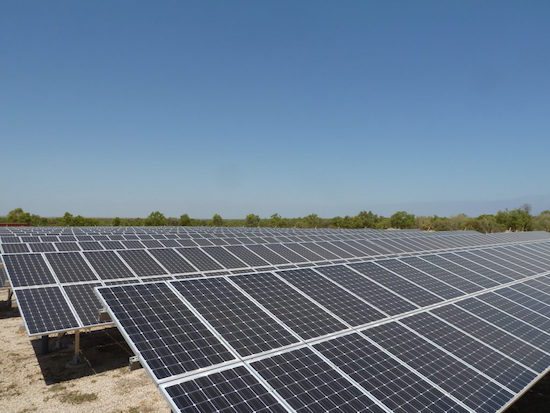
Ten remote Indigenous communities in the Northern Territory have been shifted from pure diesel generation to a hybrid mix of solar, diesel and battery storage, as part of the first phase of a $55 million off-grid renewables program backed by the Australian Renewable energy Agency.
The Solar Energy Transformation Program (SETuP), jointly funded by ARENA and the NT government, on Tuesday announced the commissioning of solar PV systems in the first 10 of 28 communities – a combined total of 3.3MW of solar that will cut diesel fuel use by more than one million litres a year.
As we reported here in May, the Nauiyu community south of Darwin was one of the first communities to be chosen for the SETuP program – which is being led by NT utility Power and Water Corporation.
The Daly River project involves a 1MW solar facility (in this case built by Conergy), that is expected to provide 100 per cent of the Nauiyu community’s energy needs during the day, relegating the diesel generators for use only at night and as back-up.
“The community is ideal in demonstrating how renewable energy design challenges can be overcome in a demanding remote environment,” said Graeme Marshall – program director with Power and Water – at the time.
“We are hoping to gain valuable insight into how the integration of a hybrid solar and diesel solution into the grid can deliver even greater fuel savings to Daly River in the future as well as other remote Indigenous communities.”
Once all 28 SETuP installations are completed, the off-grid solar and storage project will reduce the communities’ reliance on diesel generation by 15 per cent and save 94 million litres of diesel over its lifetime, offering both cheaper and cleaner (and quieter) electrification in its place.
ARENA CEO Ivor Frischknecht, says the program is part of a broader, Australia-wide effort to transform the way energy is supplied to remote and outback communities, gradually shifting away from costly and polluting diesel power.
In Western Australia, for example, a collaboration between leading solar and battery technologists Energy Made Clean (EMC) and Aboriginal corporation Eastern Guruma, is using renewables and stand-alone power systems to supply reliable, cost effective and low maintenance electricity and water to people living and working in remote areas.
Its first projects, announced in March, are to design and install two multi-million dollar solar and battery microgrids at two Indigenous communities – Joy Springs and Yakanarra, in the Fitzroy Valley.
“We’ve seen the benefits of renewable energy off the grid with mining and we know Solar SETuP can deliver the same results for Aboriginal communities,” Frischknecht said in comments on Tuesday.
“This project is on a trajectory to transform the way energy is supplied in remote communities through hybrid solar and diesel power, which will allow for more solar power and storage to be introduced in a majority of remote communities.”
Solar SETuP is also helping to bring job opportunities to local Indigenous people, engaging them throughout the construction process, and employing local workers to conduct flora and fauna surveys, fencing, installation and construction.
This article was originally published on RenewEconomy’s sister site, One Step Off The Grid, which focuses on customer experience with distributed generation. To sign up to One Step’s free weekly newsletter, please click here.
Australian developer snaps up portfolio of operating and developing wind and solar projects as a…
A massive 244-tonne transformer has completed a 2,165 km road trip to the site of…
The battery industry is about to witness another change in chemistry and technology. Valo Energy…
Energy minister says imminent closure of coal is "indisputable," and "ideology-driven" policies to scrap transmission…
The supplier to the biggest battery currently being built in Australia expects to announce its…
The federal government green bank has dusted off an old mandate, but has not ruled…