Photo credit: Corio Generation.
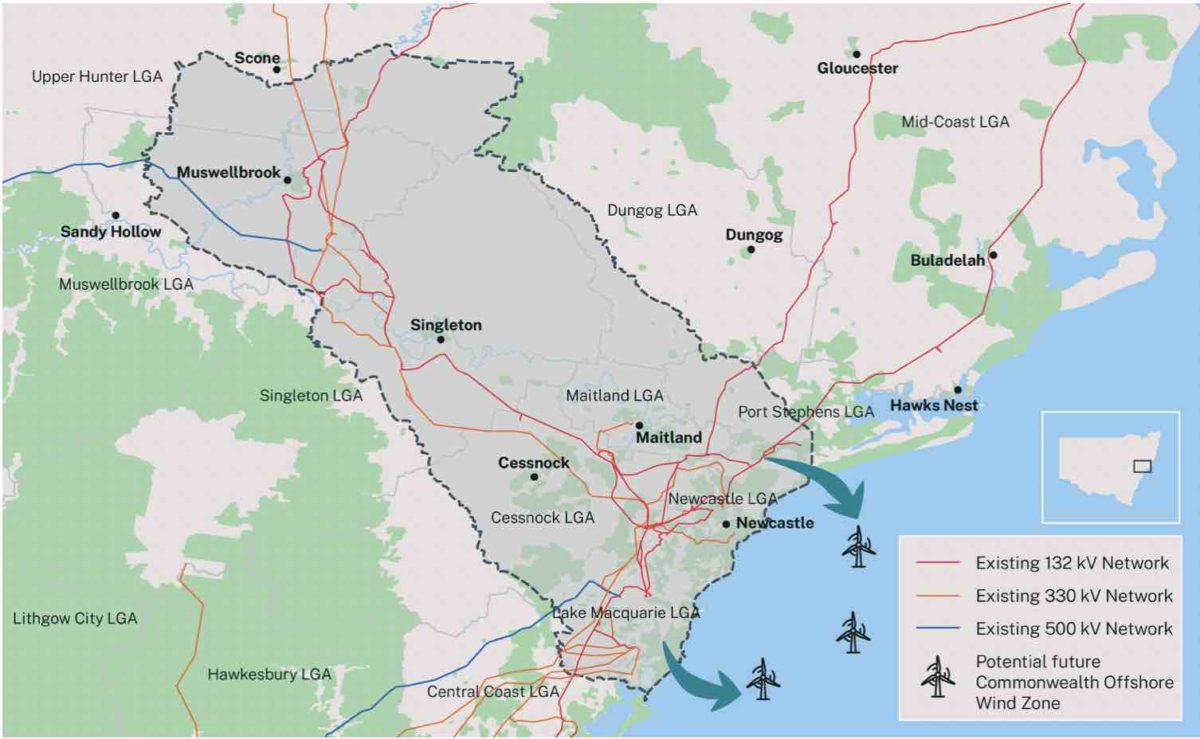
The NSW Government has declared its fourth renewable energy zone – and the first to include access to offshore wind – as it races to put in the infrastructure for new wind, solar and storage to replace the country’s biggest fleet of coal generators.
The formal declaration of the Hunter-Central Coast Renewable Energy Zone (REZ) comes after similar declarations for the Central-West Orana, New England and South-West zones.
The Hunter zone is the first to include offshore wind, although the development of that technology will be developed in Commonwealth waters.
Offshore wind dominated the expressions of interest that included more than 40GW of proposed new capacity worth more than $100 billion. A total of 24 solar projects, 13 onshore and seven offshore wind projects, as well as eight pumped hydro energy storage projects and 35 big battery proposals were received.
The formal declaration by Energy Corporation of NSW came on the same day that federal and state governments agreed on a cap on gas and coal prices, with estimates that this could include up to $500 million in payments – mostly to NSW coal generators.
The NSW coal fleet is the country’s biggest, and its most expensive, with the cost of coal soaring due to supply shortages made worse by flooding that affected mines and rail routes, and the fact that much of the state’s thermal coal is sent overseas.
The Hunter zone is interesting because it includes much of the infrastructure put in place for most of these coal fired power stations – Liddell, Bayswater, Eraring and Vales Point – and all these power stations are expected to close within the decade.
It also has good port and transport infrastructure, a skilled work force, and the capacity to repurpose existing assets, which has already attracted interest from the likes of Andrew Forrest’s Fortescue Future Industries, Japan energy giants, Origin and Orica, and multiple offshore wind players.
See RenewEconomy’s Offshore Wind Farm Map of Australia
EnergyCo executive director Mike Young says the new industries to emerge in the zone will include green hydrogen, ammonia and metal production, as well as offshore wind, electric vehicle fleet operators and the electrification of industrial processes.
EnergyCo describes the renewable energy zones – there will be at least five in NSW with the Illawarra to follow – as the equivalent of modern-day power stations, connecting multiple renewable energy projects and electricity storage and taking advantage of economies of scale.
“The Hunter-Central Coast REZ will be vital in assisting existing industries to decarbonise and supporting the development of Hunter hydrogen hubs and clean manufacturing precincts by supplying the renewable energy required to power these industries,” Young said in a statement.
The creation of the REZs is part of the NSW renewable energy infrastructure roadmap, which includes a series of auction on grid access and underwriting agreements, and which form the basis of the new Capacity Investment Scheme adopted by state energy ministers on Thursday.
The Safeguard Mechanism is Australia’s principal policy for cutting emissions from the nation’s largest industrial…
The age of electricity is Australia’s opportunity to remake itself as a zero-emissions energy, trade…
Federal government invites input from Australia's manufacturing supply chains to help shape the future of…
A landmark renewable energy and green hydrogen project in New Zealand has reached financial close…
Households could face a four-fold increase in network costs as a result of the regulator's…
A major reform intended to drive investment in renewable energy and storage capacity could have…