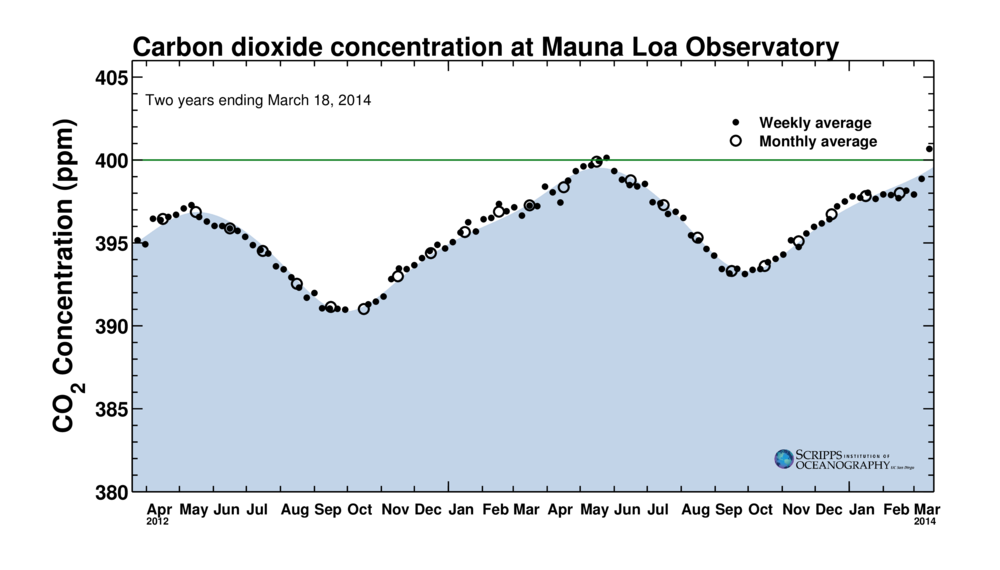
The level of carbon dioxide in the atmosphere reached 400 parts per million for the first time in human history at Mauna Loa Observatory in Hawaii in May last year. That same level has been reached again in the last few days. This year we’ve hit the target in March, two months earlier, and it will stay above 400ppm for longer. At that rate, it will only be a handful of years until we are living in an atmosphere permanently above 400 ppm. While 400 ppm is a somewhat arbitrary marker, humans did not exist the last time atmospheric CO2 was at that level.
Each year, the amount of CO2 in the atmosphere rises during the northern hemisphere autumn and winter, then decreases through the spring and summer as plant growth removes the CO2 from the air during the growing season. The annual peak usually occurs in May, but this season we will experience this new milestone of 400ppm CO2 for a couple of months before the annual decline occurs. Source: Scripps Institute of Oceanography.
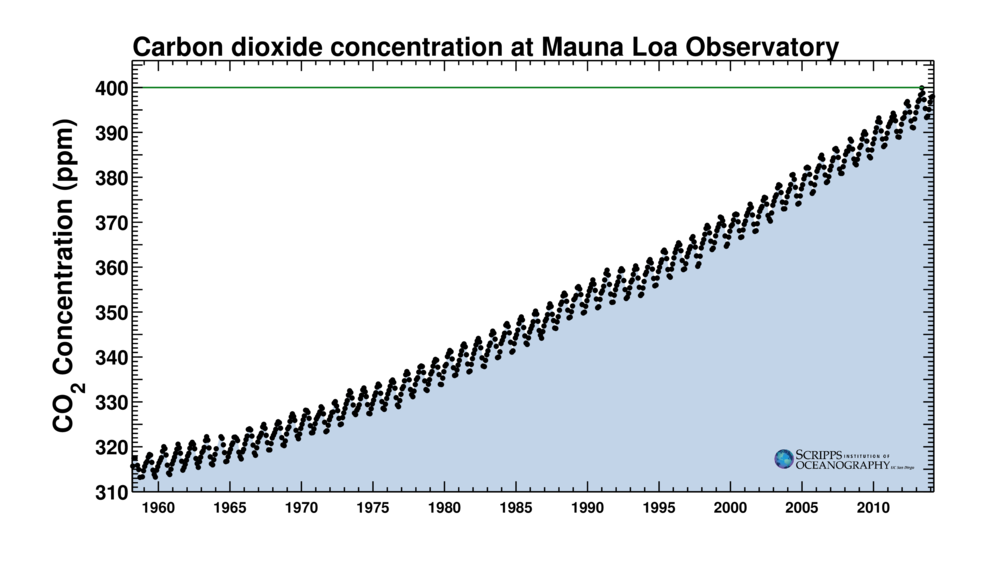
The excess carbon that you and I have been dumping into the atmosphere for the last half century — from deforestation and from burning coal, oil, and natural gas — has pushed CO2 levels more than 25% higher than when measurements of air began at Mauna Loa in the late 1950s. These critical measurements by the Scripps Institution of Oceanography represent the longest continuous monitoring of CO2 in air. However, facing a funding crisis, Scripps has astoundingly had to resort to crowdsourcing to make up the shortfall in federal funding. They are one of only two agencies that carries out measurements at Mauna Loa (the other one being NOAA, that began monitoring about a decade later than Scripps).
Carbon dioxide (CO2) concentration in air at the Mauna Loa observatory in Hawaii has increased by more than 25% since measurements began in 1958 — when levels were at 317ppm. Today they have topped 400ppm. Source: Scripps Institute of Oceanography.
As I’ve described in an earlier blog, my scientific career began in a 350ppm world. And, now in our 400ppm world, we need a world-changing view to tackle the challenge that we face. We must reduce global emissions of carbon, by transforming both how we produce energy and how we choose to live going forward. What is required of us is enormous but I believe we are up to the task — after all, the 450ppm world is fast approaching.
Source: UCSUSA. Reproduced with permission.
Wholesale electricity prices surge as wind displaces coal, batteries push out gas and home storage…
Queensland has set a new record for the share of solar power in its electricity…
With less need for networks to perform their traditional role, and the state of tariffs…
Australia's growing number of large-scale data centres must be powered by renewable energy, groups say,…
Quinbrook begins planning journey for the first of two solar projects worth up to 500…
Plans to develop a wind farm in Queensland’s Whitsunday region have been cut in half,…