Our household decarbonisation journey has been a long and winding road, initially with a 100% GreenPower electricity plan followed in subsequent years by divestiture of fossil-fuel investments, purchase of two battery electric vehicles after previous ICE vehicles reached end-of-life, and installation of rooftop solar and a battery.
But we were still using one fossil fuel directly – ‘natural’ gas, otherwise known as that potent greenhouse gas, methane.
Replacing gas appliances with electric alternatives in an existing property can range from not too hard to very difficult – and potentially very expensive. But we recently completed our phaseout of fossil fuels with abolishment of our gas connection. Here’s how we did it and the challenges along the way.
We had four gas appliances: a cooktop, instant hot water system, fireplace, and an outdoor barbecue. Our approach was to get the cooktop and hot water replaced first as these were the highest priorities and then disconnect the gas. The other two could wait.
These were the considerations for the induction cooktop:
– We have a natural stone benchtop (granite) and the cutout for the previous gas cooktop was a nonstandard size. The new induction cooktop needed to have a cutout equal to or bigger than the existing cutout.
– We were not going to pull our kitchen apart so existing cabinetry remained. Some induction cooktops require underbench ventilation to draw in fresh air and expel warm air. It is difficult to retrofit that if existing cabinetry doesn’t have it.
– While some induction cooktops are 10 amp “plug and play” these are underpowered for a 4-person household. Even “power share” or “power lite” induction cooktops often require a 15 amp circuit. So a new higher power dedicated circuit was required to the existing cooktop location.
– Fixed hardwired appliances like induction cooktops also must have a visible and accessible isolation switch installed with rules about how close or how far away they can be from the appliance. It can’t go in the cabinet below the cooktop.
The considerations were different for the hot water:
– Heat-pump hot water systems (HPHWS) are tank based and for a 4-person household the tank needs to be pretty big. We live in inner Sydney and needed to work out where this could go given our limited outdoor space and aesthetic considerations (who wants a water tank to be a feature of their pocket garden?)
– HPHWS also have a separate condenser (like an air conditioning condenser) that does the heat exchange to heat the water. While all-in-one HPHWS exist with the condenser above the tank they have other constraints.
– A full water tank might weigh well over 400 kg so it needs a perfectly horizontal and structurally sound base on which to stand.
– HPHWS typically also require a dedicated electrical circuit to be installed.
– Pipe run length – the longer the pipe run to the tank the longer it will take for hot water to appear at taps in the house.
– WiFi connection – everything has an App and is ‘smart’ these days, so the HPHWS controller needs to be able to connect to the internet usually via WiFi. Is WiFi reception possible at the chosen tank location?
Finding a suitable induction cooktop was fairly easy. A well-known online appliance store has advanced product filtering where we could specify minimum and maximum cutout sizes and it would only show cooktops that fitted.
We quickly found a 60cm cooktop that required no additional underbench ventilation. But the cutout required was 10mm more in width and 15mm more in depth than the existing cutout. Nothing would exactly fit the existing cutout so benchtop cutting was inevitable.
We had an electrician assess the feasibility of running a new circuit and installing the isolation switch without disfiguring the kitchen or having to rip walls apart. Luckily he could do it with a ‘cable feeder’ using existing wall and ceiling cavities.
We asked if he had ever waved the white flag on an induction cooktop retrofit. He said there is always a way, such as running the cable under the floor (for timber floor houses), running the cable outside then in through a wall and the back of existing cabinets, cutting slots in brickwork (chasing) or covering the cable in trunking. It all depends on how much money you want to spend and how fussy (or not) you are on the final appearance.
I ordered the cooktop and the first job was to enlarge the benchtop cutout. Unless you are an experienced DIY-er I recommend getting a professional in to do this. Using a wet saw is mandatory to suppress dust and using one indoors is not for the faint-hearted. Also any mistakes cutting a nice kitchen benchtop are likely to be irreversible.
I opted to cut the benchtop myself. I hired a diamond blade hand-held wet saw, wore PPE with P2-grade respiratory mask, industrial earmuffs, goggles and work gloves, and laid down lots of old towels and sheets to capture as much water and slurry as possible. It still created an almighty mess that took over an hour to clean up.
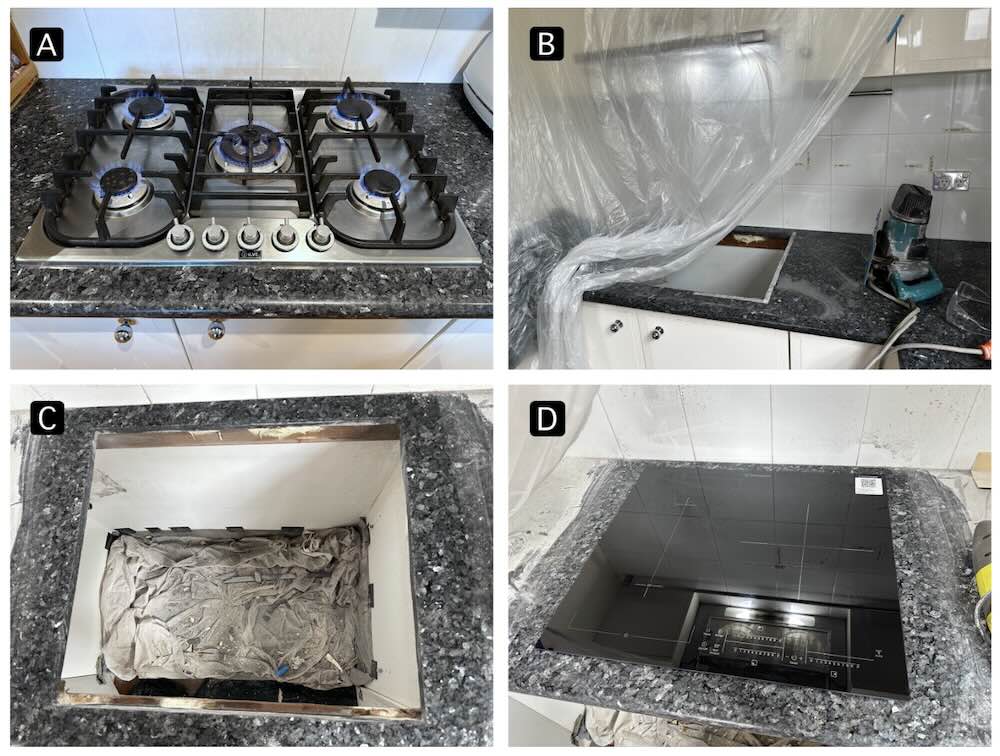
The final thing was to check the new cooktop fitted properly in the enlarged cutout before returning the saw. Figure 1 shows the gory details.
Figure 1 – (A) The original gas cooktop (B) Benchtop setup for cutting with hand-held diamond blade wet saw (C) Old sheets and towels were used at the bottom of the cabinet and on the kitchen floor to absorb water and catch debris (D) Checking the induction cooktop fits properly after cutting.
If you have an engineered stone benchtop then you might be out of luck if you can’t find an induction cooktop that fits the existing cutout. You should definitely not cut it yourself (in fact it’s illegal to do so) and instead seek expert professional advice.
The electrician then completed the install by installing the new circuit in our switchboard and running the appropriate cable to the new isolation switch and cooktop.
We are absolutely delighted with induction cooking. We find the responsiveness and control better than gas, especially to simmer on low temperatures which on a gas cooktop requires moving pans onto smaller burners. Cleaning is a breeze. There’s not a single thing we miss and many things we prefer. And we even feel better with zero fumes!
Deciding where to put the HPHWS was the most difficult part of this project, as we had limited options and wanted it out of the way as much as possible for aesthetic reasons.
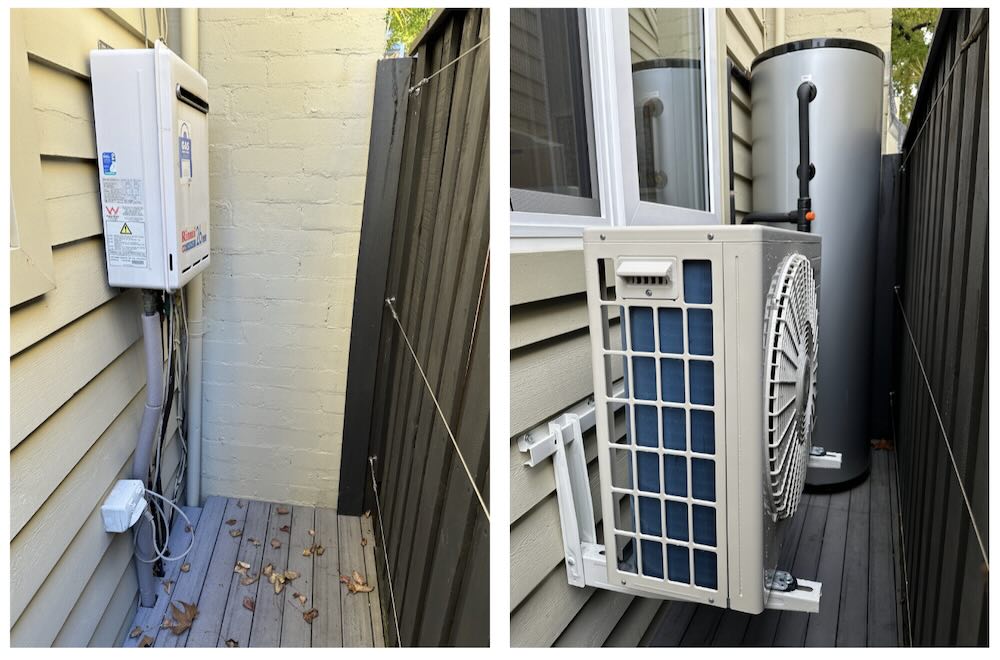
We decided to locate it where our gas instant hot water was located, up the only side passage we have. But the installer had to seek manufacturer advice since the various clearances available were slightly less than the minimum they specify. In the end this location was deemed OK but there was almost zero leeway.
We chose a 315L stainless steel tank for better longevity and a brand known for its extremely quiet condensers which was critical due to its proximity to the boundary fence. Home owners need to check any local council requirements for installation of such equipment near a boundary to ensure it is legal as well as complying with noise limits.
The HPHWS took a full day to install given the confined working space and other complexities with our particular installation. It also needed a new electric circuit to power both the condenser and the controller, although only a dual 10 Amp socket was required.
Figure 2 – Our former gas instant hot water system replaced with a heat pump hot water system – with no room to spare
I was very relieved when it was up and running that the condenser was as quiet as I hoped, if not more so. Much quieter than an air conditioning condenser. I programmed the system to heat the water during the noon to 3pm solar peak and to also run in the early morning at off-peak rates but only if required.
So far on average the system has used 3.2 kWh per day (noting it uses more power during winter) at the tiny cost of 13 cents a day. Prior to installing the HPHWS our average daily gas cost including daily supply charges was $2.70.
We have not run out of hot water and the water is absolutely hot enough (it is mandatory for hot water tanks to be heated to 60°C in order to kill Legionella bacteria). And unlike gas instant hot water systems, which have a minimum water flow rate below which they cease heating, we can run hot water from the tank as slowly as we like and it stays hot. This was occasionally a problem with our low-flow shower heads, but not anymore.
Having replaced our two main gas appliances, there are two options to stop the gas bills coming: disconnection or abolishment.
Disconnection involves the distributor capping your gas supply at the meter to prevent gas use and closing your gas account. It is relatively low cost (around $100-$150 depending on where you live) but means a future owner could easily reconnect the gas supply.
Abolishment involves the distributor physically removing your gas meter and disconnecting the property supply near the main which involves digging up the street or footpath. It is permanent disconnection and can cost thousands depending on where you live.
The Australian Energy Regulator (AER) however made a ‘Final Decision’ requiring the Sydney gas distributor Jemena to cap the cost of gas abolishment to $250 (plus CPI) from 1 July 2026 until June 2030. So although we ceased using gas in March we applied to have our gas connection abolished on 1 July at the capped price. Abolishment is also capped in Victoria at a similar price.
The call to our retailer to get this done was perfectly fine and there was no attempt to scare us off abolishment or change our mind. Initiating the process was pretty straightforward, involving some online form-filling and confirmation of the date from which the gas supply could be removed. We were advised that abolishment could occur up to 20 working days from the date requested.
The rest of the process though was a bit frustrating. On two occasions I received early morning text messages that the abolishment would be done that day only for the work to not be done. On the first occasion two workers turned up in a traffic control truck, put down some traffic cones, waited for about 4 hours, and then after no crew turned up, packed up and left without saying a word.
On the second occasion some workers turned up to dig a small hole in the road, fill it up again, and spray-paint some markings. But the gas connection and meter remained and radio silence then descended – there was no subsequent communication as to the status of the work or when the abolishment would actually be done.
Calling my retailer was of limited use as all they could do was ‘escalate’ it with the gas distributor. Eventually I started calling the gas distributor directly. It took four phone calls and an email before a date was finally confirmed for the abolishment to be done.
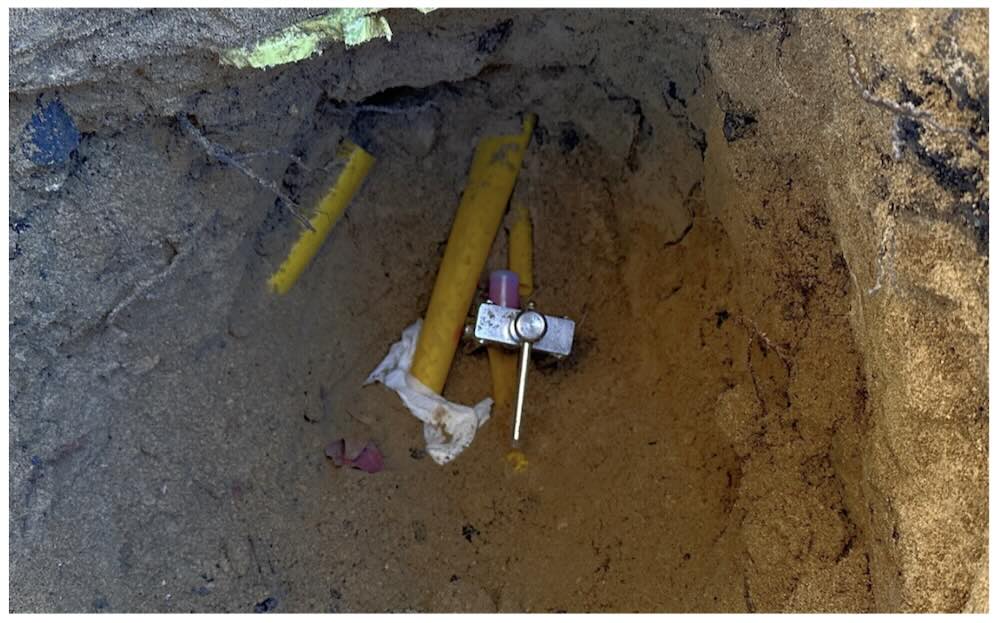
This time it all happened. A hole was dug in the road at the same spot as before and the supply pipe to our property located. This pipe was crimped with a metal press to stop the gas flow, cut downstream of the crimp and then permanently capped (Figure 3). The gas meter was then removed. Goodbye gas! It took less than an hour.
The pipes on our side of the property were not touched, but neither was the gas regulator. The contractors merely took away the meter and said I could do what I liked with the rest of it. So I got out my big shifting spanners and removed the regulator, connectors and mounting bracket. In due course I will remove the remnant gas pipes (Figure 4).
It will be interesting to see how this process scales if tens of thousands of people start abolishing their gas connections.
Figure 3 – Disconnection of our gas pipe from the main. The pipe was crimped with the metal press, cut, and then permanently capped with a seal.
Why did we opt for abolishment? We deliberately wanted to make it very hard – and expensive – for any future owner of our home to reconnect the gas. That way, the emissions abatement is permanent. Brutal? Perhaps, but the climate crisis necessitates it.
Figure 4 – Where our gas meter used to be. Goodbye! You won’t be missed…
We have physically removed our gas fireplace (leaving an empty firebox) and outdoor gas barbecue. But our research to date has revealed the opposite of what we expected: electric fireplaces are pretty common and not that expensive, but good quality residential electric barbecues are as rare as hens’ teeth and cost a fortune.
We will probably not install an electric fireplace. Unrelated to this project, we replaced our 20-year-old ducted air-conditioner with a much more efficient and effective system that has made the fireplace redundant. We’ll seal up the fireplace and instead do something funky like install an LCD screen or plasma ball.
For the barbecue, we were inspired by Tim Eden’s recent article “How I shocked my 20 year-old gas BBQ back to life with an electric conversion” so may go down a very different path for that. But it’s not urgent.
Getting off the gas in an existing home might not be simple and require significant financial commitment. The practical barriers people might face in their own home, and the costs involved, are real. We spent nearly a year examining all the options and working through the various hurdles.
But also don’t be discouraged! With good research, advice from professionals, and taking your time to consider options, it should be possible in most homes – protecting you from any future gas prices rises or supply crunches as well as doing that little bit more in the cause of tackling climate change. And hopefully an investment in electrification is an advantage when it comes the time to sell your home.
The total cost for our two projects was about $11,500 – at the high end of what we expected due to some of the complexities involved. Given we were spending about $1000 a year on gas it won’t have a quick payback but this was never about the money. The satisfaction in not burning gas anymore? Priceless!
Brendan Jones is an electrical engineer, data analyst and passionate advocate for renewable energy and electric vehicles.
Australia’s cheapest new car is now electric. We wrap up Everything Electric Sydney. Plus, news…
Modelling by Renew reveals a Goldilocks package of energy efficiency upgrades is needed to make…
Federal Coalition vows to detonate most of Australia's efforts to decarbonise "within 30 days" of…
The Murdoch media has come up with some Very Big Round Numbers in reports on…
A big battery that had promised to be state's biggest back when it was first…
Australia's biggest coal generator plans another two massive battery projects, including an eight-four facility that…