Image source: Chris Bowen, LinkedIn
Australia is setting battery records from one end of the market to the other, as the federal home energy storage rebate passes a new milestoneand large-scale battery energy storage systems (BESS) continue to flex their muscle on the grid.
First, at the household level, federal energy minister Chris Bowen announced on Tuesday that the Cheaper Home Batteries scheme has passed the 300,000-mark.
The new milestone for Cheaper Home Batteries comes almost exactly one month before the introduction of some major changes to the rebate, including a new sliding scale discount that decreases substantially for batteries with a storage capacity greater than 14 kilowatt-hours (kWh).
From May 1, batteries sized up to 14 kWh continue to receive the full roughly 30% discount off the up-front cost of a storage system. Batteries sized between 14 kWh-28 kWh will get 60% of the discount, while batteries between 28 kWh and 50 kWh will get 15 per cent.
The looming change has helped to keep the rebate very, very busy, but two weeks ago the Clean Energy Regulator warned that time was running out to access the original rebate settings, given the discount is determined by the installation date and not when a contract is signed.
In a statement on LinkedIn, Bowen is touting the latest rebate milestone as a big win “at a time of international instability” that is shaking fossil fuel-tethered energy markets to the core.
“These batteries have helped shield everyday Australians from shocks overseas,” Bowen said on Tuesday.
“Energy sovereignty includes storing more of our renewable energy, including in Australian households. What’s good for the planet is good for the pocket.”
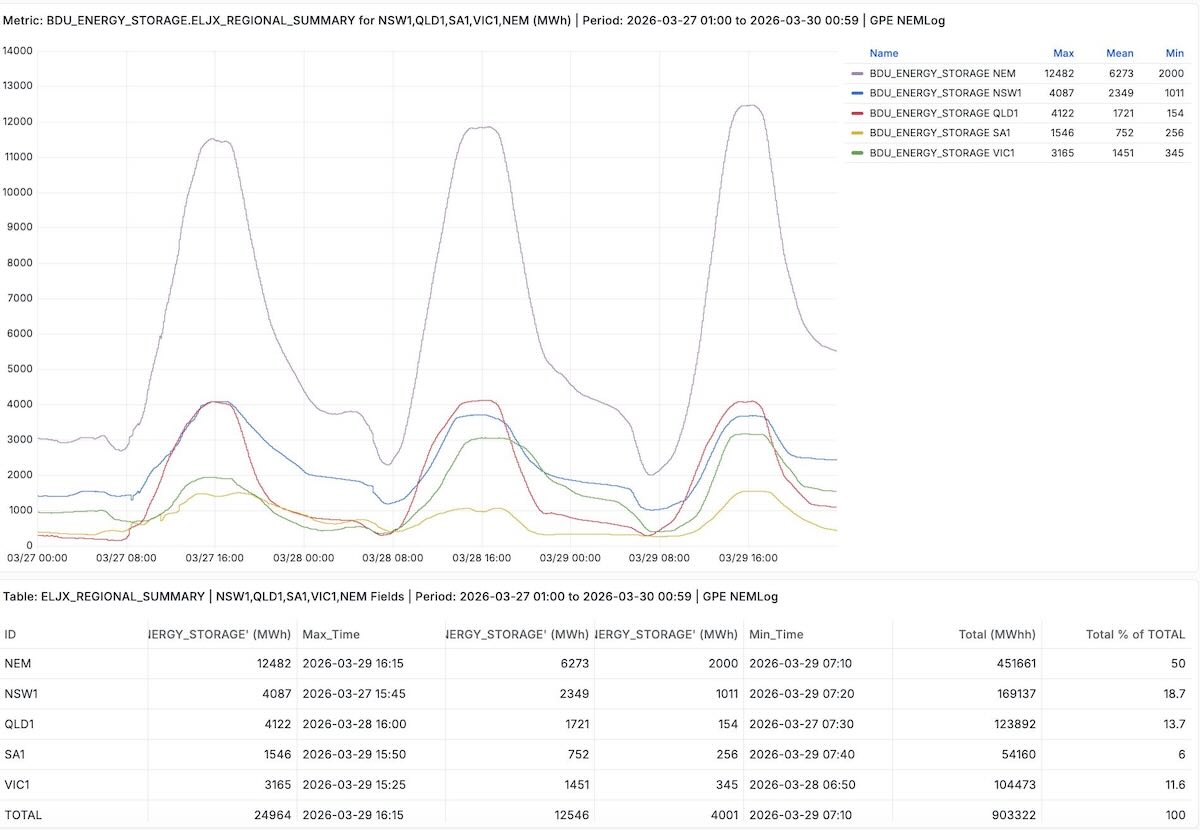
At the other end of the battery scale, Global Power Energy’s Geoff Eldridge points to a series of grid-connected battery records across the National Electricity Market (NEM) over the past few days, spanning charge share, net battery share, charge in megawatts and stored energy.
From Friday March 27 through to Sunday March 29, Eldridge says a run of battery records was set across Queensland, New South Wales, South Australia,Victoria and the borader NEM.
In Queensland, the battery charge share of demand hit a new high of 13.6 per cent at 10.00 am on Saturday March 28, showing “how visible batteries can now be in daytime demand,” says Eldridge, and serving as a reminder that “strong charging materially reshapes the grid’s net supply-demand balance.”
On the same Saturday, Queensland batteries clocked a record 4,122 megawatt-hours (NWh) of bidirectional unit storage output at 3.55 pm.
In New South Wales, and South Australia, both states recorded new battery highs of 4,087 MWh at 4.45 pm on Friday March 27, for NSW, and 1,546 MWh at 3.30 pm Sunday March 29 for South Australia. Victoria, meanwhile, hit a record new battery share of generation of 16.4 per cent at 12.40 pm on the Sunday.
On the NEM, three new records were chalked up on Sunday March 29: A NEM battery charge share of 9.6 per cent at 1.05 pm, a NEM battery charge of 2,815 MW at 12.05 pm, and a NEM bidirectional storage output of 12,482 MWh at 4.10 pm.
The below chart shared by Eldridge on LinkedIn shows “the build and release of battery energy storage (MWh) across those regions over the three days, highlighting the repeated afternoon lift in stored energy and the new highs reached across the NEM and several regions.”
Image souce: GPE NEMLog
“[The] new stored energy records in NSW, SA, Queensland and the NEM point to a fleet that is not only charging harder, but carrying more energy into later periods,” says Eldridge.
“The new NEM battery charging record of 2,815 MW is notable in its own right, showing the scale batteries can now absorb during favourable charging conditions.
“Victoria’s new 16.4 per cent battery charge share shows how prominent batteries are becoming in some regional midday demand shapes.”
“Taken together,” says Eldridge, “they point to more than a single standout interval. They show batteries charging more deeply, storing more energy, and becoming more visible in midday and afternoon system conditions across multiple regions at once.
“The records …[paint] a broader picture of batteries not just responding at the margin, but increasingly shaping the market’s operational profile.”
If you would like to join more than 29,000 others and get the latest clean energy news delivered straight to your inbox, for free, please click here to subscribe to our free daily newsletter.
Victoria's former energy minister talks gas bans and coal closures – and says that without…
Anger about renewables will not be fixed by scrapping, burning or burying. If political leaders…
A key to China's "staggering" economic success is that its "commitment to decarbonisation is absolutely…
The first of 69 wind turbines has been erected at the 414 megawatt project that…
A major hydroelectric power plant has gone up in flames, gutting the station's main building…
State owned company cops hefty fine for "profit maximising" and electricity price "distorting," through battery…