Mokoan Solar ParkImage Credt: European Energy
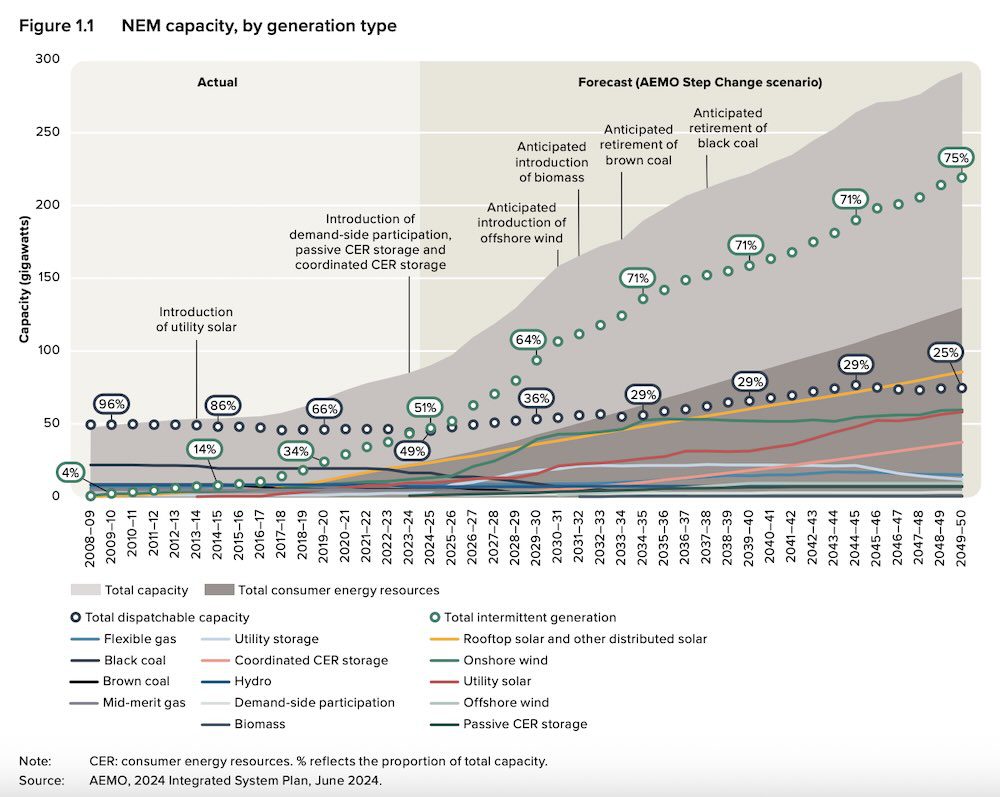
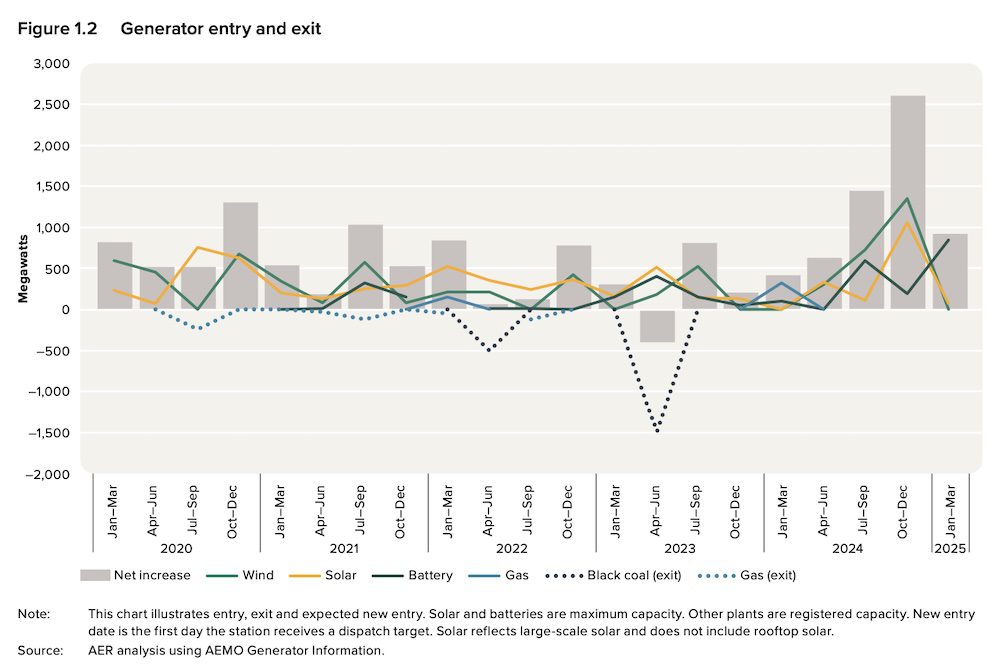
What a difference a decade makes. Between 2014 and 2024, around 18.5 gigawatts (GW) of large-scale wind and solar generation capacity and 18.2 GW of rooftop solar has joined the Australian grid, a new report says, while more than 6.6 GW of coal and gas-fired generation has left it.
The latest State of the Energy Market report from the Australian Energy Regulator (AER), published on Tuesday, says renewables made up 60% of the NEM’s generation capacity at the end of 2024, up from around 14% in 2014, and met around 39% of electricity demand.
Indeed, the AER report says almost all grid-scale generation investment since 2012 has been in renewable sources, leading to an energy market that regularly sets new records for the contributions of non-fossil generation – and has slashed emissions by 28 per cent since 2005.
Over the course of the year, the report says, new records were set for rooftop solar output, the highest number of negative-priced 30-minute periods, minimum daily electricity demand and entry of new registered generation capacity.
“In 2024, over 5 gigawatts of new solar, wind, battery and gas capacity entered the National Electricity Market (NEM) – the largest annual new entry of capacity since the NEM began in 1998,” says AER chair Clare Savage.
“By the end of the year, renewable technologies including rooftop solar, solar farms, wind, hydro and batteries made up 60% of the National Electricity Market’s generation capacity and contributed 39% of generation output, representing a significant increase over the past decade.”
One of the biggest success stories, of course, has been the rooftop solar market, the total installed capacity of which was seven times higher in May 2024 than the total in May 2014, according to the report.
By the end of 2024, the AER puts total generation capacity in the NEM at 86,945 MW, led by rooftop solar, totalling 25% of registered NEM capacity and streaming ahead of the next in line, black coal at 19%.
Rooftop solar systems contributed 14.7% of the NEM’s total generation in the first quarter of 2025, more than utility-scale solar (9.3%), wind power (13.7%), hydro (4.9%) and gas (3.5%).
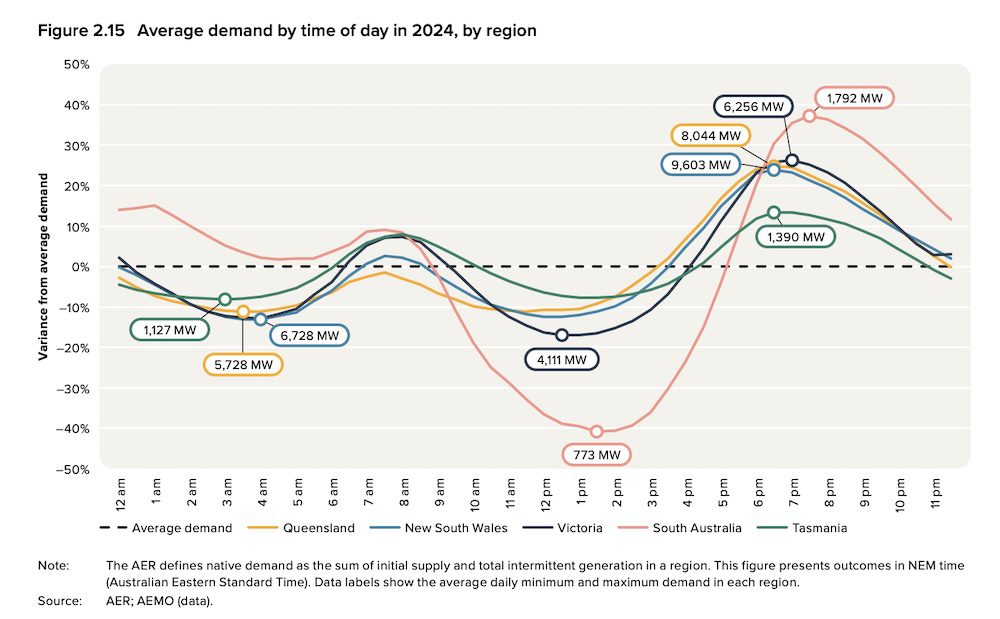
“Output from rooftop solar systems has also more than tripled in the seven years to 2023-24 and is now capable of meeting over half of underlying energy demand across the NEM in the middle of a sunny day,” the report says.
And the booming rooftop solar market has also had one of the biggest impacts on the grid. The report notes that while NEM consumption rose by 3.4 per cent in 2024, about one‑third of this increase was met by rooftop solar generation, rather than being supplied through the grid.
And rooftop solar has changed the game for coal generation, too.
“When rooftop solar generation peaks in the middle of the day, the demand for grid-sourced electricity collapses (at times falling to zero in some regions),” the report says.
“Coal plants are not engineered to run at low levels of output, so may offer negative prices to maximise the likelihood of being dispatched. Prolonged periods of negative spot prices, and potentially having to shut down during the day, makes it harder for coal plants to operate profitably.”
Meanwhile, the supply of electricity has also become a bumpier ride.
The report shows that the complex relationships between weather conditions, shifting demand, coal plant and network outages and an increasingly diverse mix of generation – nearly 400 generators sell electricity into the NEM – are having an impact on the wholesale market, resulting in increased price volatility.
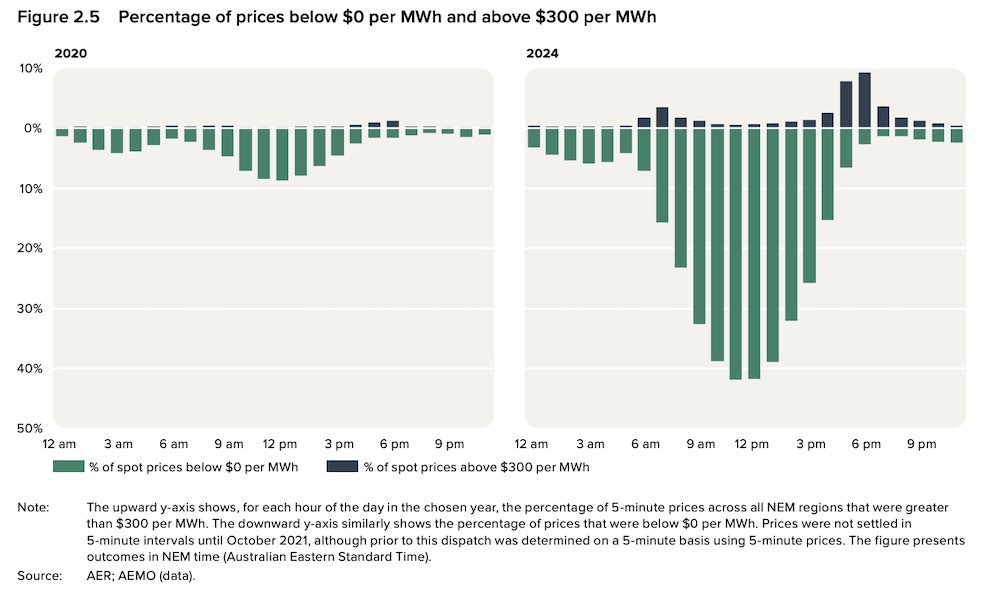
The AER says the proportion of wholesale electricity prices below $0 per megawatt hour (MWh) and above $300/ MWh was slightly higher than in 2023, but has “increased significantly” since 2020.
Negative prices made up 15% of all prices in 2024, up from 3.5% in 2020, according to the report. Prices above $300 per MWh increased from 0.4% to 1.8% of all prices over the same period.
The AER notes that despite their greater frequency, negative prices have less of an impact on average spot prices that price spikes. The report offers the example of January-March 2025 in South Australia, when negative prices reduced the quarterly average price by $8.33 while prices above $300 per MWh increased it by $23.68.
“In the July to September [2024] quarter, the contribution from high prices was more extreme, with negative prices reducing the quarterly average price by $7.79 while prices above $300 per MWh added $115.81.
“This is partly because when high prices do occur, they are often much more extreme than negative prices (which are often only slightly below $0 per MWh). It is also partly because higher prices tend to occur when system demand is greater, meaning that high prices apply to
a greater proportion of the electricity that is dispatched.”
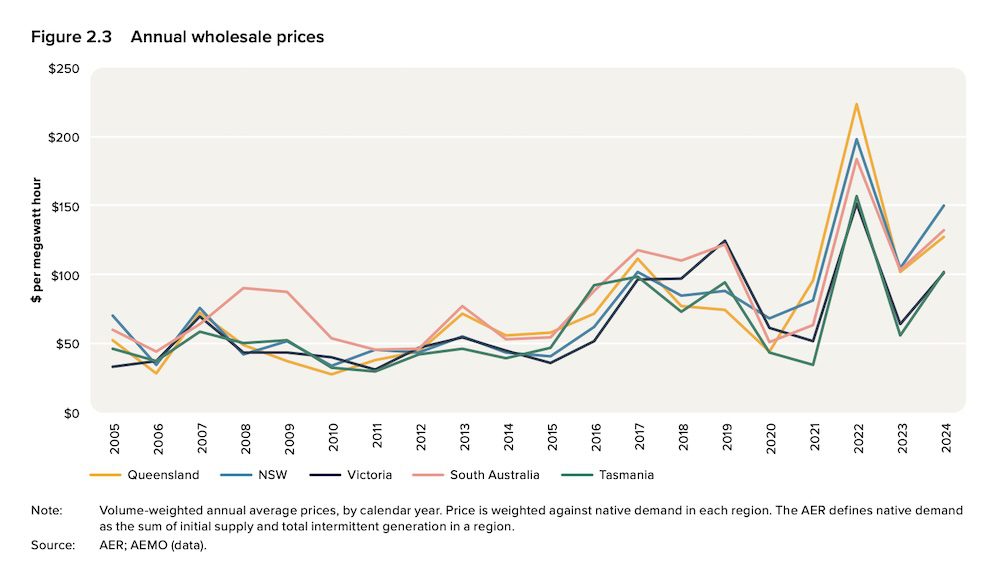
Ultimately, wholesale electricity prices in 2024 were higher than in the previous year in all regions, the report says – although they remained lower than the record levels reached in 2022.
Movements in retail electricity prices were less dramatic, though. As of March this year, median electricity market offers for residential customers in default market offer regions ranged from a 5% decrease in South Australia to a 4% increase in Queensland compared to the same period last year.
Interestingly, the poles and wires cost component of consumer energy bills is said to have fallen slightly in the 12-months to June 2024, with electricity network service providers given $270 million (2.1%) less for delivering core regulated services than in the previous year.
This, the report says, resulted in a decrease on average of $36 for each electricity customer compared to 2023.
On the demand side, the report says that while households are currently projected to consume more energy as houses and vehicles electrify, they are unlikely to draw much more from the grid in 2050 than they do now.
“Higher energy needs will be mostly met from their own investments in rooftop solar and counteracted by improved energy efficiency,” it says.
“Consumers will also play a vital role in meeting future grid demand for industry. Integrating rooftop systems, home batteries and other consumer energy resources into the system will allow households to export rooftop solar and stored energy into the system when it is needed.
“As the system continues to evolve consumer energy resources must be effectively integrated and coordinated to help achieve a least-cost transition, with networks evolving to support these new energy services and ensuring they are utilising their full capacity,” says
Savage.
Middle of the day wholesale electricity prices are rising, and prices in the evening peak…
UNSW groups set new perovskite efficiency record but the real secret sauce is a new…
Envision Australia’s Peter Cowling talks their plans and the state of the energy transition.
Australia can now boast of record amounts of wind farm construction starts this year, but…
Andrew Forrest-owned Squadron wants to build a massive wind farm in western Victoria and connect…
A sunny Spring has delivered two new output records for rooftop solar in two Australian…