Source: Volkswagen
Interested in buying an electric vehicle in Australia? Good luck. It won’t take you long to discover that the choice is not large, barely more than a handful, and nothing is available at a price of under $50,000.
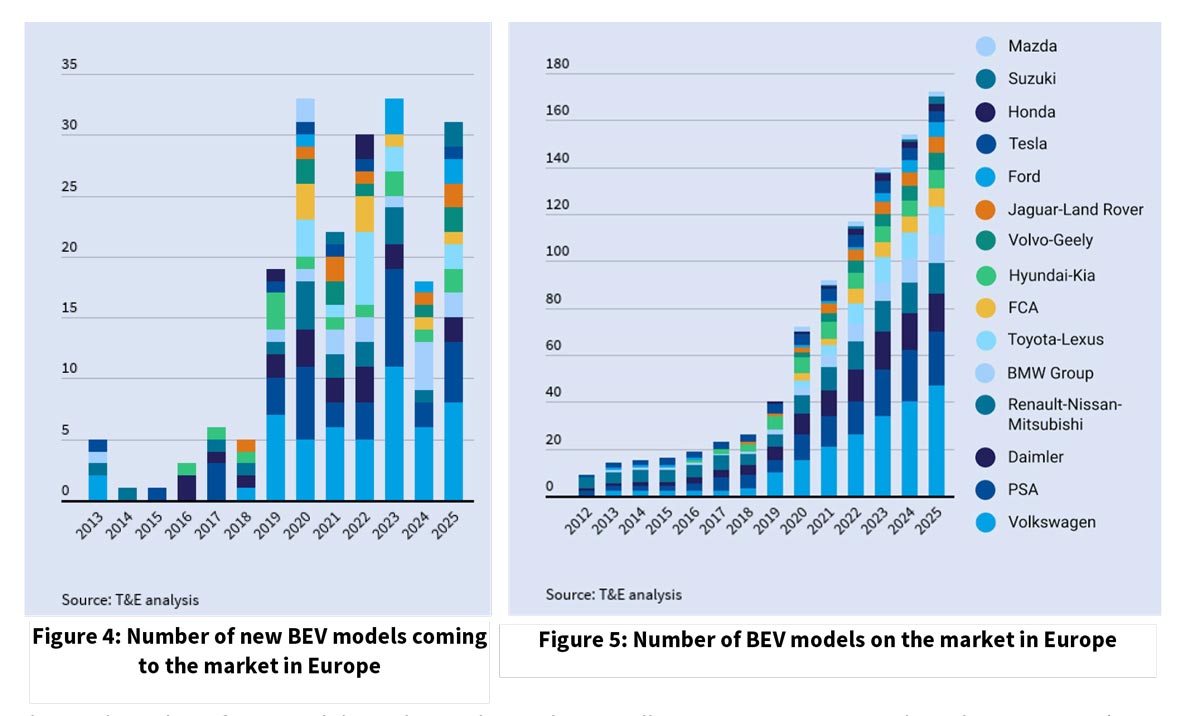
Contrast that with Europeans, and the globe at large, where consumers have a choice of more than 50 different models, a choice that will grow to more than 150 in the next two years – thanks to concerted efforts curtail vehicle emissions to comply with the new mandatory reduction targets.
The new European Union regulations specify a fleet-wide average of 95gm of carbon dioxide per kilometre will become compulsory for carmakers selling vehicles in Europe by 2021, or face big fines.
The new rules have seen a huge push from carmakers to introduce electric vehicles as they work to avoid fines, resulting in some 50 new plug-in hybrid models and 33 new battery electric vehicle models being introduced in 2020 alone, according to 2019 report by Transport & Environment.
Interestingly, while the number of new BEV models will continue to proliferate from 2019 to 2025, the number of new plug-in hybrid models introduced will taper off, and hydrogen fuel cell will remain low, as we noted in our coverage of the report in 2019.
The follow on effect of the European regulations – not so much because of them rather than because of the lack of similar regulations in Australia – is that carmakers are tending to shunt resources first to countries to comply with vehicle emissions rules.
While some automakers are struggling with battery supply issues – both Jaguar and Audi have halted production of their flagship electric vehicles in recent weeks – others, such as South Korean auto maker Kia have straight out said they will take the e-Niro and e-Soul to other markets first.
The upshot is that Australia is missing out.
So what European electric models is Australia missing out on? Here is a list of some of these vehicles from the Euro main automakers that Europeans will see – or already are – on roads in 2020.
To read the full story on RenewEconomy’s electric vehicle dedicated sister site, The Driven, click here…
One of the heaviest and longest road trips ever undertaken in Australia's energy transition has…
Australia has a choice between investing in the future we can already see – or subsidising…
The lengthy delays at what would have been the country's biggest wind farm have forced…
The public remains largely in the dark about the full cost of the giant Snowy…
Amandine Denis-Ryan from IEEFA on what can be done about Australia's unique and unhealthy dependence…
For maximum readings, September came in as Australia's third warmest. For minimums, last month narrowly…