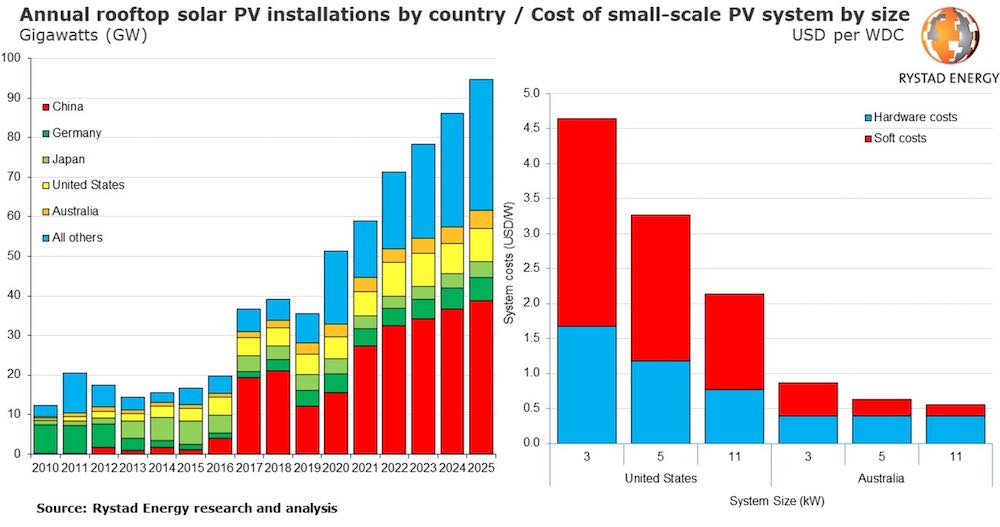
As Australia maintains its dominance as the world’s leading per-capita rooftop solar PV installer, a new analysis by Rystad Energy predicts that global rooftop solar PV installations will surge over the next three years, doubling by 2025 and approaching 95GW.
Oslo-based energy research business Rystad Energy published this week a new analysis of the global rooftop solar PV industry, forecasting recent growth to continue through the middle of the decade.
After a relatively slow period of adoption between 2010 to 2016, annual rooftop installations have jumped by 64% in five years, increasing from 36GW in 2017 to 59GW by the end of 2021, when they accounted for 30% of total global installed solar capacity.
The growth was driven primarily by increased adoption in China, which saw annual rooftop installations increase from 19.4GW in 2017 to 27.3GW in 2021. China installed just 4GW of rooftop solar in 2016.
The surge in rooftop solar capacity across the globe is due in large part to incentives and friendly policies introduced by many governments in an effort to promote adoption, among which feed-in tariffs (FiTs) that guarantee an above-market price for producers remain the most important.
“Small scale solar PV, including residential, commercial and industrial (C&I), and off-grid projects, are gaining momentum supported by economics and policies, with China, Japan, Germany, the US and Australia emerging as key markets,” said Gero Farruggio, Rystad Energy’s head of renewables research.
“Key drivers for the high uptake in the residential sector include high retail electricity costs, low system costs, high FiTs and the available roof space.”
As stated above, Australia leads the world in terms of per-capita rooftop solar PV installations, with 746-watts per person (Wpp). Australia is followed by Germany, with 668Wpp, and then Japan well back at 353Wpp.
Similarly, Australia is one of only three countries in the top 10 for total installed rooftop capacity (along with the United States and United Kingdom) where most of the systems are residential.
Rystad says this can be put down to a combination of factors, including various incentives such as FiTs and grants, a high proportion of homeowners, rooftops with suitable space, and the incredible solar resources that are synonymous with Australia.
Australia also holds its own against much larger countries, such as the United States, in terms of solar installations, thanks in large part to the nature of Australian solar incentives.
This is largely driven by the significantly higher cost of installations in the US, where a 3kW system costs around $4.6/W, compared with only $0.96 (USD) in Australia.
The higher US price tag is due primarily to the significant soft costs associated with purchasing the system – including the sales tax, permitting, inspection, interconnection, and profit margins, which together account for 64% in the United States, or $3/WDC, of a 3kW system.
South Australia unveils project proposals totalling 13 GW of new wind and solar which it…
Australian developer snaps up portfolio of operating and developing wind and solar projects as a…
A massive 244-tonne transformer has completed a 2,165 km road trip to the site of…
The battery industry is about to witness another change in chemistry and technology. Valo Energy…
Energy minister says imminent closure of coal is "indisputable," and "ideology-driven" policies to scrap transmission…
The supplier to the biggest battery currently being built in Australia expects to announce its…