Germany receives, quite rightly, a very significant focus when it comes to climate transitions around the world. The country is huge, central to the European Union, and embarking on an ambitious approach to decarbonising its economy. It is a sensitive time in the country, with the imminent departure of long-time Chancellor Angela Merkel, and a ‘climate election‘ due this year.
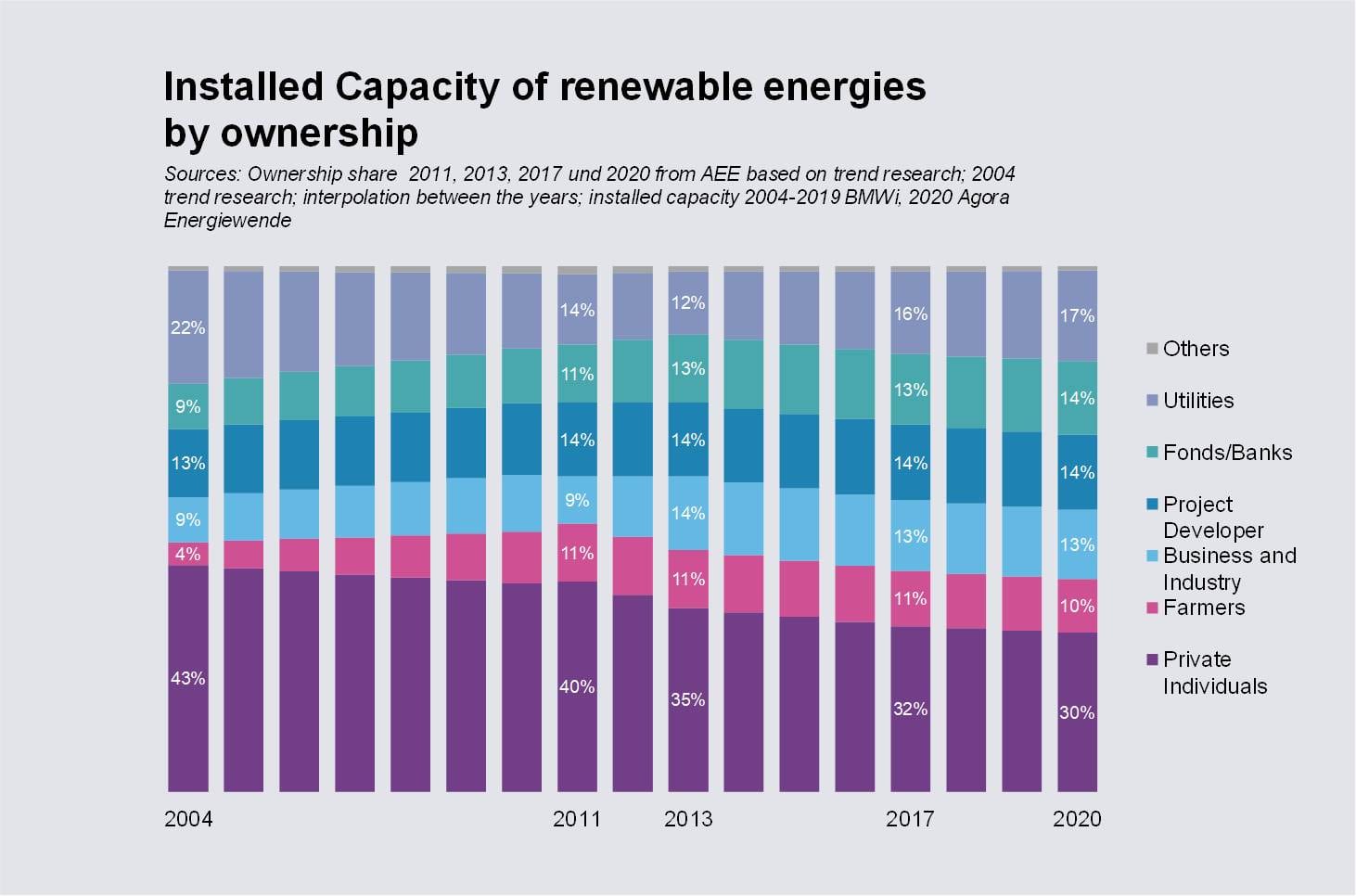
In a series of tweets published on Monday, Agora Energiewende’s project manager for the ‘international coal transition’, Phillip Litz, published a series of new graphics showing how Germany’s progress, to date, has been partly powered by a diverse array of ownership structures across several renewable energy technologies.
In Germany, private individuals are the biggest group of owners of wind, which has been part of why that technology has largely been welcomed by communities in Germany. In fact, a recent report released by the European Environment Agency shows that Germany has among the highest shares of renewable energy in the European Union.
It has been legislative action that has resulted in creating historically stable growth for renewable energy in Germany.
“The diversification of ownership in Germany’s renewable energy installations is secured through a long term oriented and stable regulative framework, the renewable energy law”, Litz told RenewEconomy. He advocates strongly for the model of ownership.
“A broad ownership structure has a positive impact on the market sustainability. It ensures broad political support and stability in times of regular, legislative change,” he said. “As technologies evolve quickly, also market design and financing schemes need to be adopted regularly. It also increases acceptance for the energy transition through active participation.”
Germany is also a good example of a country working hard to figure out the hard realities of 2050 climate targets, and the actions that must be taken today to reach the goals of tomorrow.
“The biggest challenge for the upcoming year is to adapt the current renewable targets and planned annual capacity additions to the recently agreed climate neutrality target in 2050,” said Litz.
“Our calculations suggest that Germany would need to triple it pace on wind and double its speed for PV until 2030 to get on track for climate neutrality in 2050.”
In his Twitter thread, Litz compiles for the first time data on the ownership of renewable energy in Germany across time. It shows a small but consistent shift since 2011 away from private individuals and towards utilities, banks, business and industry. Since 2004, private ownership has fallen from 43% to 30%.
A recent report from Agora Energiewende outlines the steps required for Germany to achieve ‘climate neutrality’ by the year 2050. This includes, by 2030, reaching 70% renewables, 14 million new electric cars, 6 million heat pumps, an increase in green retrofit rates by 50%, and 60 new terawatt-hours of zero emissions hydrogen.
Ensuring fairness and inclusivity in the 2021 legislative period, after the next election, will be pivotal for Germany. This will surely have flow on effects across the world, as many countries look to Germany for inspiration, guidance and warnings of dead ends.
A group of locals are appealing a permit issued for the on-shore transmission infrastructure to…
French developer of the troubled Hinkley Point C nuclear power plant says it likely to…
State Labor government shifts into caretaker mode after locking in "pivotal" plan to launch a…
Renewables dedicated offshoot of finance giant Macquarie emerges as buyer of oil giant's gigawatt-scale portfolio…
The draft rule will allow the energy regulator to alter a specific part of network…
Last week, the UK committed up to £1 billion to community and local energy, with…