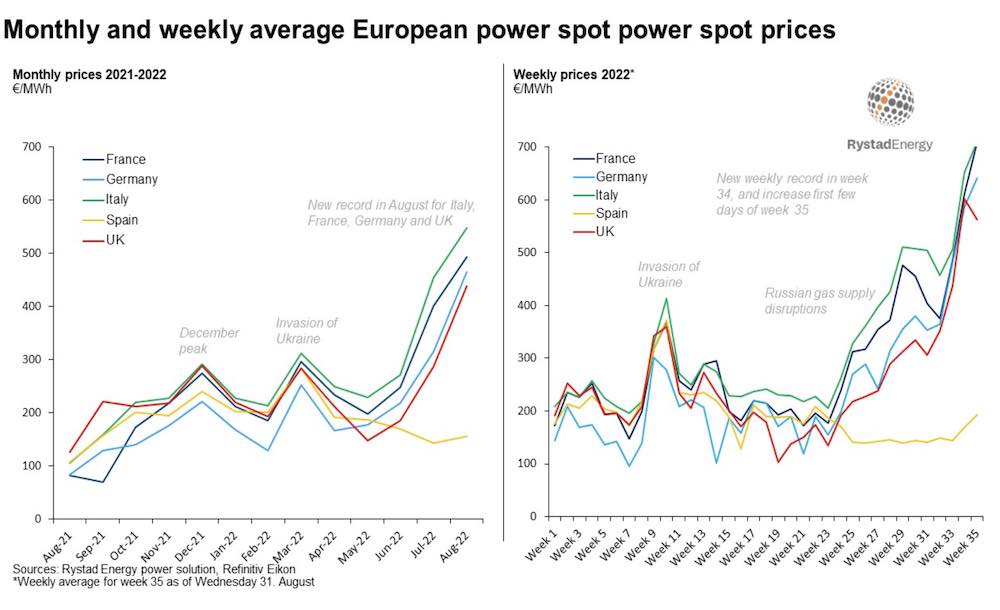
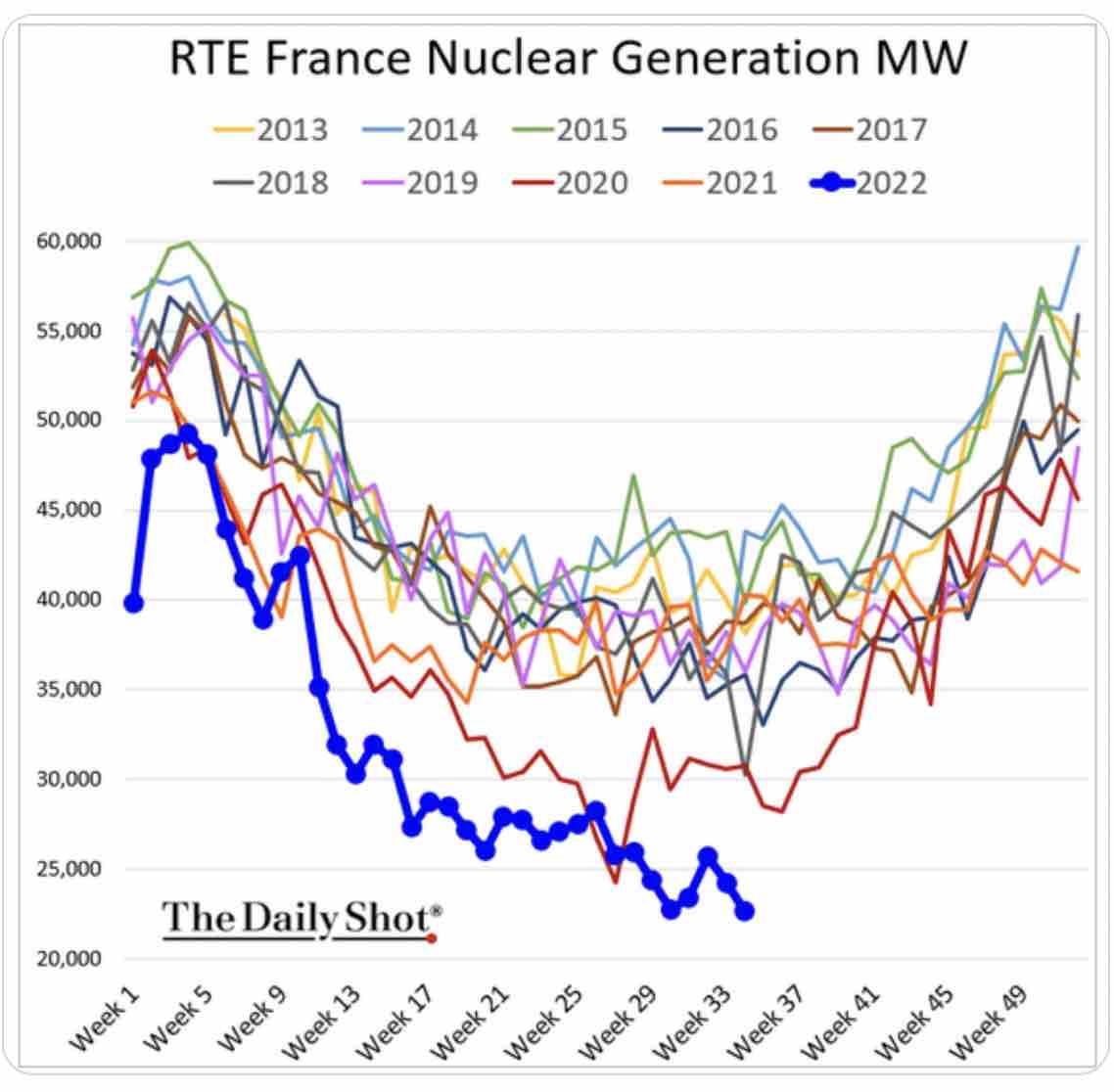
The month of August has been confirmed as the most expensive month ever for electricity in Europe, as markets were buffeted by the soaring cost of gas and outages that have taken up to two third’s of France’s nuclear capacity offline at time.
The twin impact of the soaring gas price – largely caused by the Russia invasion but exacerbated by French nuclear outages and reduced output from hydro power due to water shortages – has also prompted the EU to find new ways to shield the market from the impact of soaring fossil fuel prices.
According to analysts Rystad Energy, Italy – heavily dependent on imports from France’s nuclear fleet which have now all but stopped – became the first market to record a monthly average spot price above €500 per megawatt hour, with an average price of €547.
France came close to also breaking the €500 barrier, averaging €492, while Germany followed at €465 and the UK came in at €438.
And it is not going to get any better any time soon. In the past week, the average price surged to more than €600/MWh in the Italy, France and the UK, and on Monday France recorded a new record daily average price of €744/MWh as its nuclear output plumbed to new lows due to planned and unplanned outages.
In the coming winter, the picture looks even more bleak. The contract for Q1 prices in France peaked at €1750/MWh in France, and the contract for average prices in 2023 peaked above €1,000/MWh in both France and Germany.
The situation eased in the last couple of days as Germany expressed confidence that it has enough gas in storage to negotiate the winter, although France’s prime minister has warned of electricity shortages in that country.
This has already crippled the France’s EdF, majority owned by the state, which is spending an estimated €40 billion buying expensive electricity on market to make up for the staggering shortfalls in production from its nuclear fleet. (See graph below).
France has gone from being a major and often the biggest exporter of electricity to the biggest importer, which is causing pressure on prices all over the continent as it sucks in much needed supply from other countries.
One piece of good news is that Russia’s decision to close the last remaining generator on the Nordstream pipeline – at least for a few days – barely had any impact on prices, which might suggest – according to some analysts – that its ability to blackmail the EU on energy is already much reduced.
But the EU also keen to extract itself from the claws of the fossil fuel industry in Europe itself, mainly because extended periods of super-high prices will damage other industries dependent on cheap power.
The EU is now looking at ways to “split” to market to properly reflect the fact that the majority of power is delivered by wind, solar and nuclear – much cheaper fuels than coal and gas – and should be reflected in prices borne by the customer.
There are a variety of options. France protects the consumer bills, but they pay through the taxpayer in propping up EdF.
Portugal and Spain have taken a different approach, by capping the cost of gas powered generation only. The reasoning is that since gas is the price setter in many hours of the day in many countries, this could have the same effect as a direct electricity price cap.
Spain, says Rystad, has seen much lower electricity prices as a direct effect of this measure, as can be seen in the top graph above (the yellow flat line).
In Australia, the regulatory bodies have just announced they will do the opposite – lifting the price cap significantly to accommodate the heightened cost of fossil fuel generation. Consumer groups are not impressed.
Australia's most powerful battery now free to trade its full capacity on market after its…
The site of one of Australia's very first wind farms now shows little evidence of…
The "35 by 35" electrification goal has an Australian origin that the government seems to…
If we fail to ensure data centres pay for new renewables and storage to cover…
Home batteries look like resetting the behaviour of households when it comes to responding to…
South Australia energy minister hints that the 100 pct net renewables target may not be…