Image: Alinta Energy
Iron ore producer Fortescue Metals Group and Alinta Energy have formally opened the country’s biggest solar farm outside of the country’s main electricity grids, the 60MW Chichester Hub solar farm that will help power two big mines.
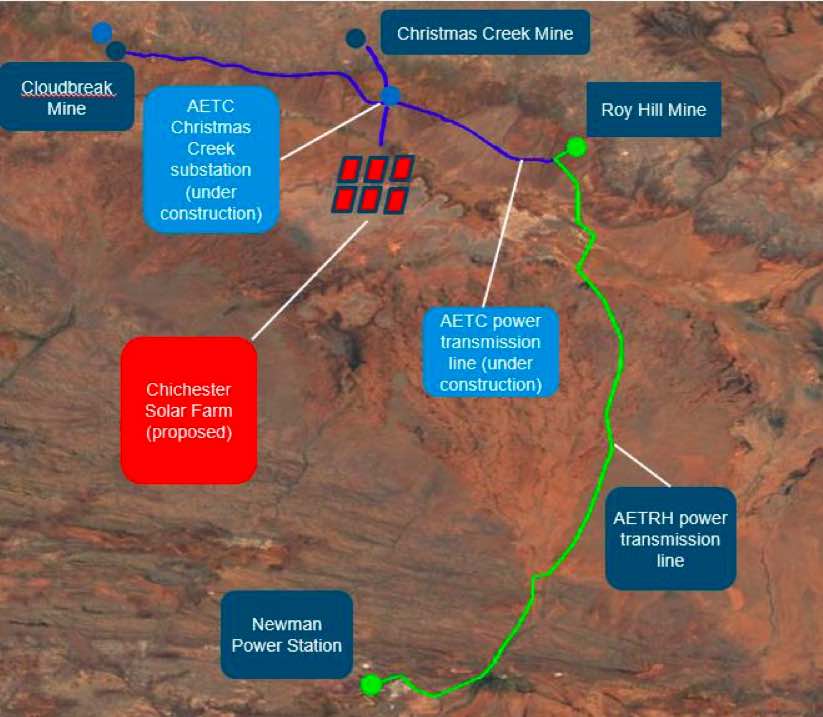
The Chichester solar farm has been up and running at full capacity since late November, and has already demonstrated that it can meet up to 100 per cent of the daytime electricity consumption of the Christmas Creek and Cloudbreak mines operated in the Pilbara by Fortescue.
The Chichester solar farm is located at the end of a 60km extension to the network operated by Alinta Energy that also includes the Newman gas station and the highly successful Newman big battery, and also provides electricity to the iron ore operations owned by Gina Rinehart.
Plans for the Chichester solar farm were first revealed by RenewEconomy back in 2018, and Alinta Energy managing director and CEO Jeff Dimery says the opening is a giant leap forward in the race to a low carbon energy future.
“We took an ambitious brief from Fortescue, who wanted to dramatically slash their emissions, and made it a reality in just three years,” Dimery said in a statement.
“I can’t understate the engineering challenge of designing and building a renewable solution on this scale, in a harsh environment like the Pilbara, to meet the reliability standards of mines like these.”
The solar farm will displace around 100 million litres of diesel every year currently used at the two mine sites, which even with the tax rebates enjoyed by big miners like Fortescue, probably amount to an annual fuel saving of the construction cost of the solar farm. So it will deliver a rapid payback, and it will cut emissions.
“The completion of this project is a practical example of Fortescue delivering on its ambitious carbon neutrality target and demonstrates that renewables can power the energy needs of Australia’s mining and resources sector,” Fortescue CEO Elizabeth Gaines said.
It will be followed by other solar farms and battery storage as part of a broader plans by Fortescue to decarbonise its electricity supply, and Alinta is also looking at a possible 300MW wind farm in the region to diversify the clean energy supply, as Dimery revealed in a recent episode of the Energy Insiders podcast.
The solar project – and some of the future Fortescue plans – have been backed by the Northern Australia Infrastructure Facility as well as ARENA, as part of its Advancing Renewables Program.
“This is a monumental step forward to see solar and battery storage help to displace diesel on mining sites,” ARENA CEO Darren Miller said.
“Optimising the transition to renewable electricity has been a key priority for ARENA and we are excited to see the Alinta Energy and Fortescue project now successfully using solar energy for the day-to-day operations of the mines.”
The Chichester solar farm sets a number of interest landmarks. Apart from being the biggest solar farm outside of the country’s two main grids (in the eastern states and in W.A.), it also has the highest penetration of solar in a network of this size.
Gary Bryant, Alinta’s head of asset strategy, says the nearby mines regularly run on 100 per cent solar, thanks to its excellent solar resources (4015 hours a year), with the Newman battery able to step in to fill the breach if clouds emerge.
In the broader context of the local network, it has a solar capacity of 60MW in a grid with an average load of 90-100MW, which makes it unique in its influence in a grid of this size, Bryant says.
The solar farm consists of more than 160,000 panels and is located on 120 hectares of land on Nyiyaparli Country, and contract value of $4.7m was awarded to Indigenous owned enterprises, Alinta says.
See also: The solar farm where inverters operate all night, doing voltage control for the grid
See RenewEconomy’s Large Scale Solar Farm Map of Australia
Good, independent journalism takes time and money. But small independent media sites like RenewEconomy have been excluded from the millions of dollars being handed out to big media companies from the social media giants. To enable us to continue to hold governments and big business to account on climate and the renewable energy transition, and to help us highlight the extraordinary developments in technology and projects that are taking place, you can make a voluntary donation here to help ensure we can continue to offer the service free of charge and to as wide an audience as possible. Thank you for your support.
Construction of the "hydroelectric station the size of the Sydney Opera House" has started laying…
Leading solar expert says cost of recycling scheme should be paid by end-users, including solar…
A new report finds that monitoring of methane emissions can be significantly improved, particularly for…
Germany's cabinet approves roadmap to phase out oil, coal and gas across energy, industry, buildings and…
Eastern Australia is not yet in the grip of a terrible 2019-20-like drought but early…
Queensland has ripped up its renewables target and cancelled projects, but it remains a hot…