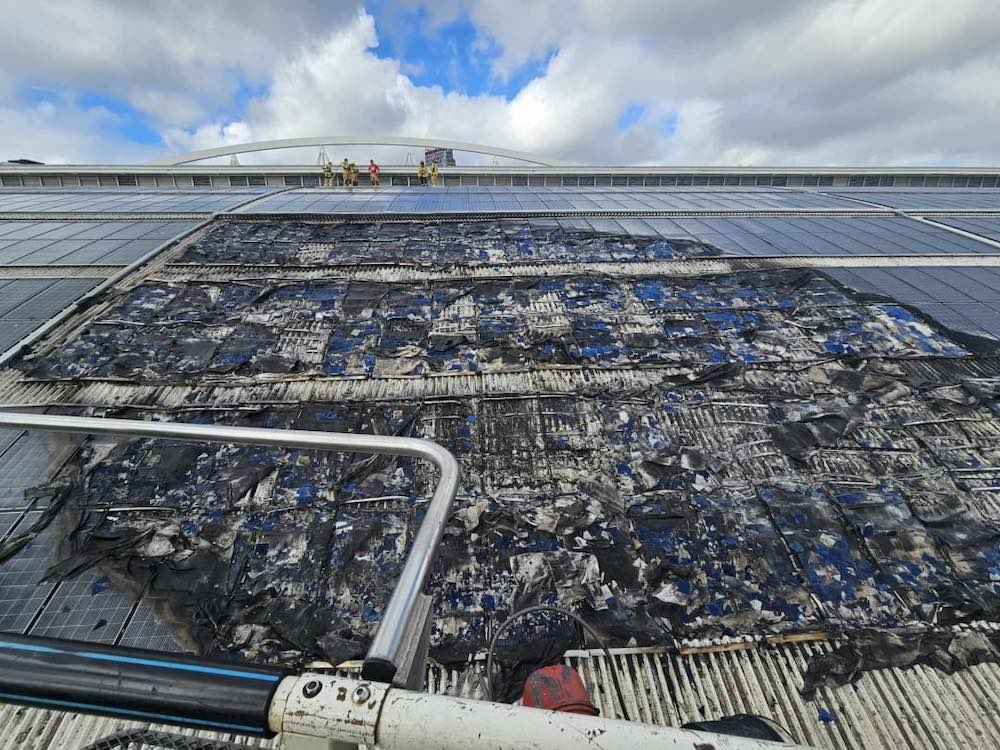
Members of Fire and Rescue NSW at the scene of fire at Sydney Olympic Park Aquatic Centre in Sydney, Monday, May 13, 2024. (AAP Image/Dean Lewins)
Investigations are underway into the cause of a rooftop solar system fire at Sydney Olympic Park Aquatic Centre on Monday that led to the safe evacuation of more than 2,500 people from the facility.
New South Wales Fire and Rescue say that no one was injured by the fire, which broke out at around midday on Monday while a swimming carnival was underway at the centre in Homebush.
“Upon investigation, crews found a working fire in the solar panels on the roof of the sporting facility,” a statement said.
Image: Fire and Rescue NSW
“Firefighters quickly got to work and utilised a ladder platform to attack the flames. The blaze was contained within approximately 45 minutes.”
In a statement on X on Monday, the Sydney Olympic Park Authority said only that the Aquatic Centre would be closed for the remainder of the afternoon “due to an unforeseen issue with a solar panel on the roof causing a fire evacuation.”
An update later on Monday evening said the centre would reopen on Tuesday 14 May at 5am and “all events will proceed as scheduled.”
The rooftop solar system at Sydney Olympic Park’s Aquatic Centre is sized at 1.3 MW – quite big for a rooftop solar system – and was installed in 2021, alongside a 99kW system on the Athletic Centre and a further 81kW on the recycled water treatment plant.
Image source: Green Building Council of Australia
According to the Sydney Olympic Park Authority Annual Report for 2021-22, the addition of the total 1.5MW solar across the three facilities was expected to deliver a minimum projected saving of $300,000 per year in electricity costs and 1,640 tonnes in greenhouse gas emissions.
NSW Fire & Rescue says investigations are underway to determine the cause of the fire.
Meanwhile, the incident has prompted calls for from within the solar industry for Australia to mandate the rapid shutdown of rooftop PV systems to make them safer.
In solar, rapid shutdown is a safety feature that quickly turns off or reduces the current of a rooftop PV system in case of an accident or emergency. It does this to stop an electrical arc from forming that can cause fires or deliver a lethal electric shock.
James Sturch, a technical director at inverter and energy storage giant SolarEdge says Australia lags behind the rest of the world on basic solar system safety measures like these.
“Many countries around the world, such as the United States, Canada, United Kingdom, Poland, Thailand, and others have already successively introduced rapid shutdown regulations to solve the safety issues associated with uncontrollable DC in solar PV systems,” Sturch writes on LinkedIn.
“Currently in Australia there is nothing in place, or even being considered within the Standards process, or by safety or electrical regulators, which is as backwards as it sounds.”
More to come.
New funding will help establish manufacturing facilities for two automated technologies – robots that install…
Updated: New firming tender to favour gas-fired power plants to help deal with long periods…
Head of market rule maker says data centres may become "first load that is interruptible"…
Two new big battery energy storage systems under development in two states have taken important…
Middle Arm, a large gas and petrochemical hub earmarked for the NT and which green…
A protest last week brought together a mishmash of causes but its core was opposition…