Victorian households could soon see a modest reduction in the costs of poles and wires in their electricity bills, even as the revenue approved for recovery by the state’s five distribution network companies continues to rise – in some cases by 50 per cent.
The Australian Energy Regulator (AER) on Thursday published final revenue decisions for distribution network service providers (DNSPs) AusNet, Jemena, CitiPower, Powercor, and United Energy for the 2026-31 regulatory period.
The decisions include a combined $119 million across the networks to support initiatives for grid resilience during and after extreme weather events, and more than $112 million in new investment to improve network reliability.
AER board member Lynne Gallagher says the AER has sought to “strike a balance” between keeping electricity costs affordable for consumers and making sure networks have the capital and operating expenditure needed to support the “complex transition” currently underway on the grid.
For all of the DNSPs, this has meant a jump in five-year revenue of between $500 million and $1.7 billion, with Powercor – the regional DNSP jointly owned by Cheung Kong Infrastructure & Power Assets (51%) and Spark Infrastructure (49%) – chalking up a jump in recoverable revenue of nearly 50 per cent.
But the AER says that even with the hikes in revenue, high level estimates indicate a likely average annual decrease of between $6 and $38 in the distribution component of Victorian residential electricity customers’ bills across 2026-31.
“This is because, even with the increase in approved revenue, forecast higher demand would result in the increases being shared among more customers, leading to lower bills than in the current period,” the regulator said on Thursday.
“Whether bills continue to fall in the later years of the regulatory period will depend on whether the increases in demand are realised.”
The AER says the business of managing the increasingly two-way flow of electricity on the distribution network is becoming more costly, as it factors in consumer energy resources (CER), major new loads like data centres, and the increasing incidence of severe weather events.
“In response to this shifting landscape, networks proposed significant increases in revenue for the 2026-31 regulatory period, to support investment in new capacity and replace ageing assets,” it says.
“The underlying costs of running the network, and market factors such as rising inflation and interest rates have also driven higher revenues for networks in today’s decisions compared to the current regulatory period.”
For AusNet, final decisions allows it to recover $4.7 billion, $193.2 million (3.9%) less than the network’s revised proposal, but $317.4 million (7.2%) more than the AER’s draft decision – and $1.1 billion (or 32.2%) more than was approved for the current 2021–26 period.
Jemena has been approved for an $2 billion, $26.4 million (1.3%) less than Jemena’s revised proposal, but $615.9 million (15.8%) more than the AER’s draft decision and $620 million (or 44.9%) higher than the revenue approved for 2021-26.
CitiPower will be allowed to recover $2 billion, $4.1 million (0.2%) more than CitiPower’s revised proposal $4.1 million (0.2%) more than CitiPower’s revised proposal and $515.8 million (or 33.9%) higher than the revenue approved for 2021–26.
Powercor can recover $5.3 billion, $22 million (0.4%) more than its revised proposal and $1.7 billion (or 49.4%) higher more than in 2021–26.
United Energy has been approved to recover $2.9 billion over the five-year period, $8.9 million (0.3%) more than its revised proposal and $776.4 million (or 36.3%) higher than its 2021–26 revenue.
“We have carefully considered all submissions and feedback from stakeholders and reviewed the proposed expenditure to ensure that it is clearly justified, timely and efficient,” Gallagher said.
“Following our assessment, we have either accepted, rejected or in some cases, identified other solutions to address consumers’ concerns and deliver the outcomes they were seeking at a lower cost.”
The AER’s confidence that overall electricity demand will rise in Victoria – and therefore spread the network costs over a broader range of customers – is based on projections that an increasing number of the state’s households and businesses will quit gas and electrify their homes and vehicles over the coming five-year period.
Already, it says, electricity usage in the state is on the up and up, with the Australian Energy Market Operator (AEMO) reporting an all-time operational demand record of 10,736 megawatts in Victoria on January 27 of this year.
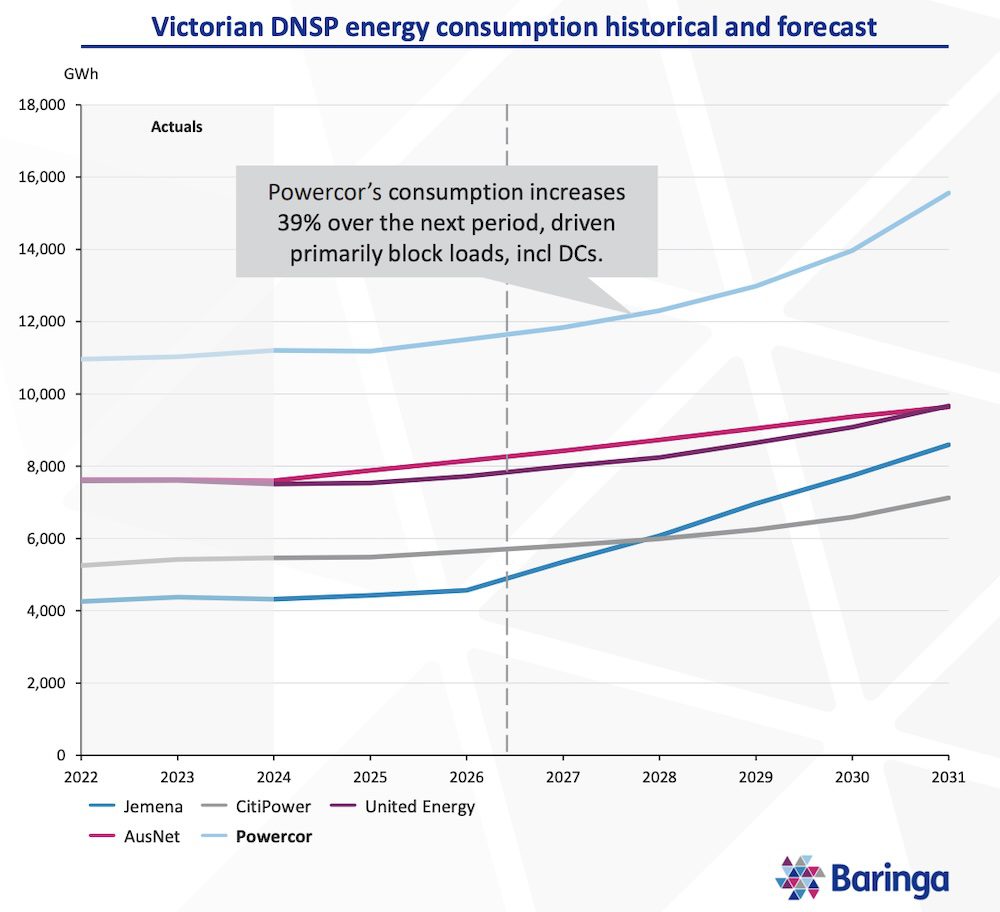
Powercor, for example, expects total annual consumption on its grid to go from 11,204 gigawatt-hours in 2024 to more than 15,562 GWh by 2031, representing a 39 per cent increase which it expects will be mostly driven by growth in data centres (see table below, from Baringa’s assessment of Powercor’s regulatory proposal).
If the albeit modest bill reductions being forecast by the AER for Victoria do come to pass, then they gel with the state regulator’s recent advice that wholesale electricity prices for residential customers could fall by around $50 for households and $170 for small businesses in the 2026-27 financial year.
The Essential Services Commission (ESC) in March published a draft decision on the 2026-27 Default Victorian Offer (VDO), proposing prices for domestic customers will decrease across the board by between $43 and $48 a year, compared to 2025-26, averaging out at $46, or a roughly 3 per cent drop.
Annual prices for small businesses on the VDO would decrease across the five distribution zones by between $165 and $179, compared to 2025-26, averaging out at a $172 decrease on last year (5%), the ESC said.
In February, state energy minister Lily D’Ambrosio said the state’s record investment in renewables had helped the achieve the lowest wholesale power prices in the country.
“Over the last year, Victoria’s average wholesale price was $78 per megawatt-hour, compared to $103 for New South Wales, $96 for Tasmania, $87 for South Australia and $85 for Queensland,” she said.
“Victoria’s draft default offer is going down,” D’Ambrosio added on Thursday in an emailed statement to Renew Economy.
“We know the cost of living is still tough for many Victorians. Only Labor will invest in the energy infrastructure needed to lower bills and crack down on big energy retailers taking advantage of Victorian families.”
If you would like to join more than 29,000 others and get the latest clean energy news delivered straight to your inbox, for free, please click here to subscribe to our free daily newsletter.
The Australian arm of a French energy giant is seeking federal environmental approval to build…
Rooftop solar uptake has ridden the wave of Cheaper Home Batteries, but new data shows…
A Taiwanese offshore wind farm has experienced its second turbine blade failure in two months.
Australia's first offshore wind auction will adopt features of the UK's successful program, including longer…
Federal energy minister concedes controversy over Marinus Link project at a ceremonial sod-turning ceremony that…
First Nations group behind several giga-scale renewables projects launches DA for its latest huge wind…