One of the tunnel-boring machines operating at Snowy 2. Source:
What an alarming headline: “Too big to fail? Snowy 2.0 critics predict fresh cost blowouts, while others say it’s far too late to turn back.”
The latest price estimate of $42 billion from Ted Woodley and Bruce Mountain, originally reported in The Australian, is absurd.
It starts by quoting a $20 billion construction cost, without apparent foundation. A much better approach is to await the official figure, which is due to be released later this year.
The calculations then add in much of the cost of major new transmission projects: Humelink, VNI West, Western Renewables Link, and Sydney Ring South. Never mind that solar farms, wind farms, battery farms, and fossil fuel generators all use new transmission at much higher power than Snowy 2.0, but do not add it to their capital cost.
They then add in another $10 billion for finance and other items at some high interest rate that has naught to do with what the federal government pays.
There is plenty of debate about the cost of Snowy 2.0 and new transmission. Some of it has claimed that Snowy 2.0 can’t deliver on its advertised potential. In effect, it argued, experienced Snowy Hydro engineers got water flows wrong.
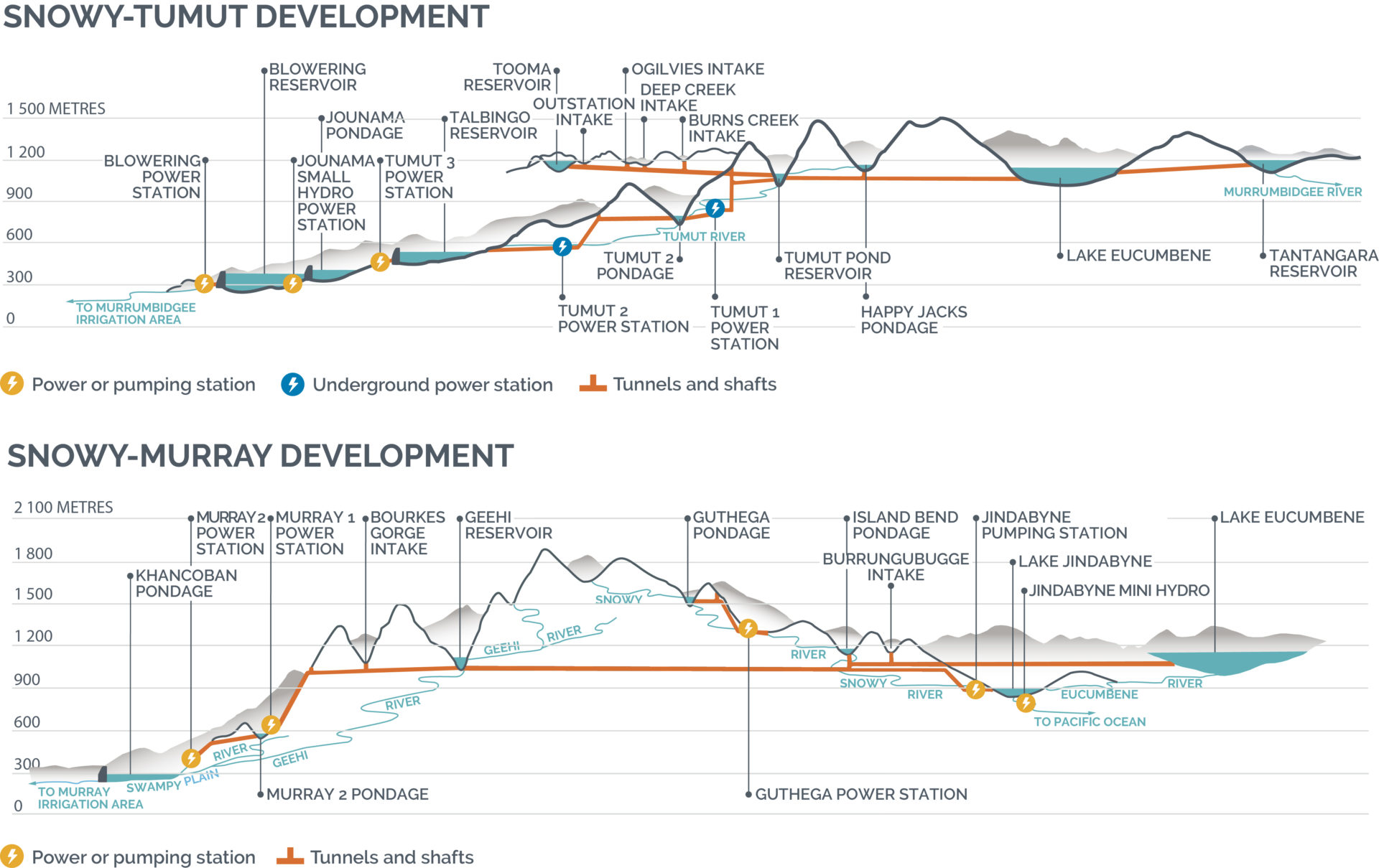
However, this overlooks that Tantangara, Talbingo, Eucumbene and Jounama reservoirs have enormous water capacity, and are interconnected through rivers, tunnels, turbines and pumps with each other and also with the rest of Snowy 1.0 including the Tumut, Murrumbidgee, Eucumbene, Snowy and Geehi rivers and dams, as shown in this classic schematic.
From 2029, Snowy 2.0 will provide about 80 per cent of Australia’s grid electricity storage (350 gigawatt-hours) for one cent per person per day. It has a 150-year lifetime, which is seven times longer than batteries, and a capital cost that is half the AEMO-GenCost estimate for an equivalent battery in the year 2055.
Batteries, hydro and pumped hydro will soon flatten the evening peak. However, we are headed for a strongly solar-dominated electricity system. The average “solar panel night-time” is 16 hours long, and a wet and windless week is 160 hours long.
Pumped hydro like Snowy 2.0 can operate in both night-time and long duration storage markets, plus provide ancillary services.
For example, Snowy 2.0 can generate for 10 hours on most nights using 7 per cent of its water to produce 22 gigawatt-hours (GWh) per night. It can pump whenever it is sunny or windy.
On a high-price wet and windless day or week it can use its 350 GWh storage to earn ~$10 million per day. Thus, Snowy 2.0 could generate 8,000 GWh per year, which is only slightly below annual NEM gas generation.
Compared with batteries, pumped hydro has high local content and long lifetime, and uses much less water, land and mining.
Pumped hydro and batteries are much better together than either alone. Together they can eliminate backup gas.
Plans for a massive wind farm with 92 turbines and an up to eight-hour battery…
Spanish energy giant snags two major transmission contracts at opposite ends of Australia – one…
UK developer and local council sign community benefit deals for two projects stuck in limbo…
A record amount of large-scale renewable generation has reached financial close, the federal government says,…
China's Envision lines up its first wind and battery deal at a new energy park…
Final all-clear for huge wind and battery project comes just in the nick of time,…