Image: Jinko Solar
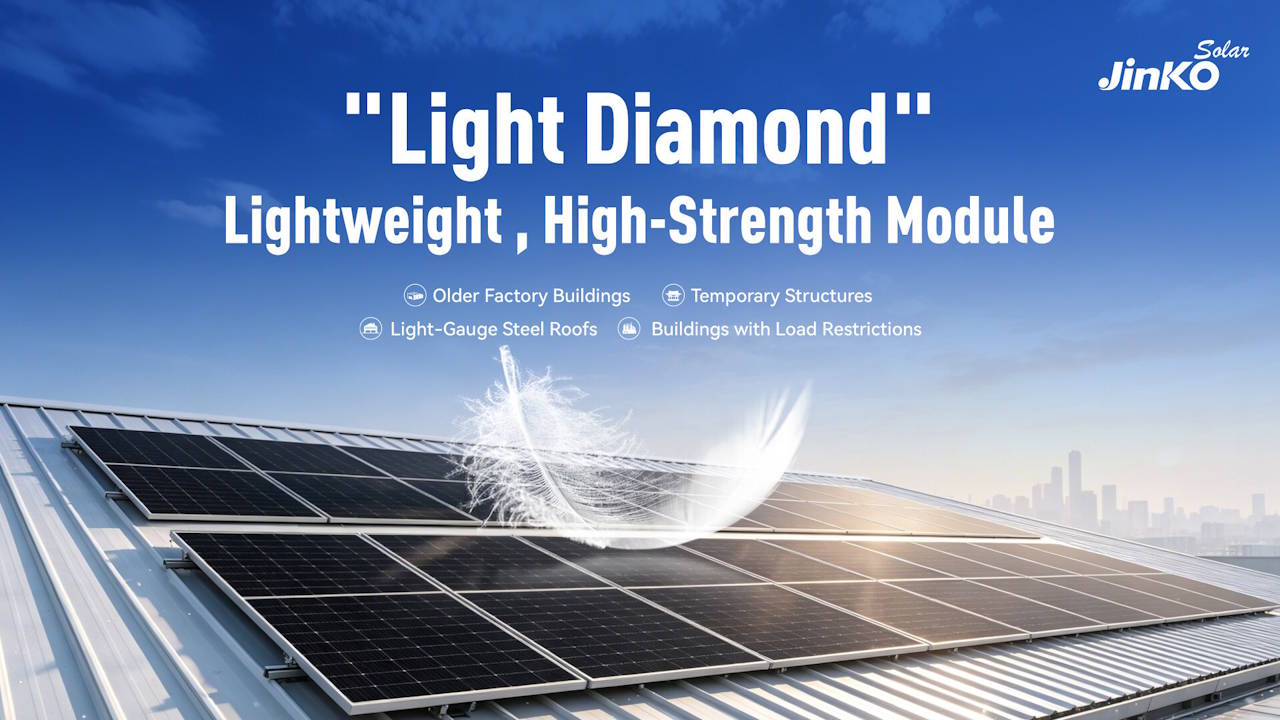
Chinese solar manufacturing heavyweight JinkoSolar over the weekend unveiled a new lightweight solar module designed specifically for low-load bearing roofs, while still delivering a maximum module efficiency of just under 25 per cent.
The new JinkoSolar “Light Diamond” solar modules weigh in at a measly 16.2 kilograms, and measure 1,980mm by 1,134mm by 30mm, boasting a weight density of 7 kg/m², equivalent to a 40 per cent weight reduction compared with conventional double-glass modules, which can weigh in at 12.2 kg/m².
Lightweight glass measuring in at 1.6mm reduces weight while maintaining light transmittance. Conversely, the module frame boasts a reinforced channel design with increased thickness, enhancing overall mechanical strength.
The total weight of a 1 megawatt (MW) project, therefore, would work out to only 28.6 tonnes, down approximately 20 tonnes to conventional back-contact double-glass modules.
“This means that a large number of roofs that previously required reinforcement or were unsuitable for installation can now be directly fitted with solar panels without any structural modifications,” JinkoSolar boasted.
Image: JinkoSolar
JinkoSolar also uses a reinforced adhesive film during the encapsulation process to significantly improve sealing performance, resistance to humidity and heat, and resistance to microcracking.
The maximum front-side load capacity is an impressive 3,600 Pa – equivalent to withstanding 3.6 metres of snow accumulation. The module is also capable of withstanding impacts from 25mm hailstones without damage. On the backside, maximum load capacity is 2,400 Pa, equivalent to withstanding Category 12 winds.
Each module offers maximum power output of 560 W and a maximum module efficiency of 24.94 per cent. The temperature coefficient is -0.26%/°C, and JinkoSolar claims that first-year degradation does not exceed 1 per cent, with annual degradation of only 0.35 per cent.
These numbers compare favourably with traditional flexible or back-contact composite modules, which often trade off performance for weight, only reaching maximum power output of 450 to 460 W.
Further optimising system costs, the higher power output means fewer modules are required, reducing overall balance of system (BoS) costs by between 3 to 5 per cent.
JinkoSolar is also backing the new solar module with a 30-year power warranty, between 12 to 15 years longer than comparable flexible or composite modules.
Bruce Hardy from the Energy Futures Foundation on the fast track to electric transport, and…
A strong state target for renewables sends the message that WA is a stable market.…
Online rating tool that ranks renewable energy developers and transmission companies against seven key criteria,…
Polling by Squadron Energy finds higher support than expected in western Victoria and central NSW,…
Contracting for huge pumped hydro project has reportedly been suspended by the state treasurer and…
Even now, with $12 billion sunk, stopping Snowy 2.0 may be the least-worst decision. It…