Image: Flotation Energy
The federal government has launched consultation on Australia’s sixth and final offshore wind energy development zone, an area off the coast of Bunbury in south-western Western Australia that could host up to 20GW of projects.
Federal energy minister Chris Bowen on Tuesday called for feedback on the proposed Bunbury zone, which is 7,674 square kilometres and at least 20km from shore at its closest point off Cape Naturaliste and Bunbury and 36km from Busselton (see map below).
Bowen says the newly proposed zone is an ideal location for offshore wind due to the high speed winds in the Indian Ocean, as well as its proximity to large energy users on Australia’s west coast.
He said offshore wind could be crucial to meeting the state’s goal of building up to 50 GW of new wind and solar to support the electrification of transport and industry in coming decades.
“We know that the South West Grid is predicted to need 50 gigawatts more electricity between now and the early 2040s,” he told journalists in Bunbury.
“And we know that this part of Western Australia, this industrial powerhouse, will need more clean, green energy as investors and consumers demand decarbonisation. And we want to see more jobs created here in Bunbury, here in this part of the world.
“Western Australia has been setting new records in recent days for electricity use. It’s going to need more electricity in the future.”
Consultations on a Bunbury offshore wind zone had been loosely scheduled to open in November of last year, following the October launch of consultations on the proposed zone in the Bass Strait off the north coast of Tasmania.
Bowen’s plan had been to have all six proposed offshore wind zones in Australia “declared” by the middle of 2024, but so far just two have reached that milestone – Gippsland off the south-east coast of Victoria and Hunter off the coast of New South Wales. Successful applicants for feasibility licences for the Gippsland zone are expected to be announced later this month.
Meanwhile, the energy minister is still wading through submissions on the proposed Illawarra zone in NSW and the Southern Ocean Zone, both of which have been met with varying degrees of community and industry opposition – see here, and here, respectively.
But as the federal government itself notes, there’s a long way to go before any offshore wind projects gain approval to be built in Australia.
“We are at the very beginning of a multi-year process. More studies and consultation will happen before offshore wind projects can be given the green light.”
He said the projects in W.A. would be located between 20 and 35km offshore. “On most days you won’t see those wind turbines,” he said.
“And on a clear day many people will struggle to see these turbines from the coast with the zone we have put out. On a less clear day you won’t see them at all.”
Bowen says the government’s focus is to balance the need to get moving on offshore wind, as a “critical” ingredient for Australia’s future energy security, while also ensuring the needs and concerns of affected communities are being met.
“Offshore wind will be a critical new clean energy industry for Western Australians as electricity demand increases, helping to provide thousands of jobs along the way,” the minister said on Tuesday.
“The Albanese government is committed to genuine consultation on offshore wind – that’s why we want communities, industry and businesses to have their say on an offshore wind area off WA from the very beginning.”
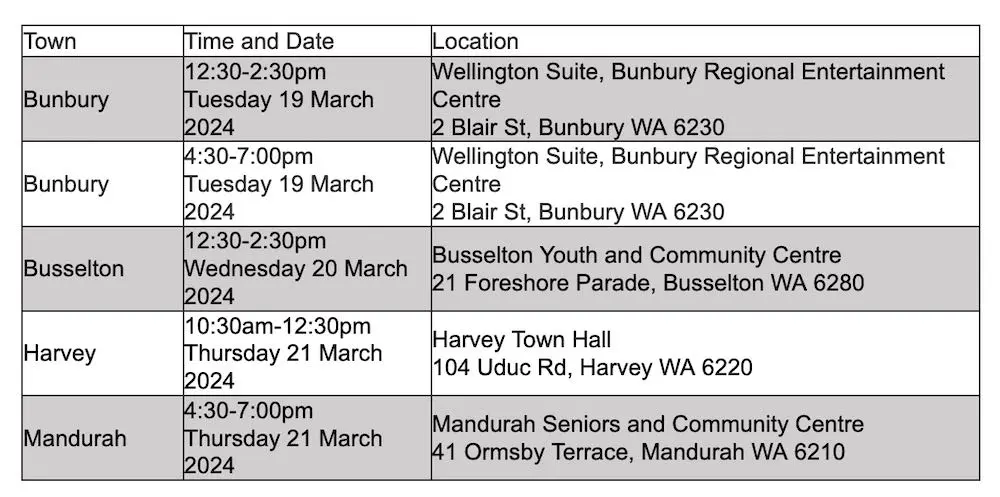
Submissions on the proposed area can be made from Tuesday February 20 until May 03, 2024, with community information sessions held from 19 to 21 March 2024 for community members to ask questions and provide feedback on the zone.
“We encourage everyone to put in a submission and attend a community consultation session,” Bowen said.
From industry, the feedback is already coming in. Flotation Energy, which is proposing the 1.5GW Sea Lion project for the Bunbury zone, says it is “an extremely valuable wind resource … and a zone that can be deployed quickly to replace existing coal and gas generation and accelerate the energy transition.”
“Western Australia is in the enviable position of having the potential to lead the development of the offshore wind supply chain in Australia through its ports and manufacturing capabilities,” said Flotation Energy Australia executive director Carolyn Sanders.
“An offshore wind industry in Western Australia can significantly support energy intensive industries close to the desired points of connection, including hydrogen production facilities, lithium hydroxide plants, green steel manufacturing and seawater desalination plants.
“It is close to significant port and fabrication facilities, servicing the defence, marine, oil and gas and resource industries.”
The Australian Manufacturing Workers Union, meanwhile, has used the launch of consultation on the Bunbury zone to call for stronger local content provisions to ensure offshore wind will deliver the promised jobs and economic benefits.
“Workers rightly expect announcements around renewable projects also to deliver good local jobs and a thriving industry,” said AMWU national secretary Steve Murphy.
“But currently, no provisions exist in this project to ensure that Australian produced steel or Australian manufactured goods are included in any projects which proceed in the Bunbury offshore wind zone.
“The reality is, we are in a global race for the jobs of the future, and Australia is standing still.
“The federal government’s lack of a credible industry policy will result in more and more inferior wind towers dumped on Australian projects from overseas,” Murphy said.
For more information on the proposed Bunbury offshore wind area public consultation, visit https://consult.dcceew.gov.au/oei-bunbury
Listen to RenewEconomy’s Podcast special: How to make offshore wind work in Australia
Middle of the day wholesale electricity prices are rising, and prices in the evening peak…
UNSW groups set new perovskite efficiency record but the real secret sauce is a new…
Envision Australia’s Peter Cowling talks their plans and the state of the energy transition.
Australia can now boast of record amounts of wind farm construction starts this year, but…
Andrew Forrest-owned Squadron wants to build a massive wind farm in western Victoria and connect…
A sunny Spring has delivered two new output records for rooftop solar in two Australian…