Photo credit: Corio Generation.
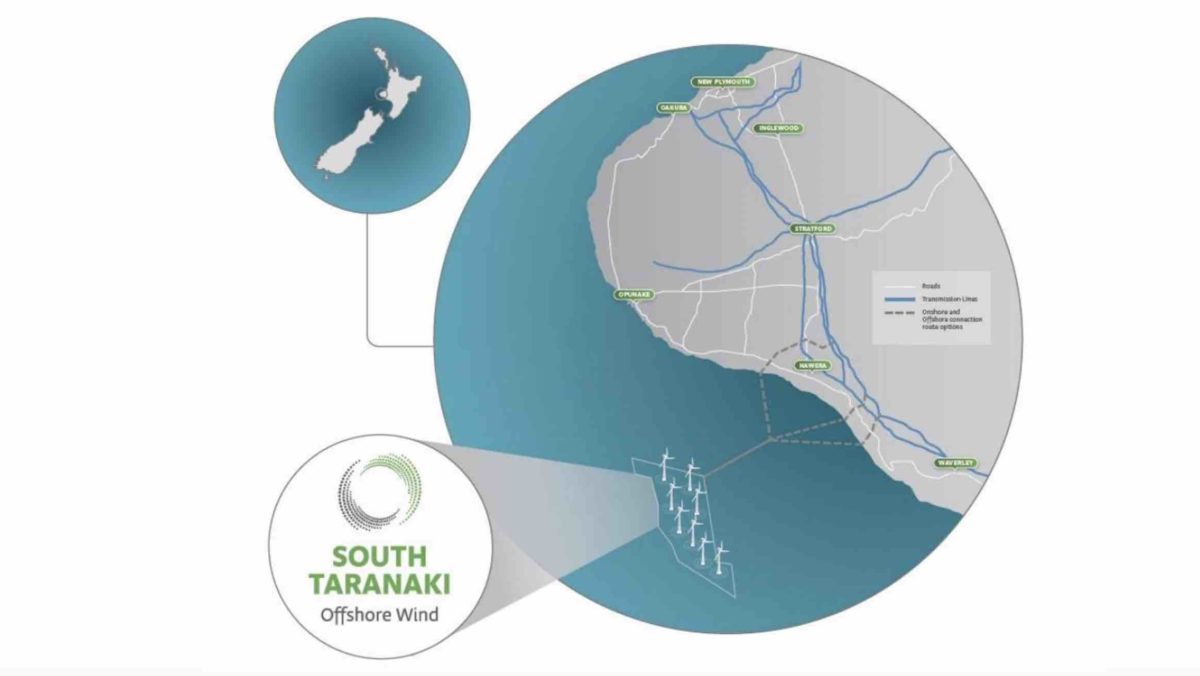
Spanish renewable developer BlueFloat Energy and its consortium partners Energy Estate and Elemental Group have unveiled plans to build a 900MW offshore wind project off the coast of South Taranaki, on New Zealand’s North Island.
BlueFloat Energy formed a joint venture with Australia’s Energy Estate and NZ’s Elemental Group in late 2021 with a goal of harnessing the “world class” offshore wind resources New Zealand has to offer. They have a goal to building up to 5GW of offshore wind capacity.
The South Taranaki wind farm will be built about 22kms off the coast, to the west of Beach Energy’s Kupe oil and gas platform. It will be a fixed-bottom wind farm, rather than floating technology.
“Offshore Wind will be an important part of the future energy mix in Aotearoa and will help the country meet its net zero targets,” said Justine Gilliland, partnerships director for the joint venture.
“South Taranaki is an obvious choice as it has a best-in-class wind resource and a skilled local workforce with decades of experience working offshore.
The planned site for the wind farm sits in a location with a relatively flat sea floor with a water depth of less than 50 metres. The site is located beyond the 12-mile nautical zone and outside the boundaries of the West Coast North Island Marine Mammal Sanctuary as well as the sensitive ecosystem of the Patea Reef.
The developers expect the project to create an estimated 600 jobs during construction, operations, and maintenance, as well as further job opportunities through the creation of a larger supply chain.
The consortium also released 3D visual simulations that realistically creates impressions of how the turbines will look from ten points along the coastline during the day and night.
“We want to be upfront and show coastal communities and users of the sea what our projects will look like,” said Simon Currie, the co-founder of Energy Estate, which has also teamed up with BlueFloat for a series of offshore wind projects in Australia.
“The process to create the 3D simulation involves the use of panoramic photographs (taken by a local photographer) from a number of locations, trigonometry, data points and digital technology.
As wind generation proposals get stuck in EPBC limbo, plans for what could be the…
The last of 30 additional turbines have been added to existing wind farm, making it…
Sydney based early-stage climate technology investor reaches $10 million under management and secures first close…
Strata manager Ash Sayers explains why getting the right advice early can turn apartment electrification…
Much more work needs to be done to create consumer protections and change tariffs to…
The Electricity Services Entry Mechanism (ESEM) is the most significant structural reform to the NEM…