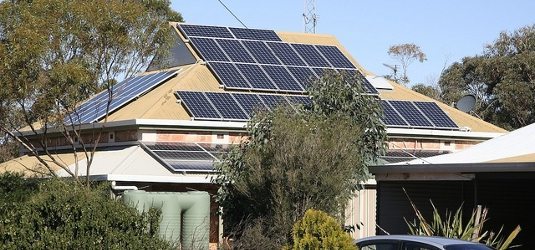
With Australia in the grips of what appears to be a second rooftop solar boom, a new report has suggested that bigger is better for homes and businesses when it comes to investing in a PV system, even for small energy users – and even if all the power generated is sent back to the grid.
The report, by the Alternative Technology Association (ATA), says that current market indicators, including falling technology costs and rising feed-in tariffs, mean that the economics now favour larger rooftop solar systems – 5kW and above – for almost all types of households in almost all locations.
“Traditionally the ATA has advised people to consider (the size of their grid-connected solar systems) carefully based on their electricity consumption,” says the report, which is authored by ATA analyst Andrew Reddaway.
“However, things have changed. Nowadays we generally recommend a big solar system even if electricity consumption is low.”
How have things changed? The chart below helps put this in perspective, showing that while larger systems have halved in price over the past five years, the cost of smaller systems has dropped by just one-quarter.
As the ATA report explains, larger rooftop solar systems have always enjoyed economies of scale compared to smaller systems, because while the installer is on the roof it’s relatively easy for them to
add more panels.
But that price gap has opened up, it says, as the price of solar panels has fallen faster than other components.
Further, it notes, the industry has also become more familiar with large systems, as they are now more frequently installed than small ones.
But why install more panels than you need – even if it’s cheap to do so – when you’re paid such a small amount for the energy you export to the grid?
The answer, according to the report, is that larger solar systems offer both bigger cuts to increasingly expensive grid power consumption, and a better return on energy sent back to the grid – particularly as solar tariffs around the country are being raised in line with soaring power prices.
These cumulative bill savings, in turn, add up to a shorter payback time on the system – i.e. the number of years until bill savings recoup the installation cost.
“We studied these economics by simulating a large number of scenarios in half-hour intervals for a whole year using Sunulator, our free solar feasibility calculator,” the report says.
The research also considered common grid tariffs in each capital city for a variety of household consumption profiles; included panel degradation over time and likely tariff changes; with panels assumed to be north-facing with a 20-degree tilt.
As the first chart, below, shows, for a stay-at-home family using 23kWh per day on average, on a flat tariff, “in no location did a 2kW system pay back quicker than a 5kW one.” The ATA also ran scenarios for 3, 4 and 6kW systems, and found those “to obey the same trend.”
Another study, comparing a range of household types with different load profiles, returned similar results.
In the chart below, “LU” is a large electricity user, “SH” is a stay-at-home family, “WC” is a working couple and “SU” is a small user. The following two digits denote their average daily electricity consumption in kWh.
The report found that for a 5kW solar system, payback time varied from four to eight years depending on the household’s consumption profile.
“Households with higher consumption achieve payback more quickly,“ the report says. “Again, there are no cases in which a 2kW system pays back quicker than a 5kW.”
All in all, the ATA says it found that a 5kW system achieved payback in less than 10 years in all but a few scenarios, with the exceptions being the lowest-consumption households in some Tasmanian locations.
Perhaps most excitingly, the report also suggests that with state and territory feed-in tariffs at, and heading to, new higher levels, a solar system can now be economic even if it exports all its generation to the grid.
“For example, an export-only 5kW system in Melbourne should generate around 7000kWh and earn $790 per year. If the system costs $6400 on the simplest calculation it achieves payback in less than nine years,” the report says.
“Because of this, low-consumption buildings such as holiday houses and storage sheds have become a new market for solar systems.”
But the report also stresses that “to make the best use” of a rooftop solar systems, households and small businesses should use the energy it is generating “while the sun is shining where practical.”
And it suggests that as gas appliances wear out, solar households can install efficient electric appliances instead – a measure that would save even more money, by eliminating the gas connection charge.
On the subject of battery storage, the report notes that batteries are getting cheaper, and could prove cost-effective to store excess solar, for use at night time, in just a couple of years.
“A big solar system will support this,” the ATA says. “Similarly, in the future you may want to charge an electric vehicle from solar power too.”
This article was originally published on RenewEconomy’s sister site, One Step Off The Grid, which focuses on customer experience with distributed generation. To sign up to One Step’s free weekly newsletter, please click here.
"Wild claims" that fire fighters will not attend fires on properties hosting new transmission lines…
Meeting our 82% renewables by 2030 target will take every lever available. Lifting the performance…
Can or should data centres be sent into orbit? It might do away with land,…
Australia's biggest DNSP is not happy that Transgrid is maxing out its network capacity, and…
Danish renewables developer will add a two-hour big battery to an existing solar farm after…
Final turbine installed at Australia's biggest wind farm, one of the very few projects that…