Hazelwood big battery. Source: Engie
Battery storage is confirmed as the one strong point of Australia’s green energy transition, as financial commitments to new wind and solar projects hit a new record low in the first half.
The latest data released by the Clean Energy Council highlights what is widely know in the industry – the surge in wind and solar projects has effectively come to a halt, and – while new investment in battery storage is at record levels – the country is falling well behind its renewable energy targets.
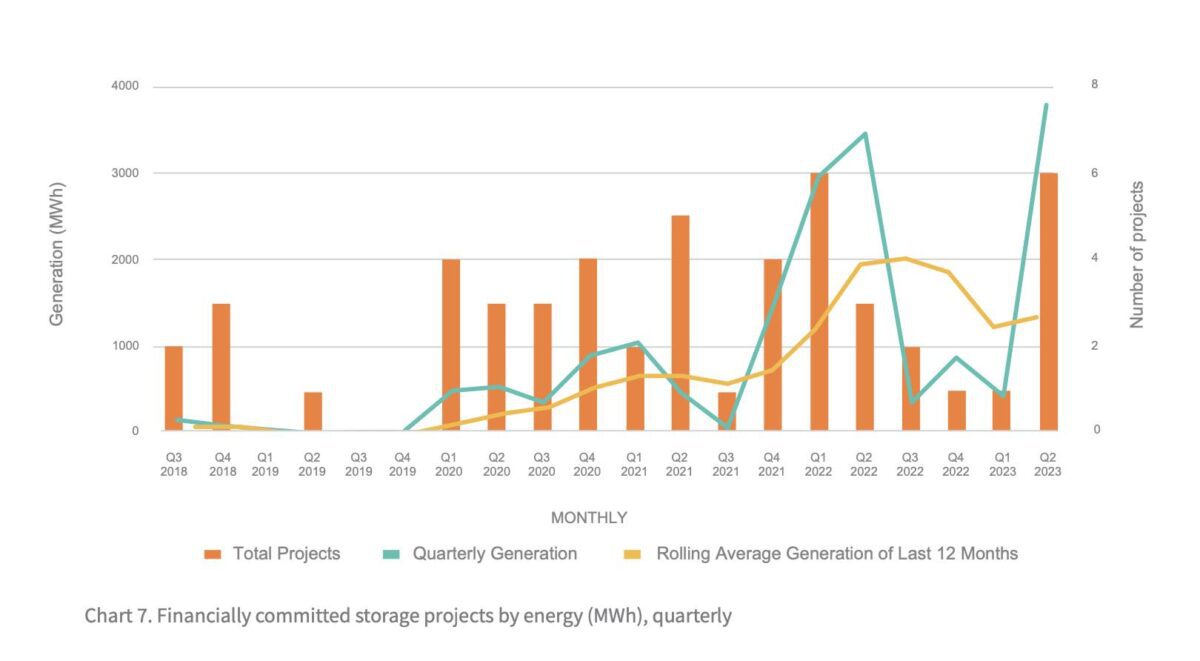
The latest Renewable Projects Quarterly Report shows that investment in new battery storage projects smashed through the billion dollar barrier in the June quarter for the first time, with financial commitments for six projects totalling 3.802 MWh added across Australia.
The big ticket items for battery storage were the new Collie battery (219MW and 876MWh) to be build by Neoen, and battery storage also features prominently in new construction starts (the 1680MWh Waratah Super battery0 and new commissioning (Hazelwood and Kwinana).
There are a heap of other projects under construction and newly commissioned that are not captured in this data due to timings since the end of June, including a new 800MWh battery at Kwinana, the 75MWh battery at Bouldercombe, and the 250MWh battery at Torrens Island, and the 200MWh battery in Canberra.
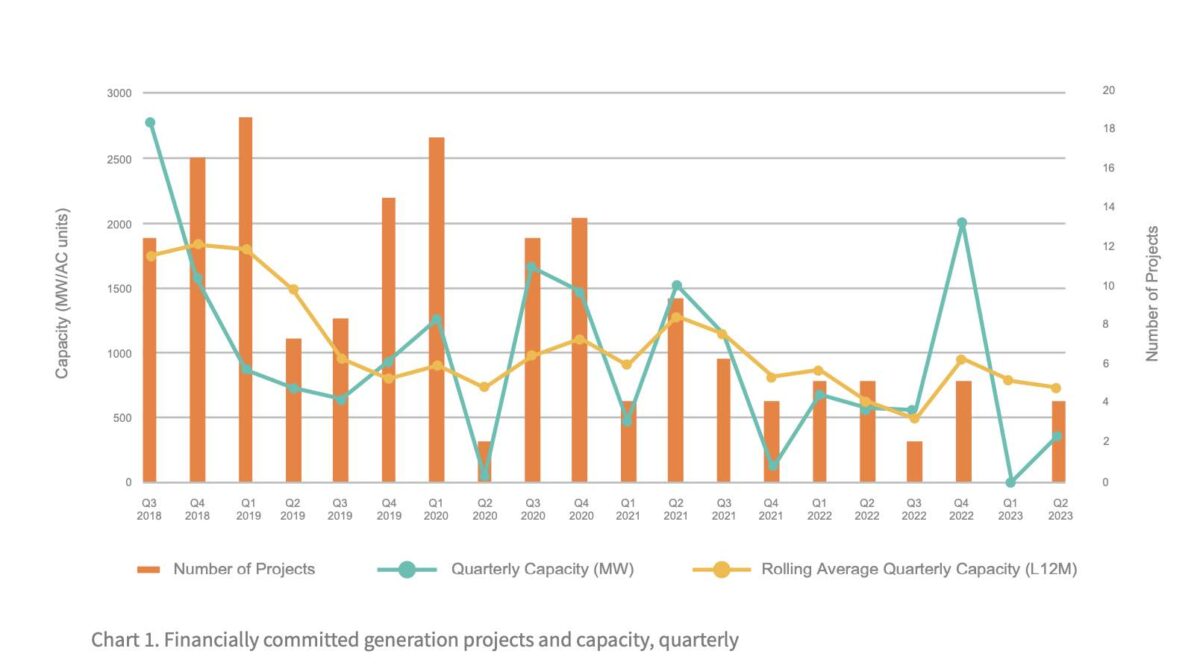
But new financial commitments in generation projects recorded the slowest first half of a year since the CEC began recording data in 2017.
Just four generation projects, totalling 348 MW of generation capacity reached financial commitment. This represented just $225 million of new investment, more than 80 per cent below the more than $1 billion recorded in previous quarters.
It is also well behind the pace needed to reach the country’s 82 per cent renewable energy target, and probably too slow for state based targets such as Victoria’s 95 per cent renewables by 2035 and Queensland’s 80 per cent by the same date.
“While there is now strong political support for the clean energy transition, there remains a raft of barriers as a result of the historic lack of leadership, planning and foresight over the prior decade,” CEC chief executive Kane Thornton said in a statement.
“These …. include under-investment in transmission, grid connection challenges, inconsistent planning policies, constraints in supply chains and workforce as Australia competes with global leaders that are all accelerating their demand for renewable energy.
“There is an enormous pipeline of renewable energy projects in Australia, but investors are swamped with global opportunity at a time where these barriers make Australian projects less attractive.”
The grim statistics underpin the need to accelerate the country’s transition to renewables, but perversely are likely to result in delays to the closure dates of giant coal plants like the 2.88GW Eraring facility in NSW.
Already in the past week, the WA government has decided to keep one coal unit at its Muja coal fired power station open in reserve for another six months, although it has vowed to continue to ramp up renewable investment in response to demands for clean energy by industry and miners.
In Victoria, the Loy Yang A coal fired generator is likely to stay open until 2035 – having locked in secretive state government support – unless the rollout of renewables can somehow accelerate in the face of increasing pushback against new projects led by the Coalition and conservative media.
“Investment levels so far this year are 50 per cent below the rolling 12-month quarterly average of 699 MW and are a long way off the pace necessary for Australia to achieve an 82 per cent renewable energy share by 2030,” the CEC says.
ITK modelling suggests that without VNI West, Victoria will build and consume more gas and,…
Democrats have achieved mid-term success beyond their wildest hopes of a few months ago. But…
Australia is negotiating a deal to import carbon dioxide from Singapore and store it offshore. We…
A union fight for $3.3 million in support packages for workers caught up in a…
An ammonia-powered dry bulk vessel has successfully been supplied with certified green ammonia from a…
Consultancy under fire for providing advice to both the government and the fossil gas industry…