A mock-up of EnergyAustralia's Wooreen BESS in Victoria. Source: EnergyAustralia
Australia has notched up a “remarkable run” on big battery investment in the first quarter of 2025, with six projects worth $2.4 billion and a combined 1,510 megawatts (MW) of capacity and more than 5 gigawatt-hours of storage duration reaching financial close in just three months.
New quarterly data from the Clean Energy Council (CEC) details a flying start to what promises to be a big year for firming, as investment dollars flow to both stand-alone battery energy storage systems (BESS) and to hybrid projects with batteries included alongside big wind and solar.
“This is the second-best quarterly result on record in terms of energy output,” the report says, and the “best annual start for new storage projects on record,” and all with the uncertainty of a federal election thrown into the mix.
“It’s great to see the high levels of investment we’ve seen over the past couple of years continue,” said CEC chief policy and impact officer, Arron Wood, on Thursday.
“Wind and solar combined with energy storage is the lowest-cost form of electricity generation and by installing more battery storage projects across the country, Australians can get the biggest benefits from renewable energy through cheaper, cleaner, more reliable power.”
The battery funding rush builds on momentum from 2024, with the CEC’s latest annual stocktake of Australia’s clean energy progress revealing a massive 500 per cent uptick in financial commitments to large-scale renewable generation from $1.5 billion in 2023 to approximately $9 billion in 2024.
The CEC says this is the highest single year of new financial commitments to large-scale generation since the boom of 2018 ($8.4 billion), but when investment in utility scale storage is included, it gives 2024 the title of largest wave of clean energy investment in Australia’s history.
CEC chief Kane Thornton says the bigger spend on renewables reflects improving economic conditions after multiple years of inflation-affected costs and materials, but it also reflects the improving policy landscape.
On this front, Thornton gives a nod to federal Labor’s expanded Capacity Investment Scheme (CIS), which announced 19 winners of its first round of tenders in late 2024.
“It is too early to say the scheme is fully delivering, but the early signs are very positive,” Thornton says in a message at the top of the report. “Investment needs certainty, and we are seeing more of that.”
And while the 2 GW total of new large-scale renewable energy generation capacity added to the grid in 2024 is well below the 6 GW/year rate required to replace Australia’s coal by 2030, Thornton says the increase in projects reaching financial close “is cause for optimism that this level of development is achievable.”
As things stand, the CEC Clean Energy Australia report for 2024 counts a total of 59 large-scale generation projects, with a combined capacity of roughly 9.9 gigawatts (GW), under construction at the end of 2024 – up from 56 (7.5 GW) at the same point in 2023.
Thirty-nine of those projects were large-scale solar farms (up from 38 in 2023), 18 were wind farms (up from 13 in 2023) and the remaining two were biomass projects.
Thirty-eight large-scale batteries were under construction at the end of 2024, up from 27 at the end of 2023, which was up from 19 in 2022. The combined capacity of those 38 projects will be 8.7 GW/23.3 GWh, up from 5 GW/12 GWh in 2023.
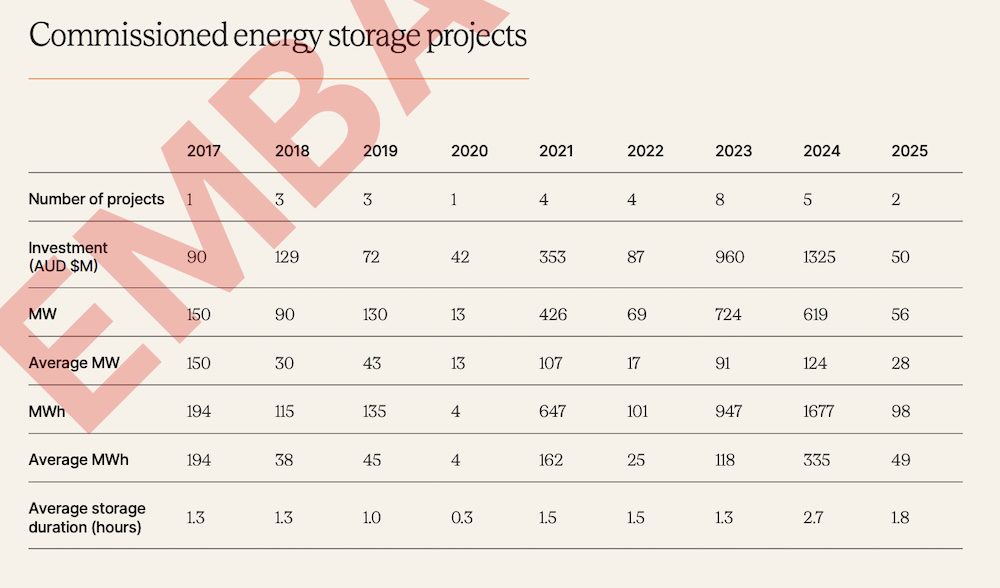
The report says five utility-scale battery storage projects were connected to the grid in 2024, with a combined capacity of 619 MW / 1,677 MWh.
In the final three months of the year, alone, a record-breaking more than 1 GWh worth of battery projects came online in a single quarter for the first time: The Rangebank BESS in Victoria (200 MW/400 MWh) and the Collie Battery, Stage 1 in Western Australia (219 MW/877 MWh).
As for the big batteries making up the big numbers for the first quarter of 2025, these include EnergyAustralia’s 350 MW, four-hour Wooreen Battery Energy Storage System (BESS) in Victoria – a Capacity Investment Scheme winner that was annnouced as shovel ready in February.
Quinbrook Infrastructure Partners, in January, sealed a $722 million debt finance deal for its massive Supernode project in south-east Queensland, with the CEC report including the 270 MW / 1,356 MWh stage two part of the 800 MW / 2000 MWh project in the Q1 tally.
In South Australia, UK developer Pacific Green agreed to sell the 250 megawatt (MW), two-hour Limestone Coast North Energy Park – a recipient of the federal government’s Capacity Investment Scheme – to Intera for $A460 million (US$293 million), while Copenhagen Infrastructure Partners started construction of its 240 MW and 960 MWh Summerfield battery.
Also in SA, the CEC tally counts Amp Energy’s Bungama Battery Energy Storage System (150 MW / 300 MWh), which is a hybrid asset sharing the same grid connection to a solar farm. In New South Wales, Equis Australia’s 250 MW and 500 MWh Calala battery also started construction next to the Tamworth sub station in northern NSW.
Australia's most powerful battery now free to trade its full capacity on market after its…
The site of one of Australia's very first wind farms now shows little evidence of…
The "35 by 35" electrification goal has an Australian origin that the government seems to…
If we fail to ensure data centres pay for new renewables and storage to cover…
Home batteries look like resetting the behaviour of households when it comes to responding to…
South Australia energy minister hints that the 100 pct net renewables target may not be…