Eraring Power Station. (AAP Image/Greenpeace)
In October 2023, a global comparison study by Rystad Energy named Australia’s electricity market the most volatile in the world, with a mix of ageing and unreliable coal generation, costly gas and extreme weather helping to deliver the widest spread of high and low wholesale electricity prices over the course of each day.
This week, Rystad published its latest research on electricity market volatility, based on a comparison of 43 markets across the Americas, Europe, Asia, Australia and New Zealand, and came up with a new, more specific winner of the “unwanted title” – the Australian state of New South Wales.
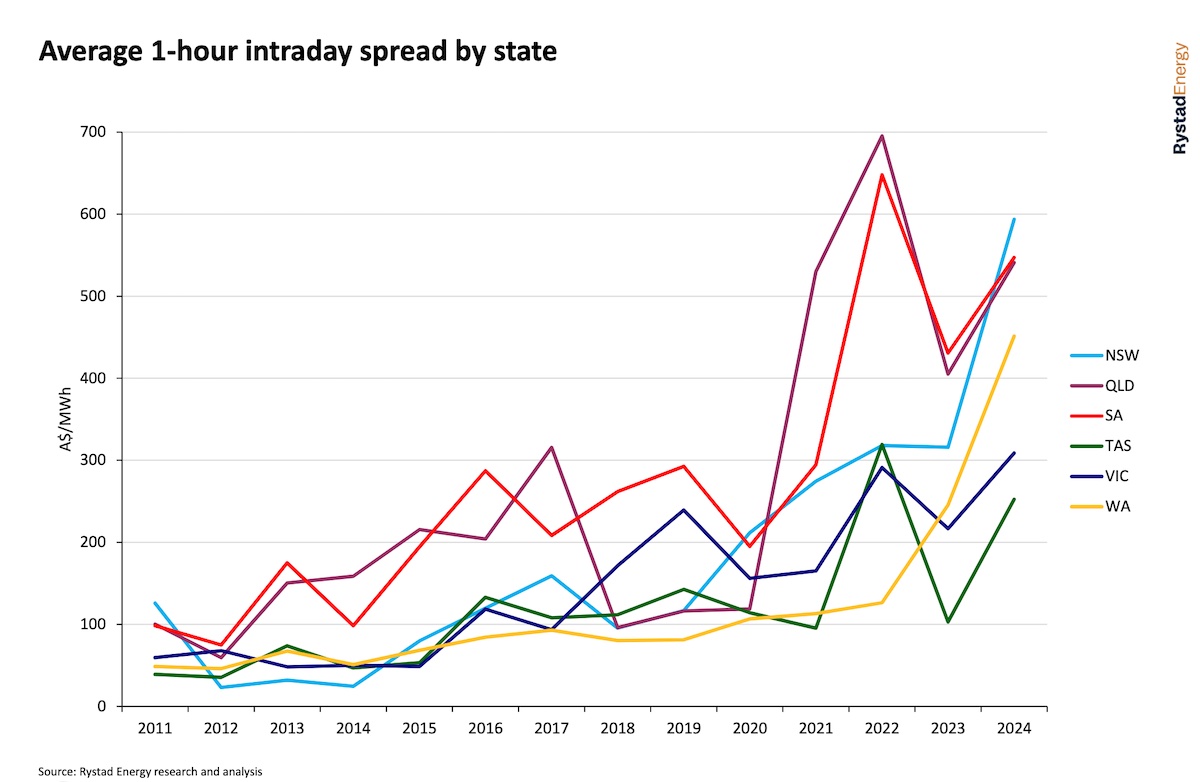
According to David Dixon, a senior analyst in renewables research at Rystad, NSW was found to have the highest volatility of all 43 markets investigated for the calendar year 2024, with an average 1-hour intraday spread of $A594 per megawattt-hour (MWh), or around $US390/MWh.
While the full report is behind a paywall for clients, Dixon lists three key factors driving this volatility: weak interconnections with neighbouring states, thus limiting capacity to draw on supply or demand elsewhere; high exposure to events like natural disasters that can cause large, unplanned grid outages; and the combination of high solar penetration with high fossil fuel prices.
“Australian states, both in the NEM [National Electricity Market] and WEM [Western Australia’s Wholesale Electricity Market] suffer from all these factors and thus see high volatility. Other regions of note, southeast Asia, Japan, southeastern Europe and Texas,” Dixon says on LinkedIn.
“The greater the combination of the following factors the higher the volatility.”
Dixon says it is the combination of high solar penetration leading to consistently low daytime prices and high gas prices leading to consistently high evening peak prices that results in “consistently high volatility.”
In the case of NSW, where “always on” coal power generation still dominates the grid, this is a reminder that coal plants – and particularly end-of-life coal plants – are unsuited to this sort of demand profile, lacking the flexibility to jump in and meet any gaps in demand as they are needed.
It is also a reminder that while gas can provide the necessary flexibility to back up aging coal and variable renewables, it is far from a cheap (or clean) option.
The answer, as Dixon said back in 2023, is more storage, strategic investment in transmission and other energy market reforms that will optimise the use of power generated from solar and wind, shifting it to where it is needed, when it is needed.
Happily, more storage is on the way, with the latest stocktake from the Clean Energy Council showing there are 52 committed storage projects currently in development around Australia, equivalent to 10.5 GW / 26.3 GWh in capacity / energy output.
AGL revealed this week revealed it is targeting final investment decisions for four new big batteries in New South Wales, alone, while Origin is progressing its 700 MW/ 2,800 MWh Eraring battery project in NSW.
And the NSW government on Friday announced its newly created green bank, the Energy Security Corporation, will target investment in battery storage, including community assets, as well as long duration storage solutions like pumped hydro, with an initial $1 billion in funding.
As rooftop solar, home batteries and EV uptake surges, networks seek regulatory change to boost…
Plans for a massive more than 2 gigawatt-hour battery south of Townsville have been given…
CCA chair Matt Kean says regulators will need to be nimble to ensure that households…
With new incentives driving battery uptake, the focus is shifting to size and flexibility -…
Regulator warns industry to brace for changes to Cheaper Home Batteries scheme, to avoid promising…
Innovative solar-in-a-box design by a Melbourne startup could change the economics of farming and remote…