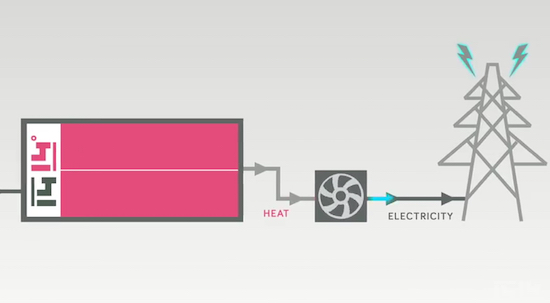
The company said on Monday that it had reached an agreement to install the TESS as part of a research and development project, to provide Pepe’s Ducks with electricity and heat, mostly in the form of steam.
Coupled with a turbine energy reclaim system, 1414 Degrees said its TESS-IND was expected to significantly increase energy efficiency at the poultry processing site, and cut its power bills, while also displacing gas.
As reported here, 1414 Degrees has spent the better part of a decade developing its TESS technology to store electricity as thermal energy by heating and melting containers full of silicon (the silicon is heated to 1414°C) at a cost the company reckons can be up to 10 times cheaper than lithium batteries.
“Silicon is a plentiful product, it’s very cheap, you can store a lot of energy in it,” says 1414 CTO Matthew Johnson in a company explainer video.
“When we need to recover that energy, we cool (the heated silicon) down and we generate power with that – using the same sort of principles as any thermal power station does.
“Battery storage is a chemical storage, we are a thermal storage …. (so) we can supply heat – a vast amount of heat – as well as electricity,” he said.
“The benefit of this heat is that it’s heat that is carbon free and it is generated from energy that is currently wasted.
“The fact that we can recover energy that is currently being spilled, and that we can supply electricity as well as heat gives us a complete energy solution.”
The company recently made the move into a factory on the Tonsely site of the former Mitsubishi engine plant in southern Adelaide, where it set to work building its first 10MWh TESS-IND system and the first 13.3MWh test cell for a 200MWh TESS-GRID system.
Part of its plans are to build two grid scale 1GWh systems in South Australia, comprised of five 200MWh units, to help stabilise the state’s renewable energy rich electricity network.
The securing of the NSW project follows the February news that 1414 was awarded a South Australia government grant towards a collaboration with SA Water, to integrate energy generation from waste with storage.
That device is under construction at the Glenelg Waste Water Treatment Plant, the company says, and set for commissioning next quarter.
1414, which became an unlisted public company in 2016, is also currently in its final stages of preparations to list on the Australian Stock Exchange with an Initial Public Offer.
To date, around $12 million has been invested in the company, and $7.5 million raised from sophisticated private investors. It hopes to raise at least $30 million through the IPO.
“The partnership between 1414 Degrees and Pepe’s Ducks will deliver an Australian-first, big picture energy solution to market,” said Kevin Moriarty, 1414 Degrees’ executive chairman.
“This project clearly underlines the strength of our technology, and its potential to revolutionise the approach of Australian and international industry to energy storage and heat generation.
“Energy storage is moving from a ‘nice-to-have’ to a mandatory requirement in communities across the globe,” Dr Moriarty said.
“2018 is an incredibly important year for us. It not only heralds the installation at SA Water and Pepe’s Ducks of technology we have worked so tirelessly to develop across the past decade, but will also see 1414 Degrees taken to a much broader market, with the backing of Australian and international investors who are champing at the bit to take up shares through our IPO.”
This article was originally published on RenewEconomy’s sister site, One Step Off The Grid, which focuses on customer experience with distributed generation. To sign up to One Step’s free weekly newsletter, please click here.
A landowner-led wind farm is seeking state and federal environmental approvals, but could struggle to…
The biggest wind project to begin construction in Australia this past year faced multiple hurdles.…
As the PM calls for climate "bravery" at a global summit in New York, NSW…
Bowen and AEMO celebrate new renewables record - first time above 80 pct in main…
Victorian Labor says it will adopt the proposed federal Labor mandate and require future data…
Powerful new wind turbine adds longer blades to reduce costs and boost output, and comes…