After a poor winter for wind, the first month of spring has served as a reminder of how important big spinning turbines will be in the future renewable energy mix, particularly in the south of the country.
In fact, the latest data from Rystad Energy shows September was a bumper month for renewables across the board in Australia, with all utility solar and wind assets generating 4,518 GWh – a nearly 20 per cent jump on the 3,819 GWh in September 2023 – and breaking a bunch of records in the process.
Wind, however, was particularly impressive – and particularly in Victoria, where wind farms contributed nearly one-third of the national total for all renewables, at 1,220 GWh. Another 117GWh came from large-scale solar, taking Victoria to top spot on generation with a total of 1,337 GWh.
All up, says Rystad analyst David Dixon, it was a record month for wind generation across the country, totaling 3,363 GWh and “eclipsing the previous record set in June 2023 (3,260 GWh).”
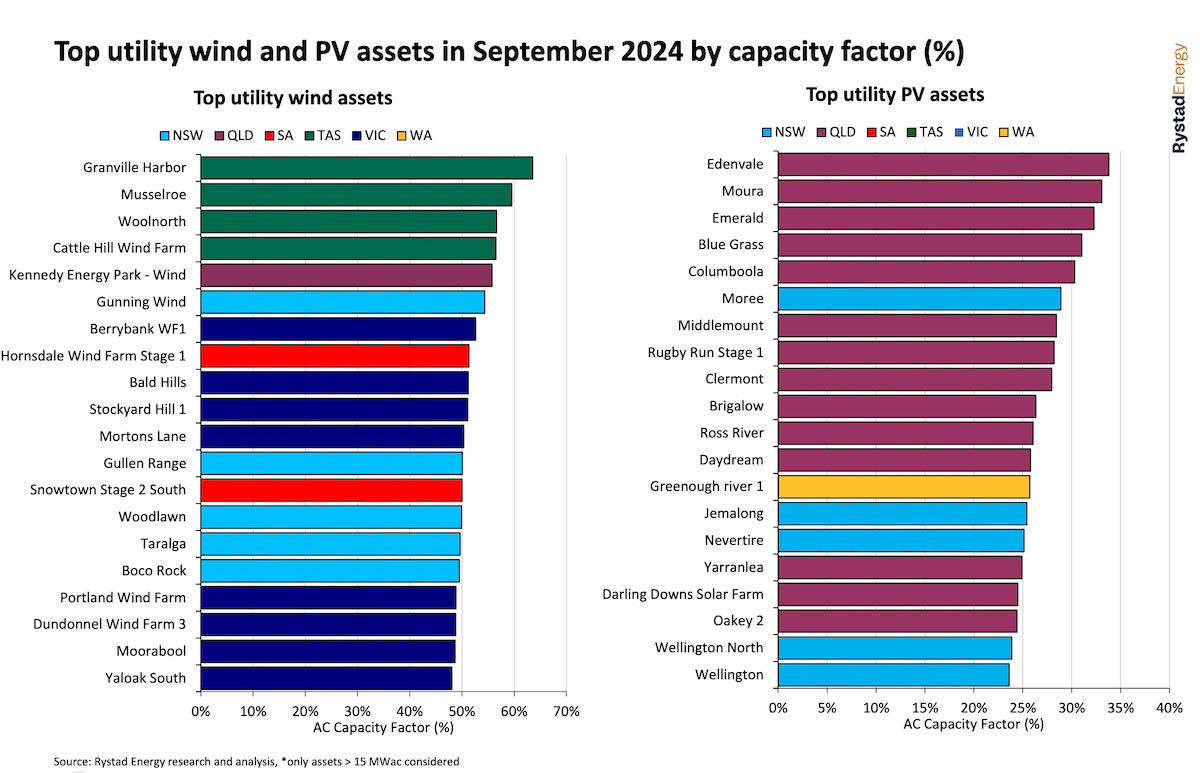
Victoria also had eight wind farms in the top 20 performing wind assets in September, but the top four were all located in its southern neighbour Tasmania:
Granville Harbor wind farm at a capacity factor (CF) of 63.6%, followed by Musselroe (59.5% CF), Woolnorth wind farm (56.6% CF) and Cattle Hill (56.5%).
The wind component of the Kennedy Energy Park rounds out Rystad’s top five best performing wind assets for September – the only wind asset to make the top 20 for Queensland.
Queensland, instead, dominated the rankings for best performing solar assets, with the state hosting 14 of the top 20 for the month. In first place is Edenvale solar farm (33.8% AC CF), followed by Moura (33.1% AC CF) and Emerald (32.3% AC CF).
Solar also helped deliver a couple of records over the month, Dixon notes, including the amount of time the National Electricity Market and WEM spent in negative price territory – which hit a new high of 1375 hours – South Australia the highest at 306.9 hours (~43% of the month).
A record high in the amount of renewable energy capacity energised – more than 4GW of utility solar, wind and battery capacity over a trailing 12-month period – was also achieved for the first time in September, breaking the 4 GW barrier – a trend we need to see more of, says Dixon, if we are to hit the 2030 targets.
Other records noted by Rystad for the month include highest month ever for total charging from batteries/pumped hydro across the NEM and the WEM, at 292 GWh; a new record for construction, with 6.5GW (AC) of utility solar, wind and battery in 2024, eclipsing the previous record (6.47 GWac) set in 2023, despite only being 9 months through the year.
And finally, coal generation in the NEM hit a record low of 8.64 TWh.
The grid is changing rapidly, battery storage durations are getting longer, and chemistries are changing…
Allowing balcony or plug in solar will make it easier to access cheaper, cleaner electricity…
Industry expert Claire Elkin on why Australia is missing out on global capital to fund…
MELBOURNE, Australia, 28 October 2026 — Fox ESS (Fox) showcases Power Beast, G-Max Plus, Power…
Join our experts to explore how expanded rebates could unlock an 80 GW market and…
Australia is home to 163 operational data centres with almost 100 more in the national…