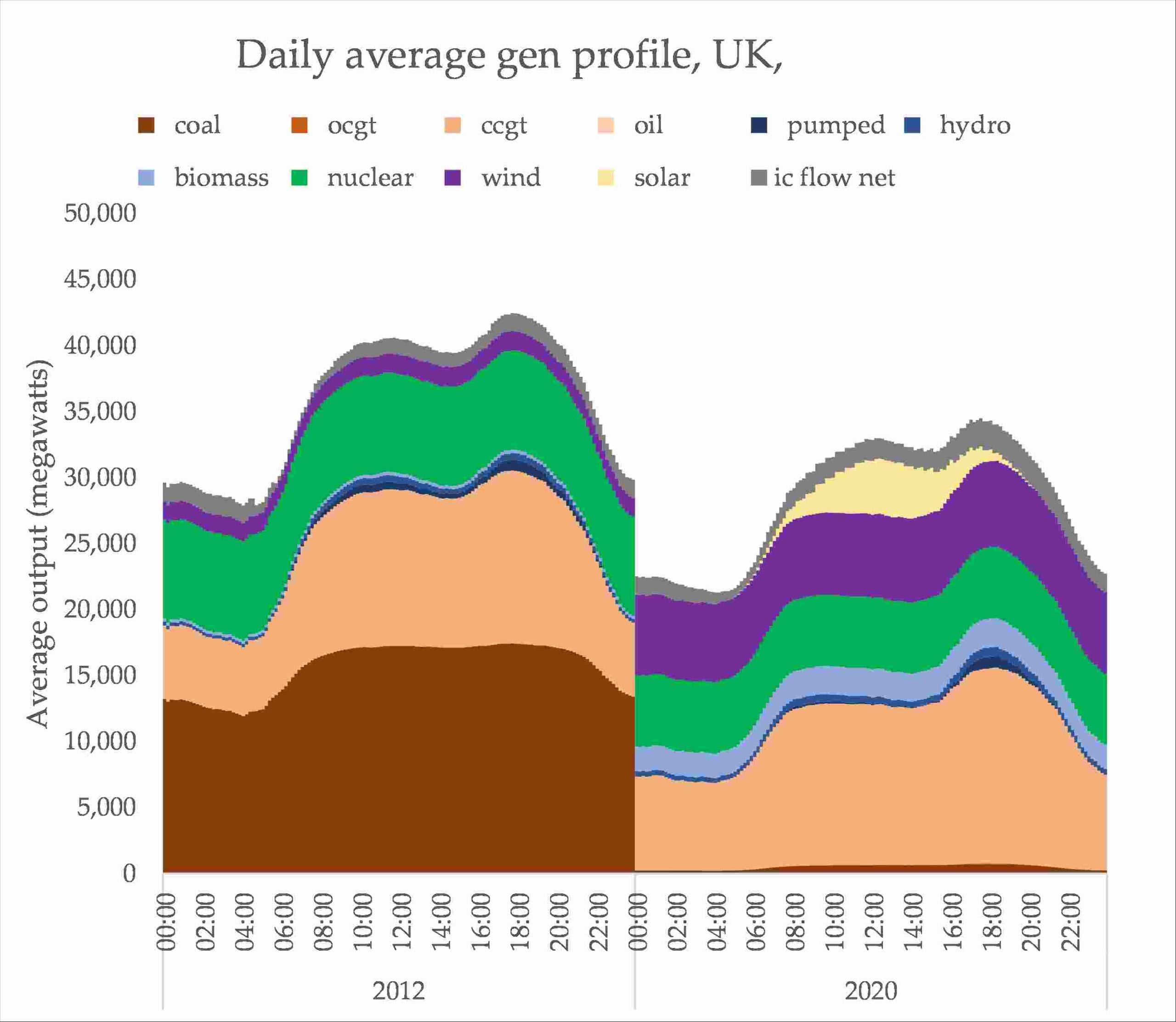
The United Kingdom has become a significant influence on global climate action, but it hasn’t been for nothing. Within the country, and within the power sector specifically, transformations are occurring at a rate far faster than previously predicted. Most recently, this has been driven by the growth of wind and solar, along with the rapid demise of coal-fired power generation. Of course, 2020 was a unique year, as the consequences of COVID19 impacted all energy sectors.
As the year has now wrapped up, and we enter the year in which the UK is set to host a major global climate conference, it’s worth looking back on a few key statistics on the growth of wind and solar in the UK’s grid.
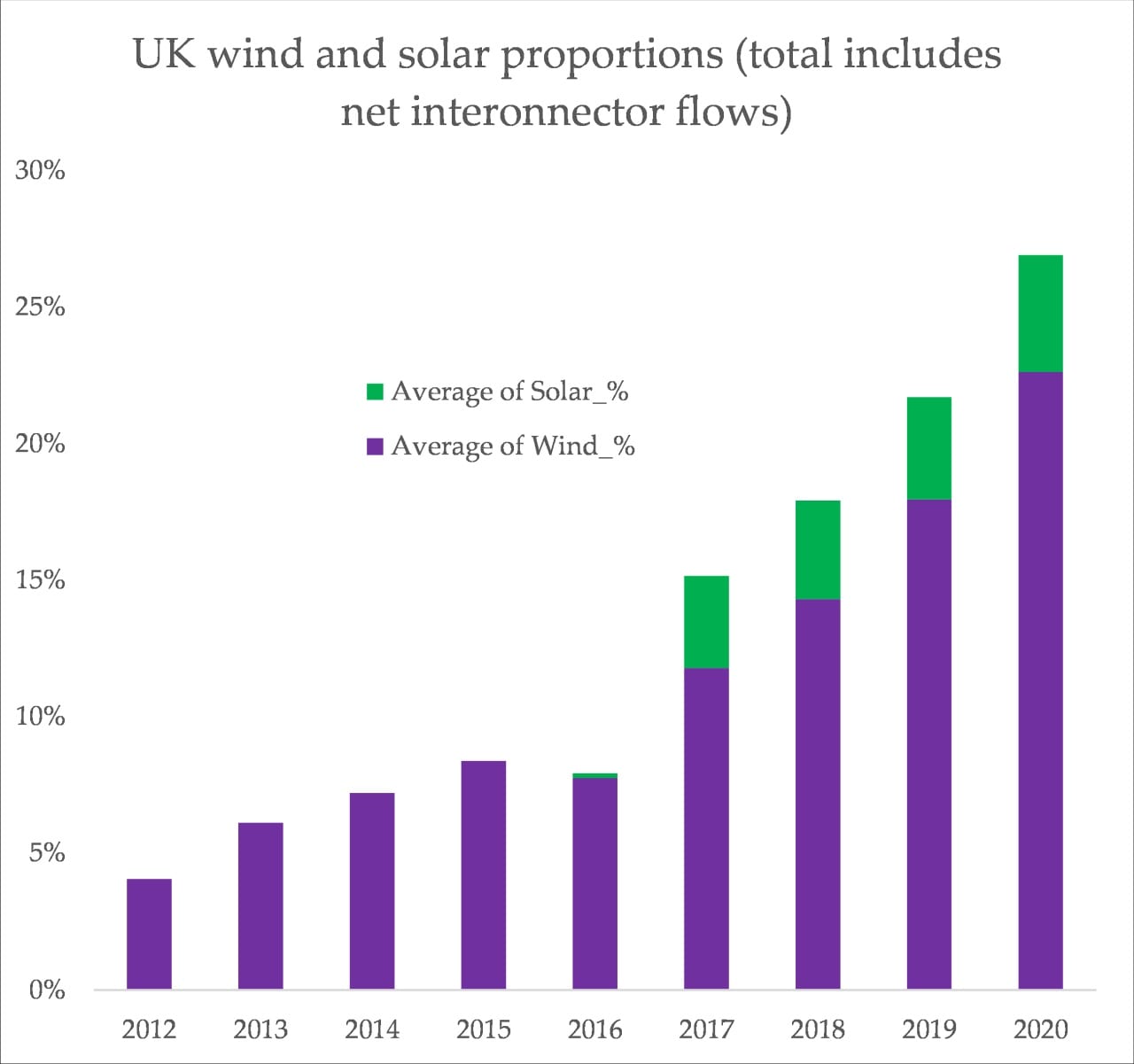
Wind and solar provided 27% of total energy on the UK’s grid in 2020
Using five-minute data from here, it’s clear that both wind and solar have grown significantly over the past decade, but it’s wind power that has performed the bulk of the heavy lifting for the growth of power generation in the UK. In 2020, wind alone provided 23%, and solar an additional 4% of total supply of power on the UK’s grids (including the flow of interconnection from other countries).
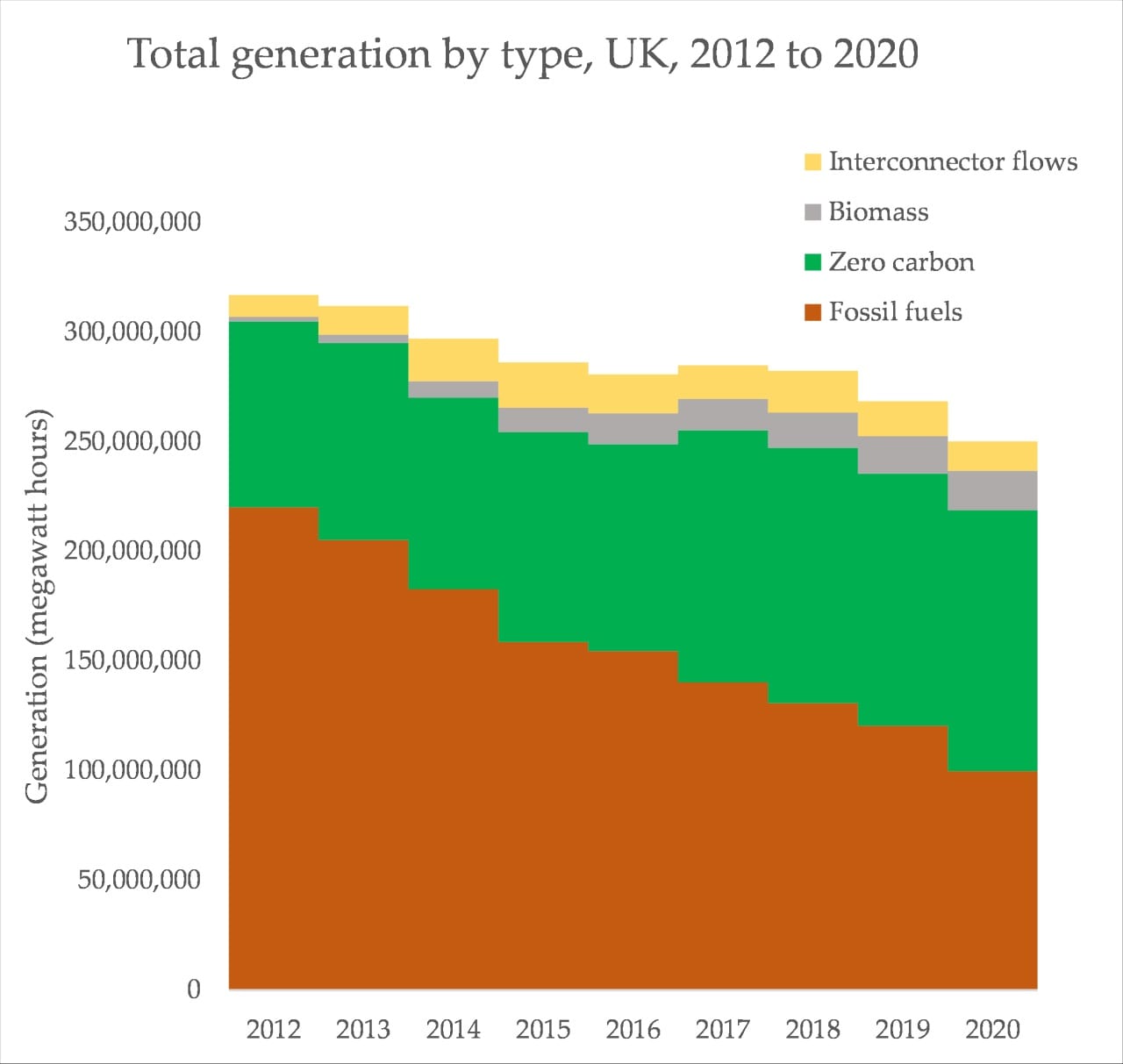
Zero carbon sources now dominate the UK’s power grid
These include nuclear power and hydro in addition to wind and solar, but wind and solar dominate this category, and when you zoom out look a the whole grid, the transformation’s slow but steady momentum is very clear. At the current rate of change, chances are that the grid will be mostly zero carbon somewhere in the mid 2030s.
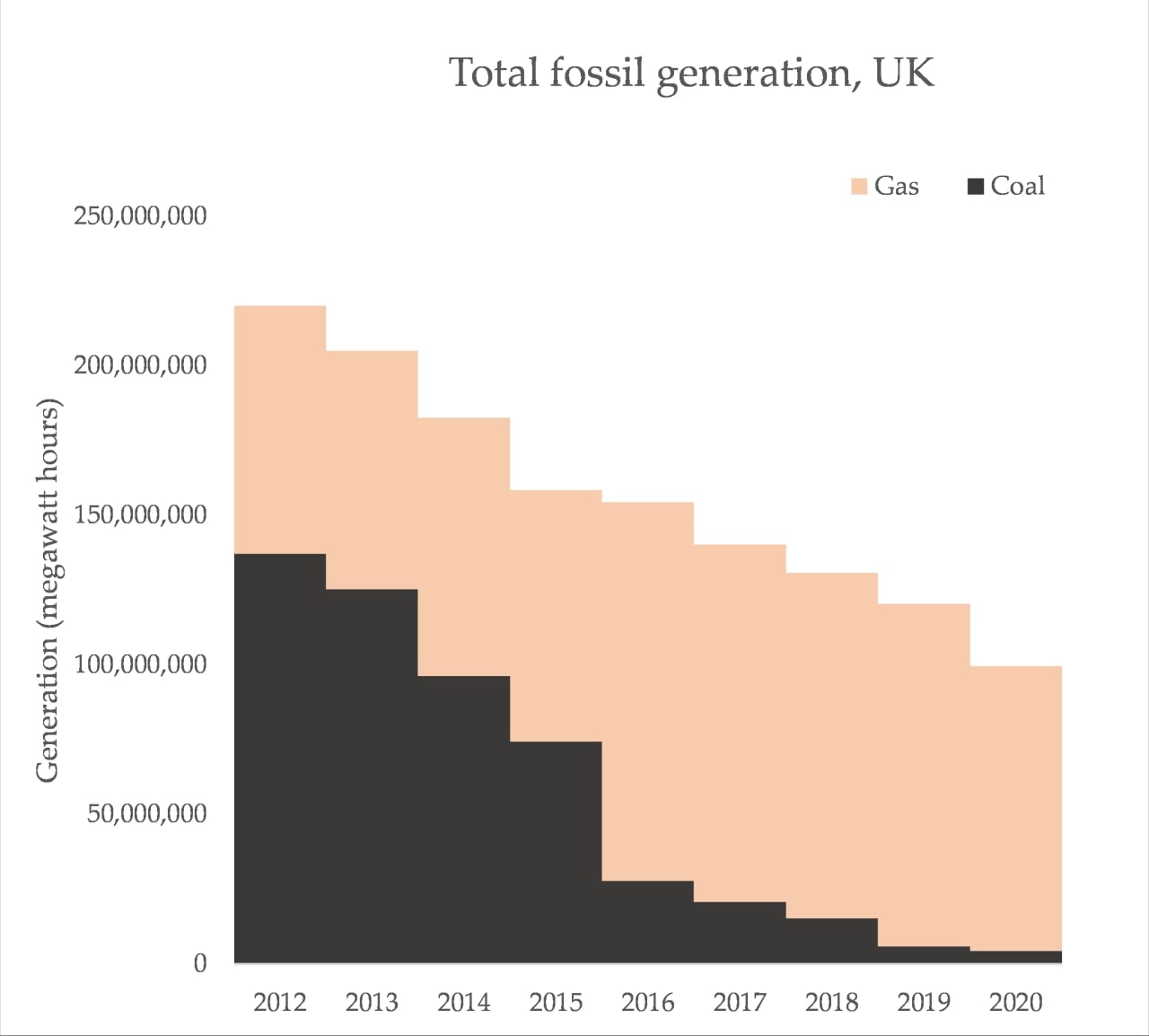
Fossil fuels keep falling, but the pressure’s on gas
As has been widely known, coal’s rapid demise in the UK has been surprising and significant. But now that coal has been nearly wiped off the UK grid, attention now turns to gas-fired power generation, which has cemented a foothold in the grid, and will need to be significantly reduced for the country to hit its climate targets. That’s going to be tougher, because those power stations are more competitive than coal, and somewhat more nimble.
Wind has grown because the turbines are bigger and better
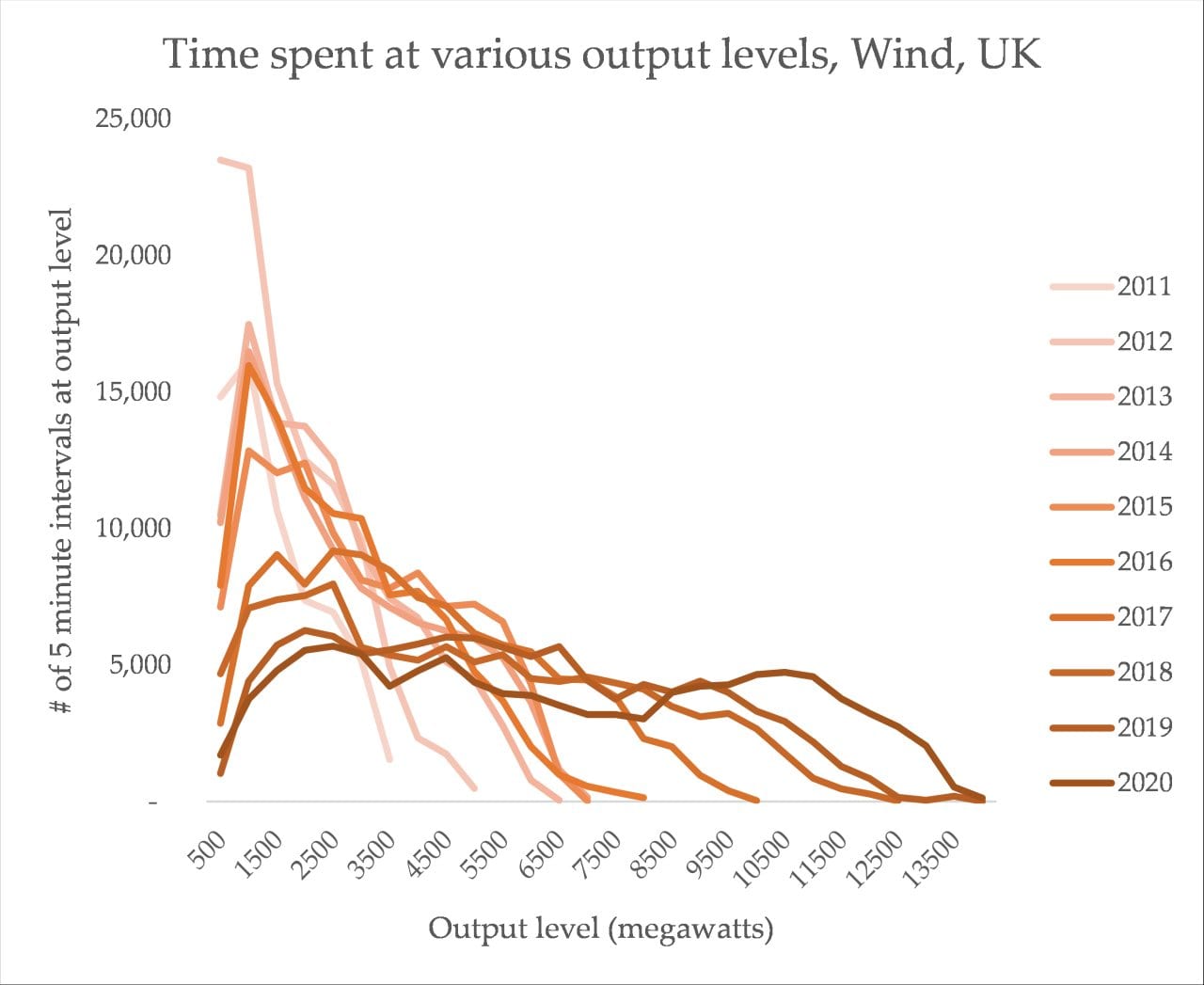
It isn’t just more wind turbines that are being added to the UK’s grid. Newer models tend to be bigger, more efficient and particularly in the UK, offshore. This means they’re capable of capturing more powerful gusts of wind, instead of scrabbling for what they can at lower wind speeds like the older, 2000s era models. That’s important because it means fewer turbines, fewer materials and smaller land and ocean impacts, but of course, also it means much higher quantities of energy.
This can be seen nicely in the chart below, which shows the quantity of time spent at each power level. 2020’s distribution sits more heavily towards the high-output end, whereas the distribution in 2012 saw much more time towards the lower possible levels of output. This signifies not just an expansion, but leaner, more efficient and more powerful new technology.
What happens when the wind don't blow and the sun don't shine? Australia got a…
Australia and Turkey have revealed the global oil crisis will prompt a major focus on…
Federal Labor commits new investment to fund state social housing upgrades like rooftop solar, electric…
Power expert Keith Middleton discusses how the growth in data centres, properly regulated, won't break…
Mine backed by Australia's richest renewables critic secures $1.2 billion in government funds to ensure…
Solar glass pioneer says certification for this completely in-house designed product will give the company…