Willow Springs wind farm, Texas. Credit: Ørsted
New data out of the US has confirmed that large-scale wind and solar are significantly cheaper sources of electricity generation than coal and gas – and even undercut fossil fuels on price with the addition of energy storage, in some cases.
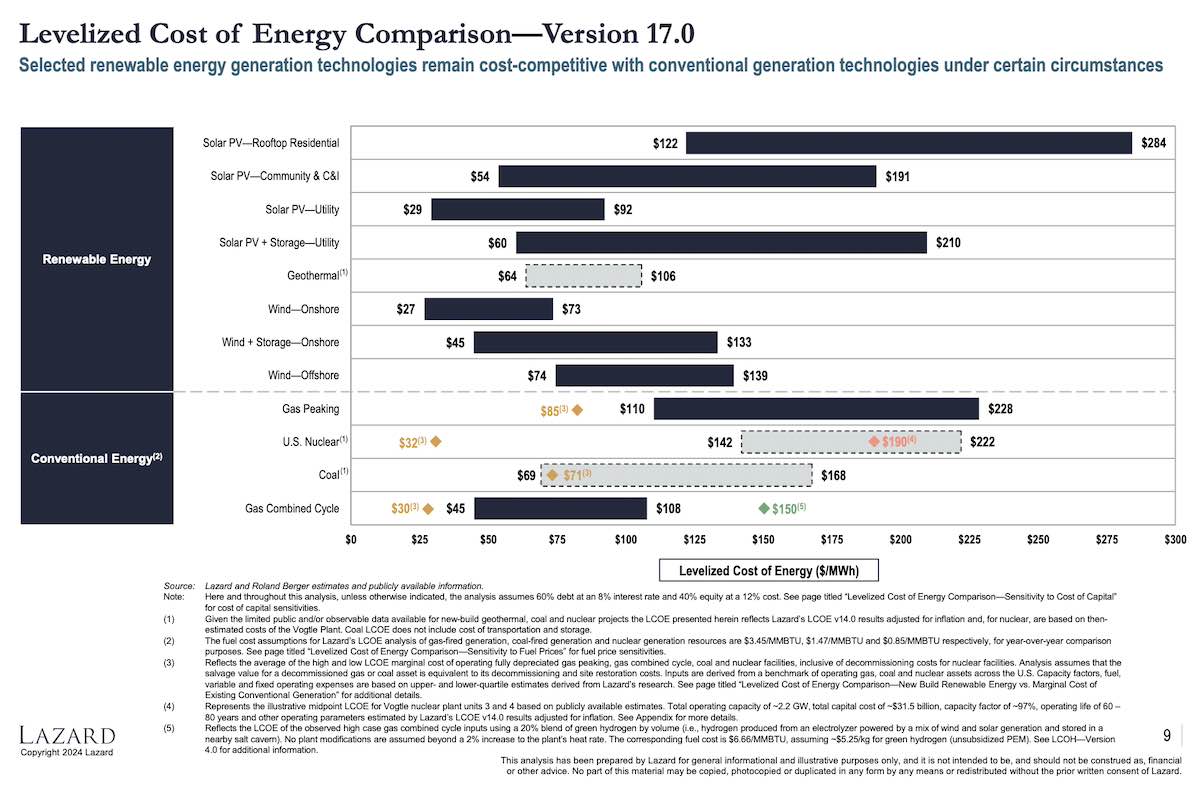
In the 17th edition of its highly regarded Levelised Cost of Energy+ (LCOE+) Analysis, US investment bank Lazard compares the cost of generating electricity from renewable technologies to conventional technologies, across various scenarios and sensitivities.
The Lazard findings are broadly similar to those of the GenCost report prepared by the CSIRO and the Australian Energy Market Operator, which have come under attack from the federal Opposition and nuclear boosters.
But while Lazard looks at the global average, the CSIRO is focused on Australia, which has some of the best wind and solar resources in the world.
In 2024, Lazard finds onshore wind to supply the cheapest form of energy, with an LCOE ranging across the globe between $US27 per megawatt-hour and $US73/MWh, or an average of $US50/MWh, depending on local conditions.
With the added costs of energy storage, the LCOE for wind rises to $US45-$133/MWh, which is still much cheaper than coal ($69-$168/MWh) and competitive with combined cycle gas ($45-$108/MWh).
Utility-scale solar, meanwhile, is valued at more than half the cost of coal, at an LCOE of between $29-$92/MWh, average $61/MWh. Large-scale solar with storage ranges in LCOE from between $60/MWh and $210/MWh.
“Lazard’s 2024 LCOE+ report highlights that, as expected, macro pressures, including high interest rates, have raised the lower end of our LCOE for certain renewables,” the report says.
“Despite this, and given relatively stable year-over-year averages, renewables continue to be cost-competitive with conventional generation, which will lead to the continued displacement of fossil fuels.
“Other key takeaways include the need for diverse generation fleets to meet increasing power demands (driven by AI, data center deployment, etc.) and the impact that innovation can and must continue to have on the future of our energy sector.”
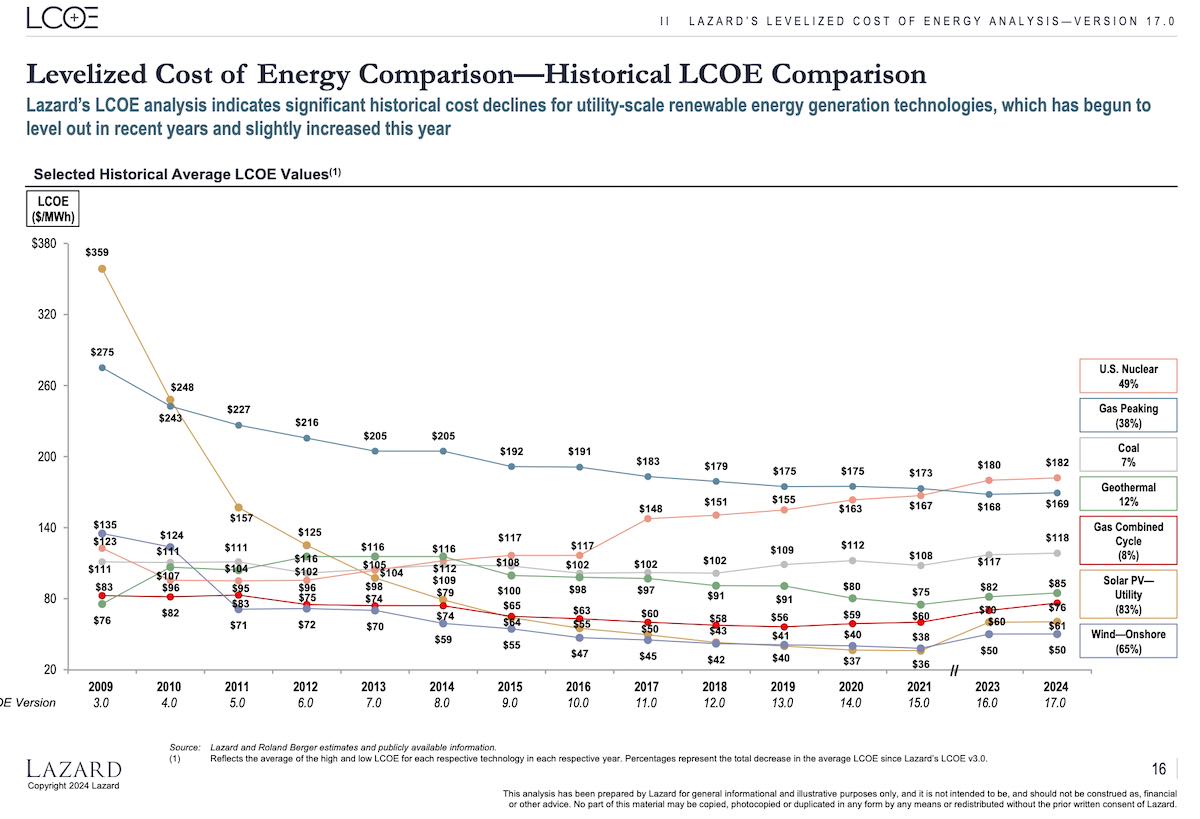
The cost of nuclear power, meanwhile, has doubled since hitting a low of $US95/MWh in 2011, to an average of $US182/MWh, or ranging between $US142/MWh and $US222/MWh, in 2024.
This makes both large-scale wind and large-scale solar significantly cheaper than nuclear, even when the renewable energy generation technologies are paired with storage, according to Lazard.
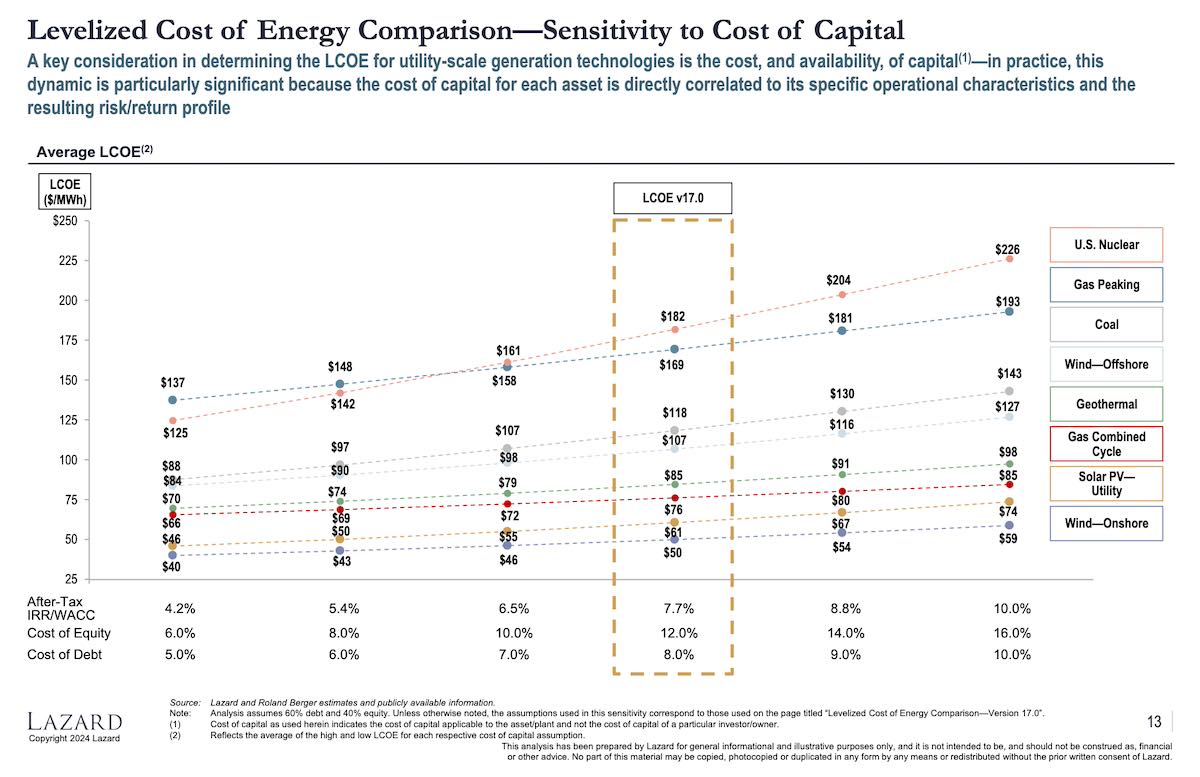
As always, Lazard also measures the sensitivity of the various generation technologies to the cost, and availability, of capital – a measure it notes is particularly significant because it is directly correlated to each technology’s operational characteristics and the resulting risk/return profile.
All technologies are affected in some way, but wind and solar actually increase their advantage as the cost of capital increases, as you can see in the chart below.
On energy storage, the report says it is becoming “more valuable, well understood and, by extension, widespread as grid operators begin adopting methodologies to value these resources leading to increased transaction activity and infrastructure classification for the ESS asset class.”
In 2024, version 9 of its Levelised Cost of Storage Comparison, Lazard finds better value for money in the longer duration energy storage system (ESS) applictions, with a stand-alone 100MW four-hour battery the cheapest at between $US170-$296/MWh, not including available US subsidies.
By comparison, a 100MW BESS with one hour of storage comes it at between $US222-$352/MWh.
Fortescue is showing the future to the rest of Australia: Batteries and electrification replacing barrels…
In remote First Nations communities primarily reliant on diesel power stations, the steep price hikes…
Investor group "dismayed" at draft reforms to the Capital Gains Tax it says will deter…
Newly minted leader of Australia's home battery market claims stunning new installation record, as regulator…
Independent regulator approves big battery proposed for next to a waste-water treatment plant, after it…
Large scale wind projects are not getting finance and are not getting built. CEIG's Richie…