Courtesy of NextTracker
The general assumption among wind and solar developers is that excess production is likely to be stored – in either batteries or by pumped hydro – or possibly used for the production of green hydrogen.
They may have to rethink their numbers.
According to the Australian Energy Market Operator’s 2022 Integrated System Plan, the rate of “curtailment” could jump from around four to five per cent to as high as 20 per cent as wind and solar projects effectively eat each other’s lunch at times of high production.
AEMO argues that it will simply not be efficient to store every watt of wind and solar produced once the share of renewables surges towards the high 80s and 90 per cent.
At lower levels, it makes sense to store excess wind and solar to fill in the gaps when the sun isn’t shining and the wind may not be blowing, but when there is much more wind and solar capacity, and fewer gaps, then there is a limit to the amount of storage that makes economic sense.
“The ISP modelling confirms that, rather than build network and storage to capture every last watt of energy, it is sometimes more efficient to curtail or spill some generation,” it says.
“This may occur when there are system security or other operability constraints in the network, or there is simply over-abundant renewable energy available.”
At such high levels of renewables, wind and solar would no longer be competing against fossil fuels – because there would be little left in the system – but each other.
“At these times there is simply not enough operational demand to utilise all available renewable resources,” it notes.
“Adding more storage to soak up the surplus supply is unlikely to be economically efficient because, with so much annual renewable generation, there is little marginal value in shifting VRE (variable renewable energy) to other times in the day, month or year.
AEMO says the most curtailment or spill will likely occur in the middle of the day and in spring and summer, when there is higher solar generation.
But it notes that it will likely make more economic sense to build more wind and solar, rather than less, because even with spilling and curtailment, it will still be cheaper than building more storage.
“The economics also demonstrate that overbuilding VRE generation is more efficient than just matching generation with requirements, similar to that for other forms of generation based on average capacity factors.”
In short, it requires a new way of thinking about the grid. But there is also likely to be a key new dynamic that changes the equation – the emergence of green hydrogen.
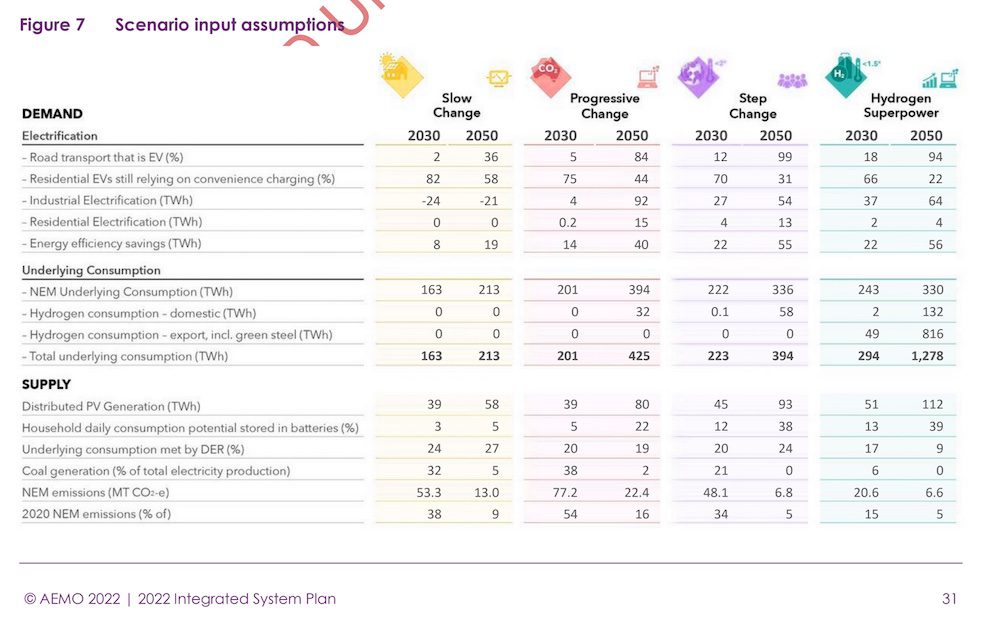
The step change scenario currently favoured assumes no green hydrogen consumption of any significance in the next 10 years, or even out to 2050 – reflecting the current uncertainty about the technology in many parts of the industry.
But if it does come to pass, it will consume four times as much power than is currently assumed. That will be another issue altogether, and those electrolysers will be seeking to consume as much wind and solar as they possibly can.
Australia has the highest rooftop solar penetration on earth because we wrote sensible rules early…
Perth-based home battery maker named as one of three businesses awarded funding to help grow…
The former PM – once one-eyed in his support of pumped hydro storage – is…
State tips $500,000 into local family-owned electric motor specialist to support delivery of a state-of-the-art…
Energy market operator reinforces need for more flexibility, storage and transmission as electricity demand is…
As the NT marks first gas from the huge Beetaloo "carbon bomb," the Pacific Islands…