A new report released by climate and energy think tanks Carbon Tracker and Ember Climate shows that the technical potential of wind and solar to power the world is around 100 times greater than total electricity demand, with rapidly increasing economic and physical capacity to take advantage of sun and wind to fully remove fossil fuels from human society.
The report also finds that the land constraints on renewable energy growth are far less than commonly stated. Harry Benham, report co-author and chairman of thinktank Ember-Climate, said: “The world does not need to exploit its entire renewable resource — just 1% is enough to replace all fossil fuel usage. Each year we are fuelling the climate crisis by burning three million years of fossilised sunshine in coal, oil and gas while we use just 0.01% of daily sunshine.”
Global energy consumption in 2019 was 65 petawatt hours, but the technological potential to capture sunlight and convert it into electricity is 5,800 petawatt hours, “as much power in a single year as could be generated by burning all known fossil fuel reserves”.
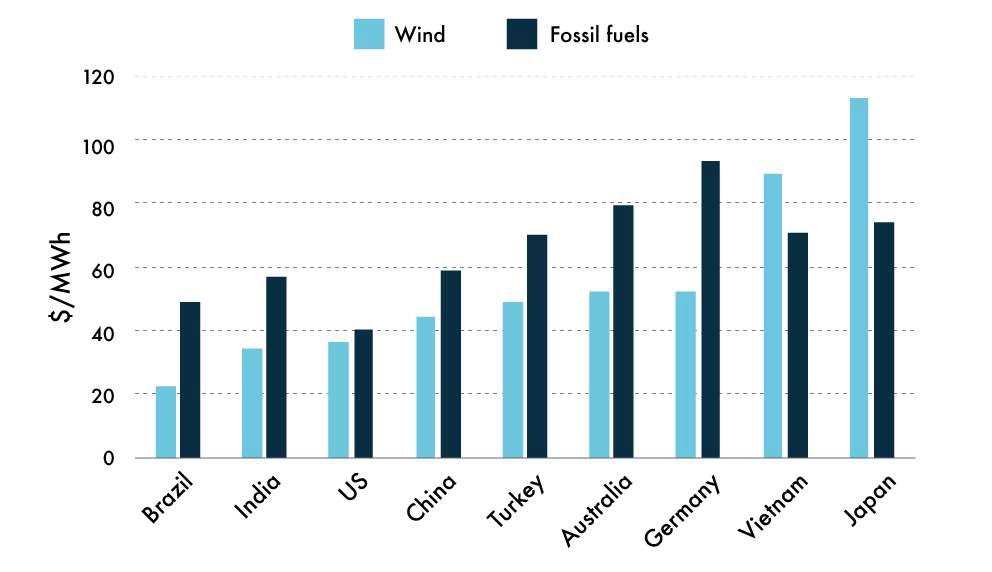
By 2030, the report suggests that all solar and half of wind power is likely to be economic compared with fossil fuel generation. The construction of enough solar panels to meet the world’s total energy demand would comprise only 0.3% of the land occupied by fossil fuel extraction and infrastructure.
The stark disconnect between the current heavy reliance on fossil fuels despite the significant over-abundance of wind and solar resources is highlighted throughout the report, with a focus on the economic potential of wind and solar to fully displace fossil fuels.
The report notes that different countries and areas of the world have different access to sun and wind resources. Germany, currently a world leader in renewable energy, actually has the third lowest solar and wind technical potential relative to total demand. Poorer countries have the largest ratio of solar and wind potential to demand. This could unlock significant benefits for the development of those countries, ‘leapfrogging’ fossil fuels.
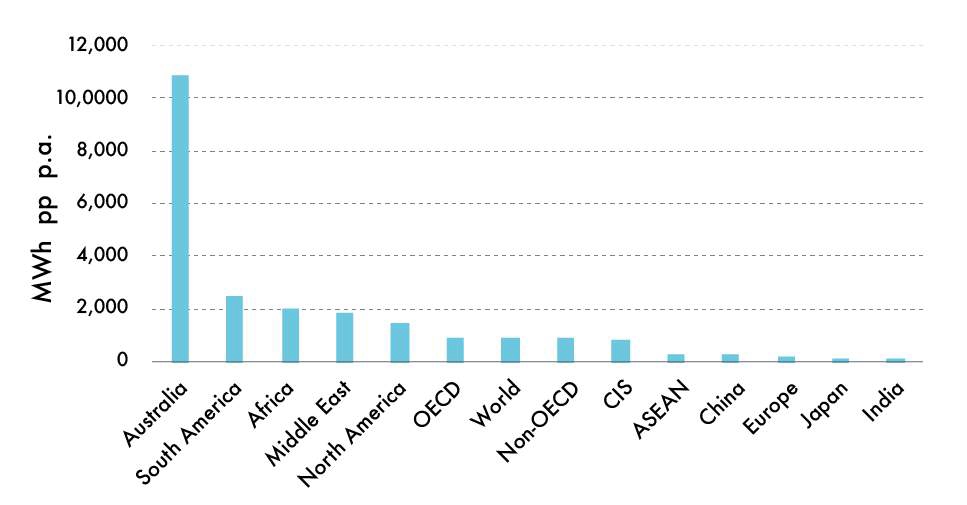
Australia sits in the ‘abundant’ category in the report, with around 400 times potential renewable energy compared to current demand. However, the report also notes that in terms of ‘per capita’ potential generation capabilities of renewable energy, Australia stands out, with the highest in the world:
Fortescue wind technology company achieves its first "craneless" wind turbine installation, using a system similar…
Victoria shadow minister David Davis promises to pause and "review" major transmission projects - an…
We need an urgent show of political courage to decouple BHP and its peers from…
As Fortescue aims for zero emissions, mining rival BHP is achieving zero credibility after an…
Chimney stacks from shuttered Liddell coal plant come down in a series of spectacular explosions,…
Electricity costs will fall for homes and businesses across Australia's main grid, as wind, solar…