The message from the NSW pricing regulator this week that rooftop solar tariffs were no longer an important part of the equation behind households and small businesses installing PV systems might have sounded disingenuous, but this week an example from one of the state’s electricity retailers has helped illustrate the point.
First a bit of the back-story. As we reported on Tuesday, The Independent Pricing and Regulatory Tribunal (IPART) on Monday announced in a draft determination that the recommended average tariff – which is voluntary anyway for electricity retailers in NSW – had been cut by 14 per cent to an average 4.8c/kWh, the lowest in Australia.
It followed up this announcement with the assurance that this shouldn’t really worry solar households, because feed-in tariffs weren’t really that important any more – “just a secondary issue” – because most electricity produced from solar panels were self-consumed, and not exported to the grid.
IPART also inferred that if the owners of small solar systems were aggrieved about the situation, they should just install battery storage.
IPART justified this through an analysis of offerings from retailers in NSW, from those who offered no FiT, to those who offered them above the recommended range.
It’s conclusions were interesting, noting that while some retailers might offer high feed in tariffs, they might be hitting customers with higher charges elsewhere. It suggested customers might be better off in some cases going with a retailer that offers no feed in tariff.
This table illustrates the point.
“We find that an electricity contract with a higher feed-in tariff does not necessarily deliver a better value to solar PV customers,” IPART wrote.
“For example, for an average PV customer who consumes 65% of PV generation and exports the rest, the contract from Retailer J with a six cent feed-in tariff is a better offer than that from Retailer B which offers a 10 cent feed-in tariff.
“In some cases, PV customers may be better off taking up contracts that do not offer any voluntary feed-in tariffs.
“This is because some retailers are offering contracts with a bigger discount on supply and/or usage charges, instead of offering high voluntary feed-in tariffs. This indicates that customers should consider voluntary feed-in tariffs as part of an overall electricity market offer.
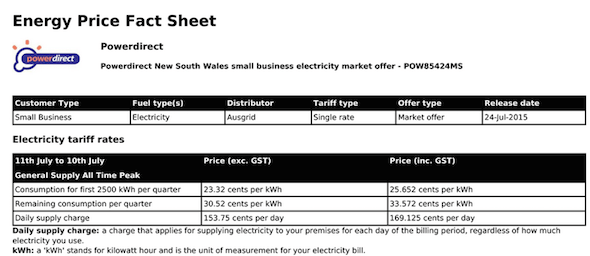
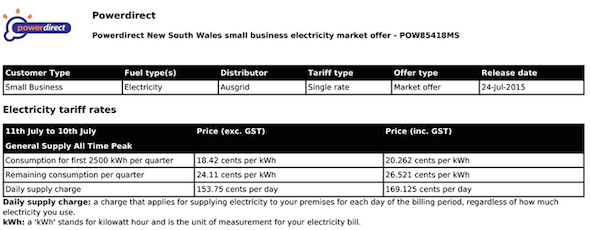
One example offered by a One Step reader this week was of NSW business solar customers of AGL Energy-owned retailer, Powerdirect (presumably L on the above table).
As you can see in the company’s energy price fact sheets below, dated July 2015, small businesses with rooftop solar on a straight net metering contract pay Powerdirect 25.65c/kWh for the electricity they draw from the grid.
Businesses without solar, meanwhile, pay the retailer 20.26c/kWh – around 5c/kWh less than their solar counterparts.
And if the solar businesses happen to consume more than 2500kWh of electricity in a quarterly billing period, they pay 7c/kWh more than non-solar business customers for power from the grid from that point on.
In that context, the comments from IPART sound about right – the 7.7c/kWh tariff Powerdirect is offering business customers with solar suddenly carries very little weight at all. Battery storage on the other hand…
This story was first published on our sister site One Step Off the Grid. To sign up for the weekly newsletter, click here.
Australian "AI factory" developer inks 12-year deal to buy firmed electricity for its data centre…
Andrew Forrest's mining company collaborates with two TAFE branches to address a critical shortage of…
Singapore-based renewables developer raises more than $1 billion in green financing facilities to support solar…
State EPA defers native tree clearing decisions to the department of mines for the new…
HMC Capital has settled on a name for its growing portfolio of energy assets and…
In a future dominated by renewables, Australia can remain an energy powerhouse. But to be…