Image: Freepik
Google is the world’s largest real-time survey.
Every search query is a tiny window into what people are worried about, curious about, or planning to do. Two sets of search trends, tracked globally from 2004 to 2026, tell a dramatically scary story about where consumers’ heads are right now in 2026.
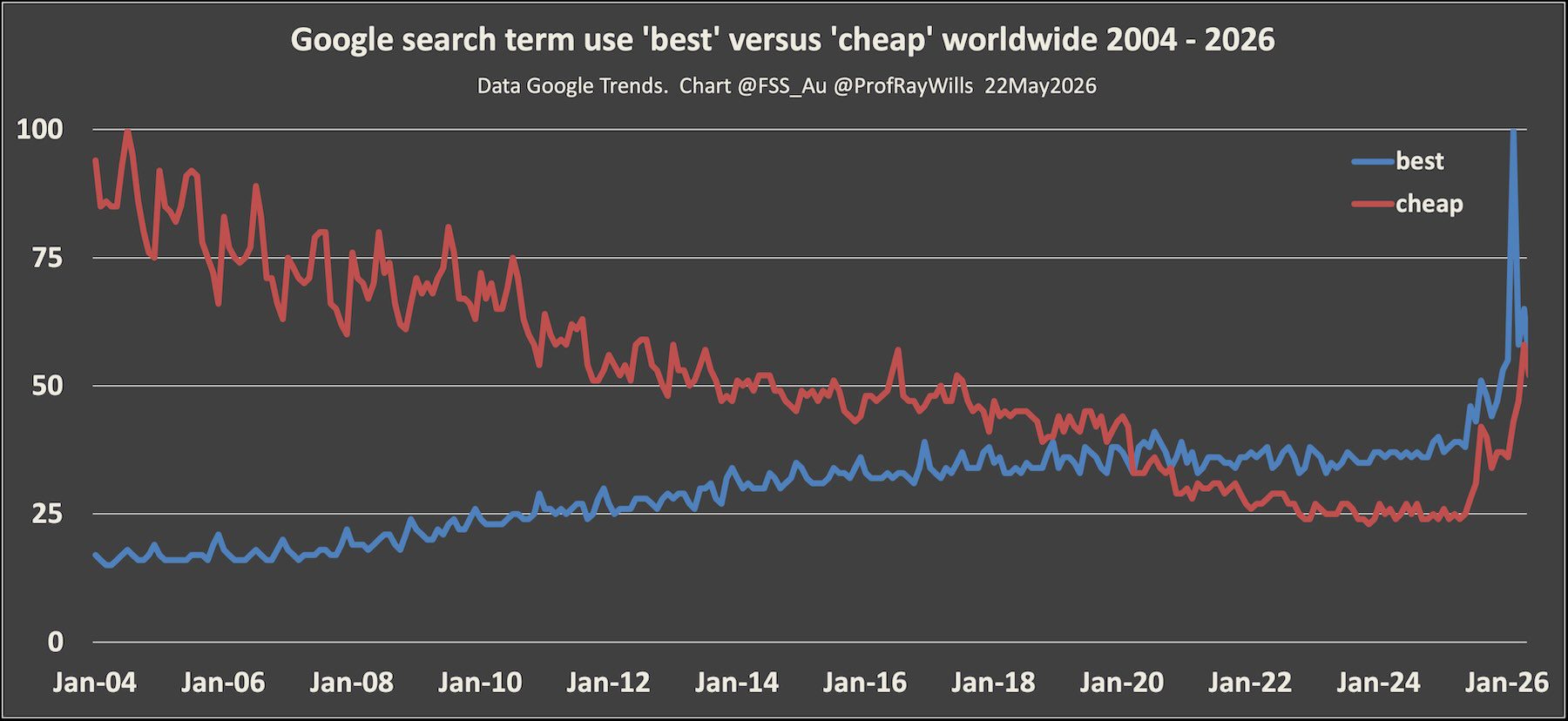
For most of the 2000s, people searched “cheap” far more than “best.” The Global Financial Crisis made affordability the dominant lens.
Then, through the 2010s, as economies recovered and confidence returned, “cheap” gradually faded while “best” climbed higher – the signature of a consumer population shifting from survival mode to quality mode.
Then came early 2026, and another fossil fuel supply crisis. Both terms have exploded simultaneously to near-record levels.
That is not a browsing preference shift – it is human stress.
When people search both “cheap” and “best” at the same time, they are doing the cognitive work of someone who needs to spend carefully, but cannot afford to get it wrong. It is a signal of households under pressure, optimising every dollar.
Research from Google’s own Think with Google team and the OECD’s real-time GDP tracker both confirm that search term pairs like these are reliable leading indicators of consumer confidence – often preceding official statistics by weeks or months.
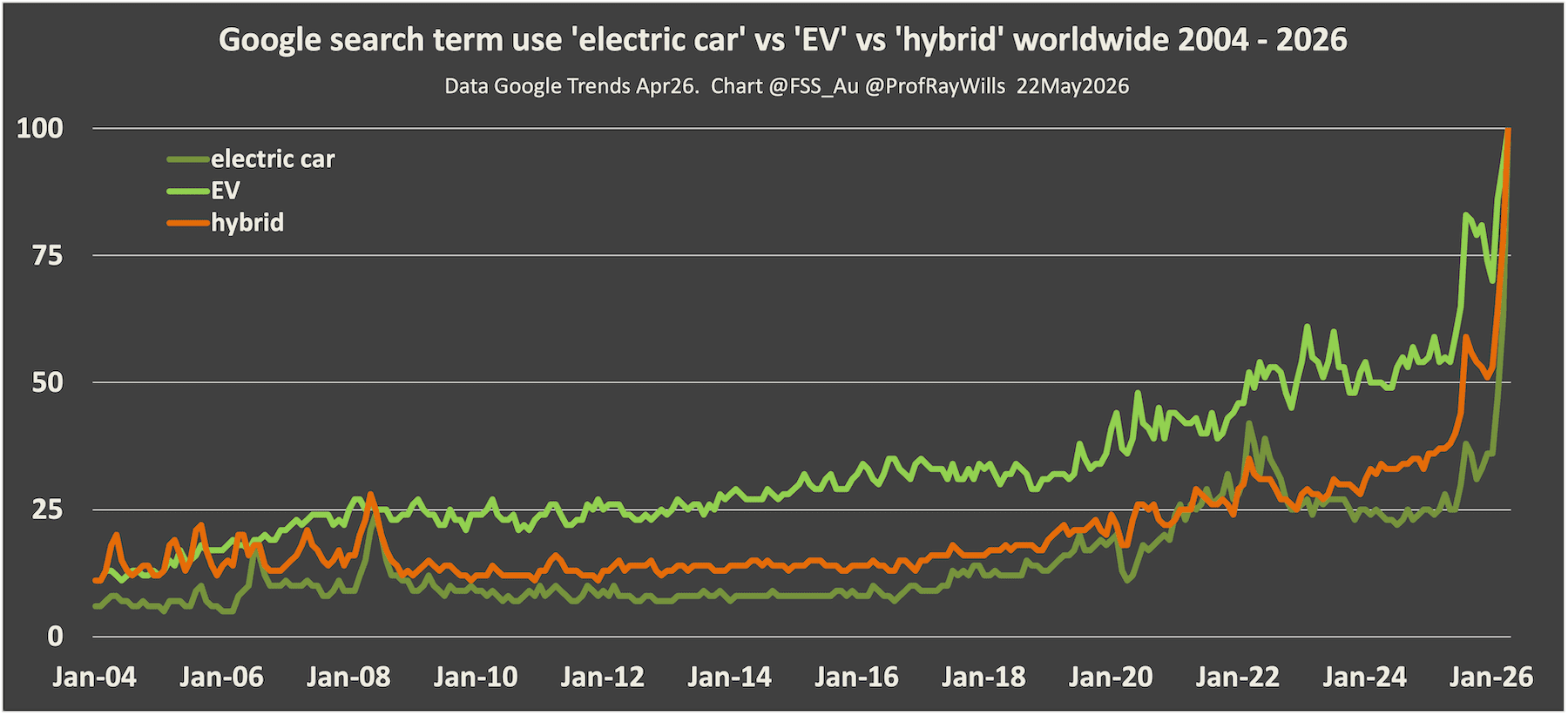
The EV/hybrid/electric car chart shows EV searches pulling decisively away from both “hybrid” and “electric car” as a search term.
The vocabulary of battery vehicles has matured. But the hybrid surge in early 2026 is real and meaningful. Not everyone is ready to go fully electric; some are hedging, seeking the security of a petrol backup while fuel prices bite. Search interest in hybrids is not a vote against EVs – it is a vote against fuel vulnerability.
And critically, now oil-shock-driven EV interest is ignited, it will not return to its previous lows.
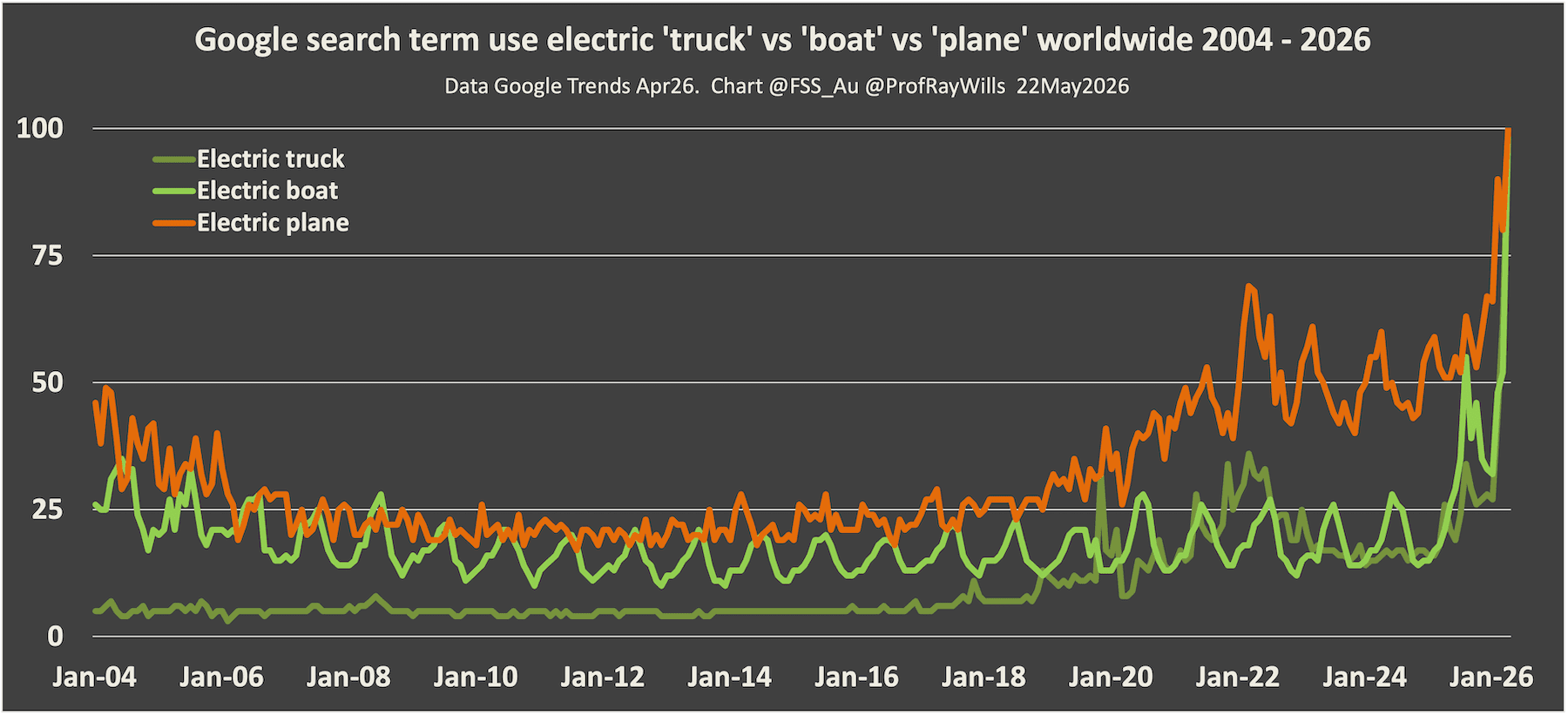
Electrification beyond the car adds the most striking signal – searches for electric trucks, electric boats, and electric planes.
For nearly two decades these were flat and low – fringe curiosity.
Then “electric plane” began pulling well ahead from around 2019, reflecting genuine aviation electrification progress. But the 2026 spike across all three is extraordinary: electric truck, electric boat, and electric plane searches have all surged simultaneously to near-record levels. This is not random noise.
When fuel prices spike, people don’t just reconsider their car – they reconsider every fuel-dependent thing in their lives. The fuel shock of early 2026 appears to have triggered a whole-of-transport rethink.
The electric truck signal matters particularly for industry. Freight and logistics are deeply exposed to fuel costs, and fleet operators watching diesel prices climb have strong financial motivation to research alternatives.
That this search interest has arrived simultaneously with EV car and hybrid searches reinforces the picture: the 2026 fuel crisis has functioned as an electrification accelerant across the entire transport sector.
The home solar versus home battery chart is perhaps the most revealing of all.
“Home solar” has tracked steadily since 2004 with modest growth — reflecting the long, slow diffusion of rooftop solar globally.
“Home battery” barely registered for most of that period, occasionally flickering after the Tesla Powerwall launch in 2015. Then in early 2026, both lines went nearly vertical — with “home battery” effectively reaching parity with “home solar” for the first time ever.
This is a profound shift.
For years, solar was the entry point and batteries were the expensive optional add-on. The 2026 search data suggests consumers are now thinking about solar and storage as an integrated package from the outset – not as sequential decisions.
When fuel and grid electricity prices spike together, energy independence becomes a single purchase intent, not a two-stage journey.
Taken together, all four charts paint a consistent and urgent picture: 2026 is a year of economic anxiety colliding with energy anxiety — and consumers are responding not with paralysis, but with research.
They are looking for affordable options, they are rethinking how they move, and they are considering how to power their homes independently.
That is not a bad moment for the clean energy transition. It may, in fact, be the accelerant the transition has been waiting for.
All charts use Google Trends monthly global data to April 2026.
UK developer and local council sign community benefit deals for two projects stuck in limbo…
A record amount of large-scale renewable generation has reached financial close, the federal government says,…
China's Envision lines up its first wind and battery deal at a new energy park…
Final all-clear for huge wind and battery project comes just in the nick of time,…
The Albanese government is making great strides on clean energy, while at the same time…
Slow grind of getting commercial, industrial businesses off gas is accelerating, a new report says.