Source: Smart Commercial Energy
Two big policy announcements in the space of a fortnight have transformed the economics for commercial solar and battery projects in Australia.
– From October 1st, the Federal government’s Small-scale Renewable Energy Scheme (SRES) STC eligibility cap will expand from 100 kilowatt (kW) to 1 megawatt (MW).
– From September 1st, the NSW Peak Demand Reduction Scheme is expanding to include commercial-scale batteries – with upfront discounts available for batteries up to a whopping 30 megawatt-hours (MWh) of capacity.
To understand what this might mean, we analysed the upfront costings of 14,000 unique C&I projects modelled over the last three years. The results are compiled in eight charts – which all point to brighter times ahead for the commercial solar industry.
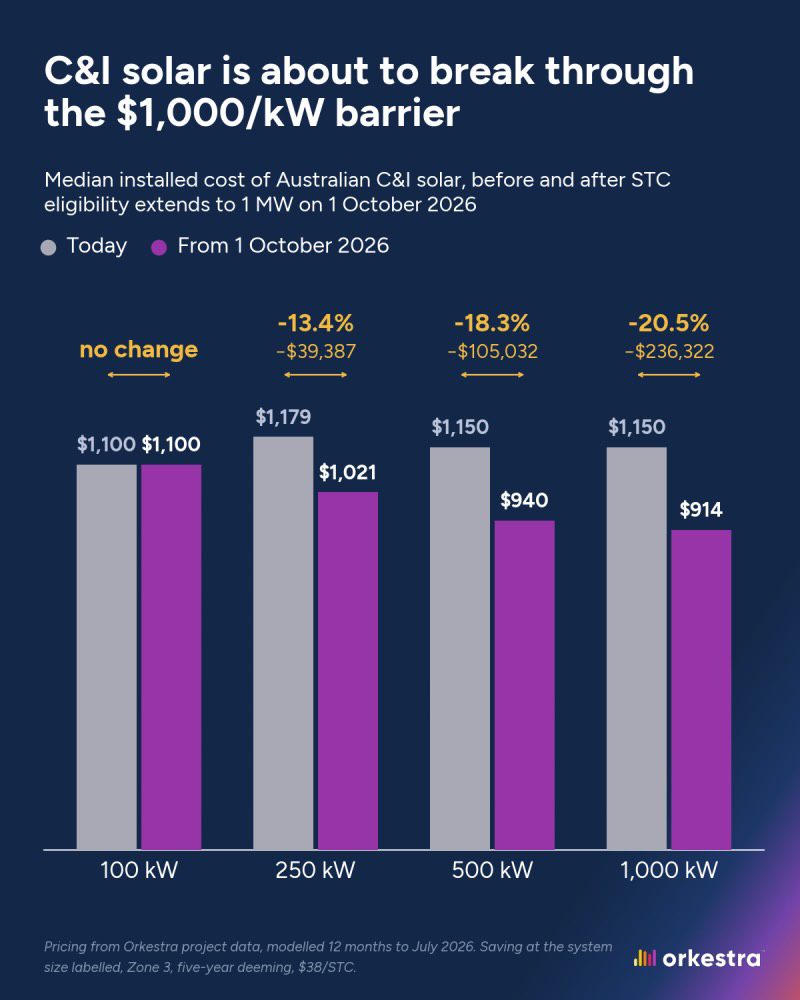
Median modelled upfront costs of commercial PV projects, before and after STC program expansion, Oct 2026.
From October 1st, the federal government’s Small-scale Renewable Energy Scheme (SRES) STC eligibility cap will expand from 100 kWp to 1 MWp.
Median C&I PV upfront installed costs are anticitated to fall by up to 20.5% at the upper end of the 1000kWp threshold, down towards $900/kWp installed, with a price gradient falling from $1100/kWp at the smaller 100kWp size.
However, the spread of prices in the market means we’ll see prices both lower and higher than the median prices dispayed here – by as much as 25% either way.
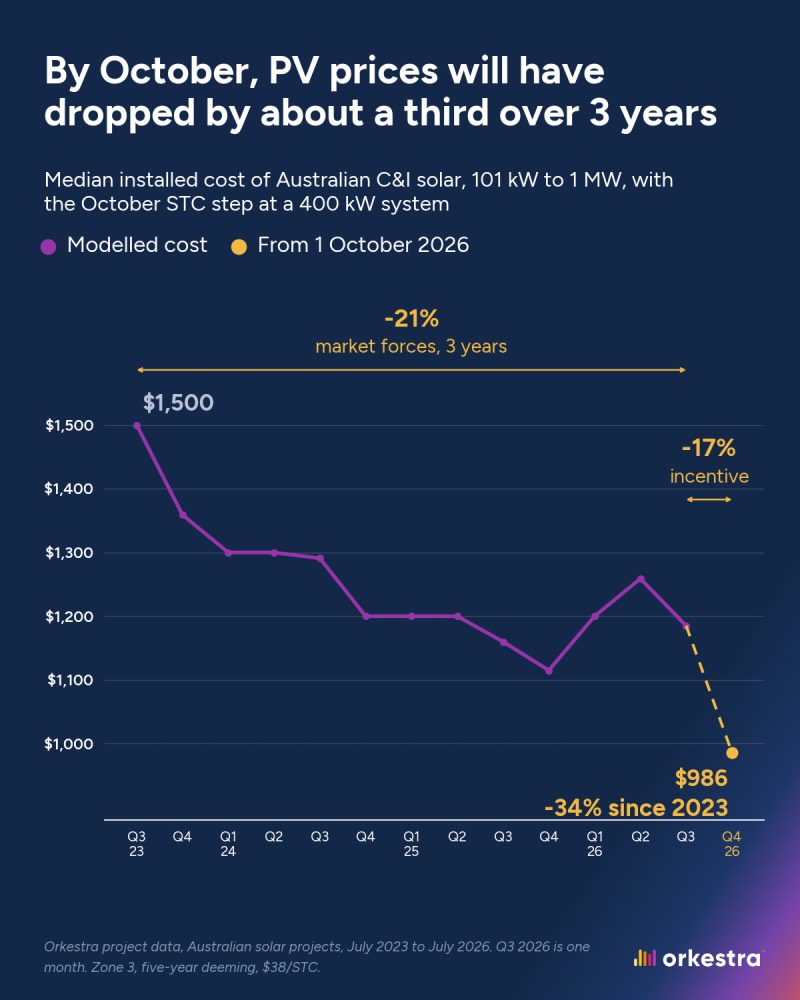
Median modelled upfront cost of commercial PV projects 2023 – 2026 (Q4 2026 is projected)
From October 1, prices will reduce a further 13-20% from today – depending on size. That’s the equivalent of 2 to 3 years of market price reductions. Median prices for C&I PV category (101-1000kWp) have already fallen by 21% in just 3 years.
Overall, come October, we anticipate that PV project costs will have dropped by about 34% – from $1,500/kWp to ~$1000/kWp – in 3 years.
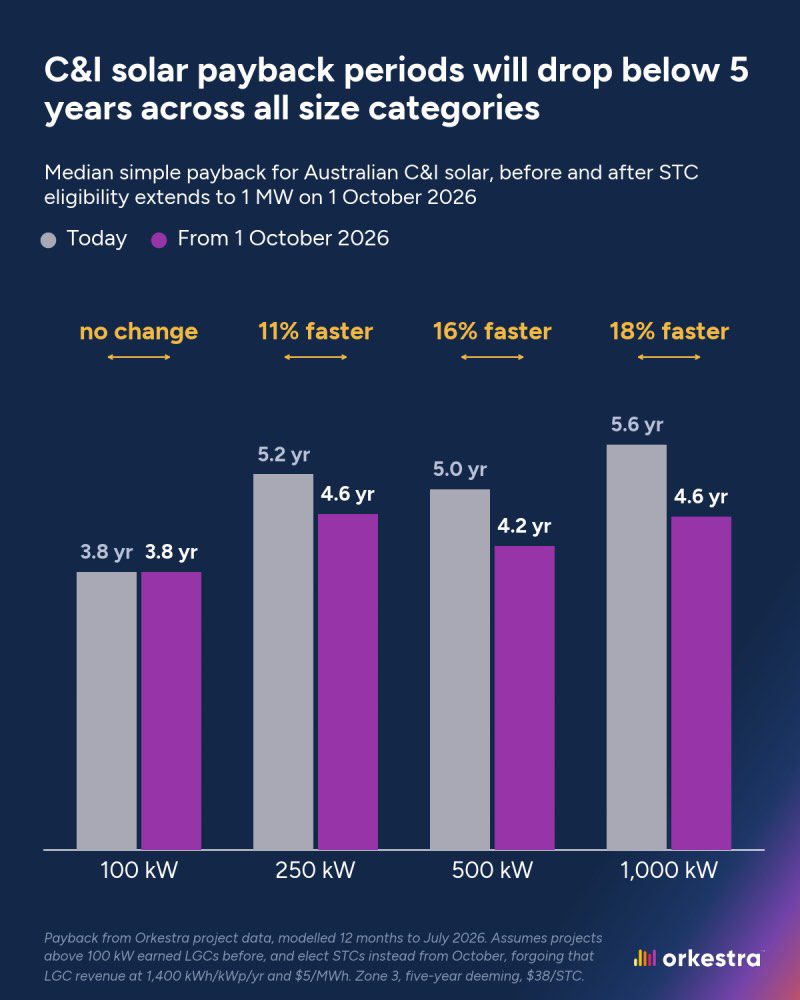
Median modelled payback period of commercial PV projects, before and after Federal Government STC expansion, Oct 2026.
This takes it below 5 years for all size categories in the 100-1000kWp range – making the decision even more of a ‘no brainer’.
Sub-5 years will typically clear the investment hurdle for financial decision-makers, so we anticipate this will have a meaningful impact on close rates and installed volume.
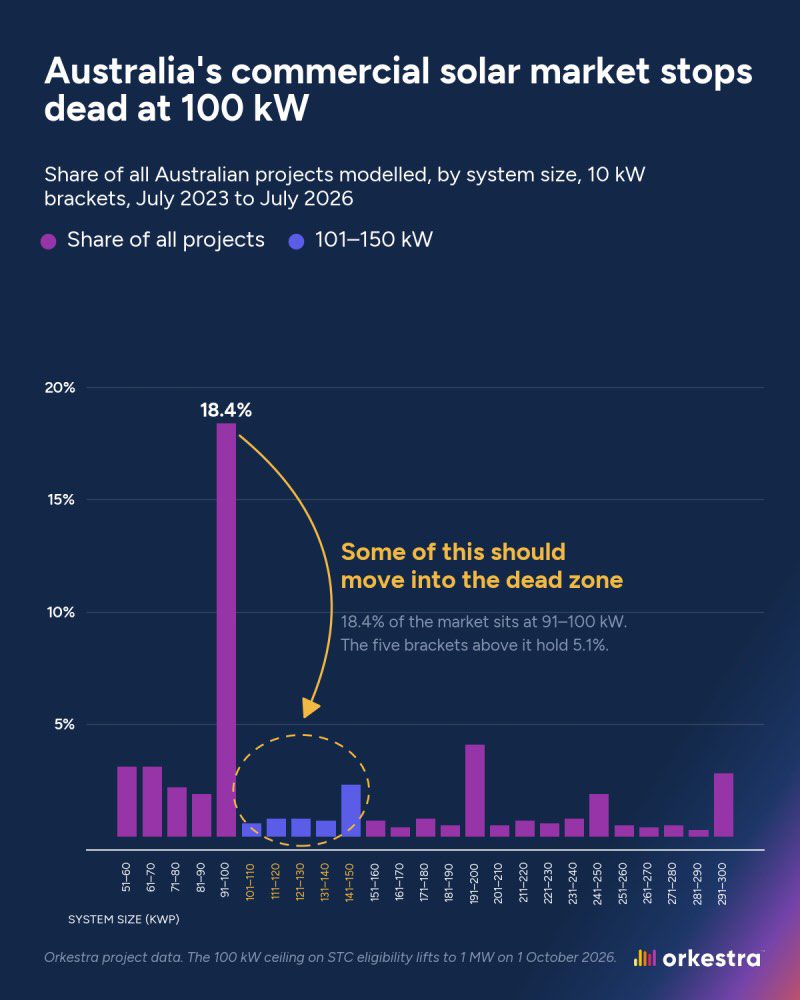
Size distribution of modelled Solar PV projects in Orkestra (2023 – 2026)
The data confirms it (and it’s definitely no secret!): 100kWp is by far the most common size modelled and installed in Aussie C&I.
100kWp systems account for nearly 1/5 of all PV projects modelled, whereas the 100-150kW category accounts for just 5.1%. I’d expected registration data to show an even more severe drop off in the real world.
With the STC changes, I anticipate we’ll see:
– a drastic uptick in installations in the 100 to 200kWp category;
– Many solar co’s revisiting 100kWp projects to add more capacity.
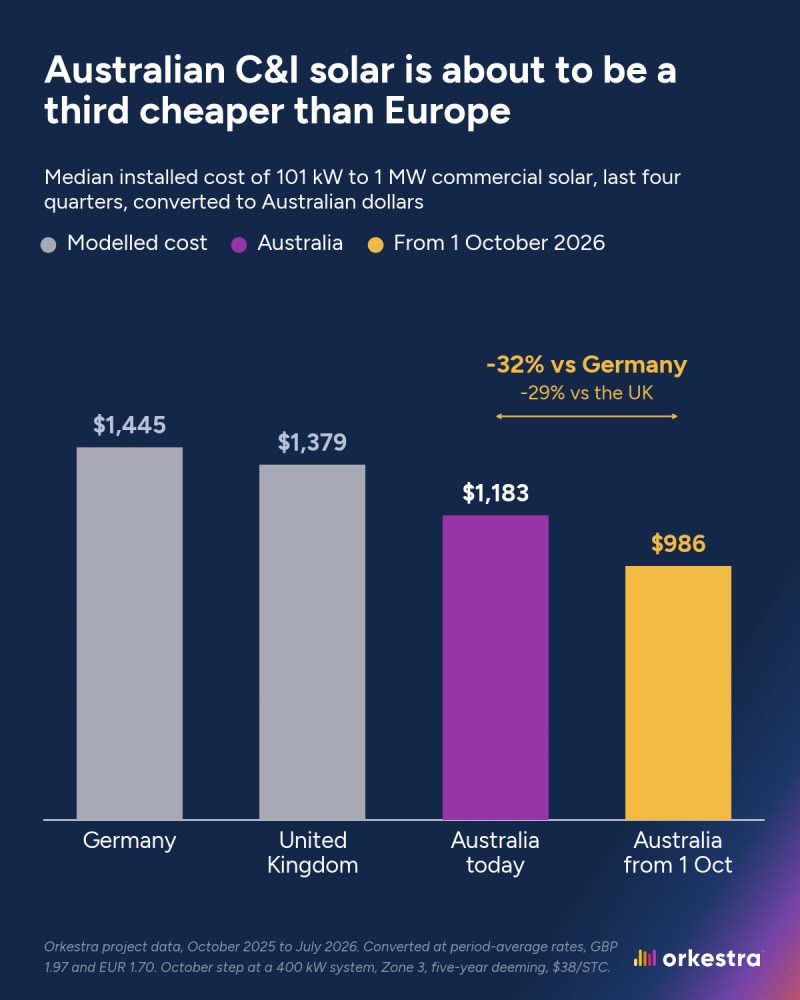
Median modelled upfront cost of commercial PV projects (101-1000kWp): Australia vs UK vs Germany, 2025/26
So just how cheap is Aussie C&I solar now versus other markets?
Orkestra has seen over 30,000 projects modelled across 50 countries over the last 5 years – and we have an active presence in Australia, UK and Germany – which gives us enough data to confidently compare prices across those markets.
Australia was already the cheapest for installed costs, but from October we’re going to be a full 32% cheaper than Germany, and 29% less than the UK (don’t even mention the sunshine!). My prediction is that by the time this scheme ends in 2030, Australia will be a global leader – not just in residential solar uptake, but also C&I solar uptake.
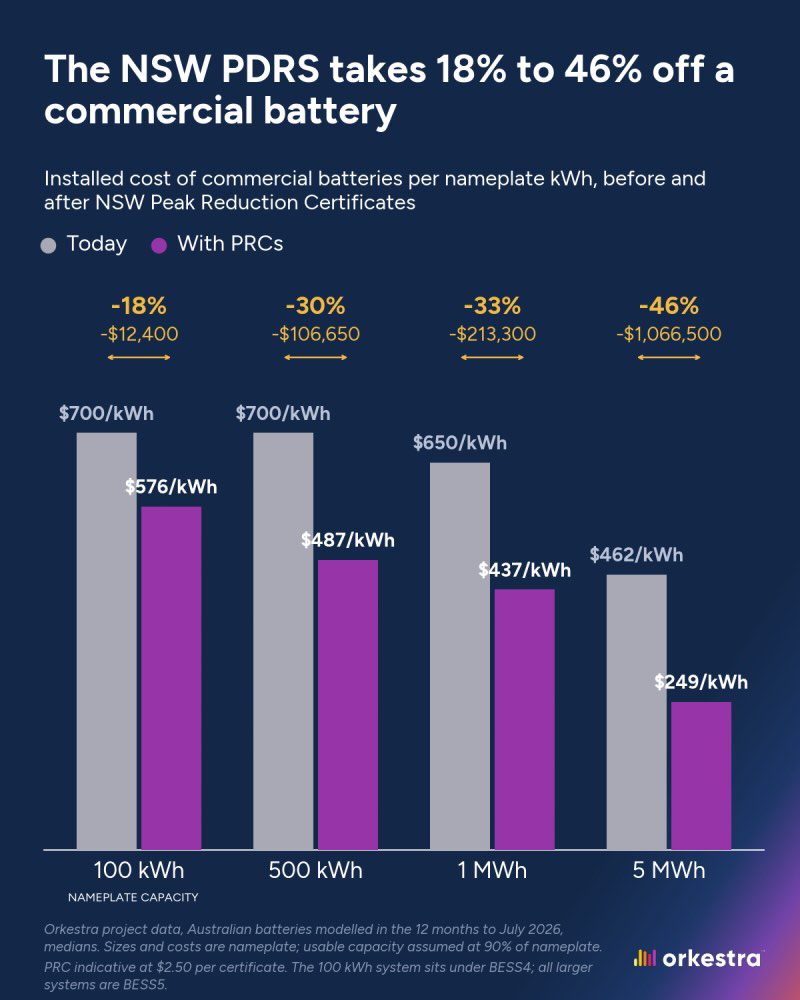
Median upfront costs for C&I batteries as modelled in 2025/26 vs after NSW PDRS changes Sept 2026.
In July, the NSW Government announced they are expanding their Peak Demand Reduction Scheme this September to include commercial-scale batteries in three new segments: Apartments (BESS3 stream), Small-Medium Enterprises (BESS4), and C&I (BESS5).
The BESS5 stream of the program pays an upfront subsidy to batteries from 200kWh to 10MWh in capacity, but eligibility scales right up to 30MWh. Like STCs, the scheme is certificate-based – Peak Reduction Certificates or PRCs – so prices will vary based on market fluctuations.
Battery prices are expected to drop by about a 1/3rd in the 200kWh to 1MWh range. For 5MWh nameplate capacity, a whopping $1.066m elgible incentive means upfront costs drop by almost 50% – to just $249/kWh!
SME-scale systems in the BESS4 stream get less of a discount – but still generous, knocking nearly 1/5th off the price.
Median modelled upfront cost of commercial BESS projects 2023 – 2026 in $/kWh nameplate capacity. Q4 2026 is projected includes NSW PDRS discount modelled for a 400kWh battery.
This chart is wild. The last 3 years have already seen massive price reductions for batteries in the Australian market. Median modelled prices have fallen from over $1050/kWh nameplate capacity to $700/kwh – in just 3 years.
For those lucky enough to be in NSW, prices will fall again by an average of 31% – taking the 3 year price drop to well over 50%.
We haven’t published payback figures for batteries here, deliberately, because we see a wide range across commercial storage, driven by highly variable site load and tariff factors, and the variable (and sometimes volatile) value streams a battery is actually configured to capture.
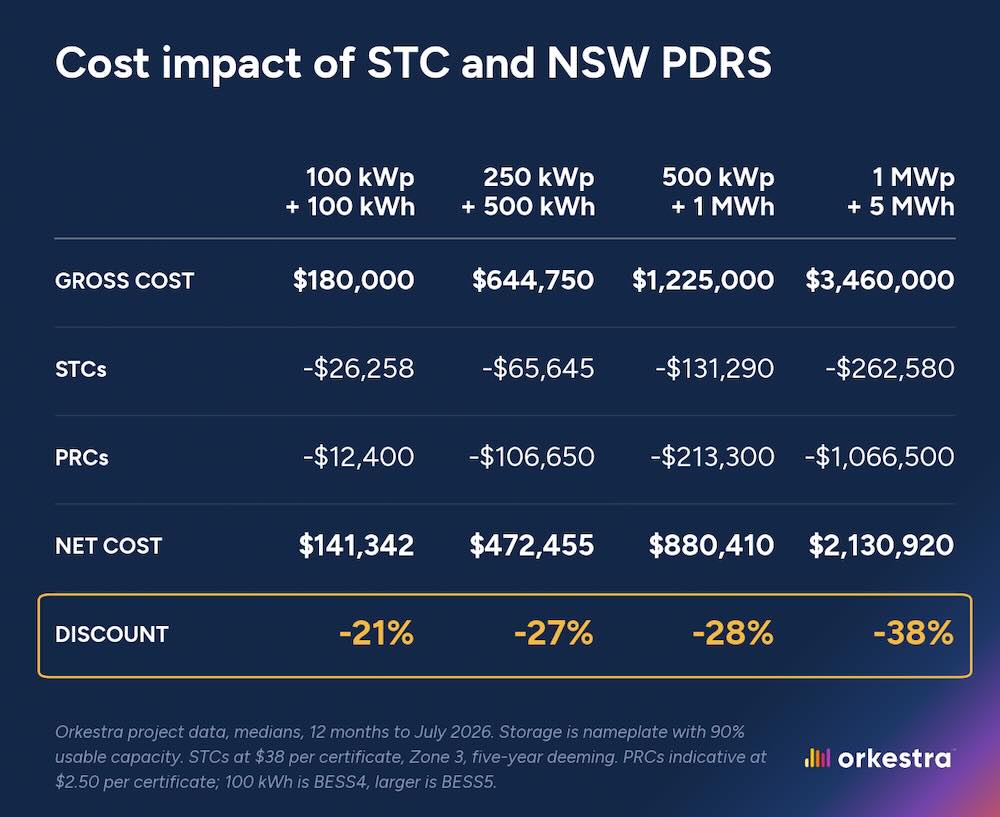
Yes, you can stack STCs and PRCs in NSW. This is the cost impact on a range of system combinations.
The combined discount eligible for stacking STCs and PRCs in NSW for Commercial C&I projects
– Many 100 kWp projects already installed will be undersized to the load. If there is roof space free – that’s an easy upsell.
– 100 kWp won’t cut it as a suggested system size. What matters will be the ‘optimum size’ – which might be substantially higher. That will require more robust sizing analysis.
– Cheaper solar prices will also increase demand for batteries, as overall paybacks drop. Bigger solar sizes – when oversized to load – lends itself well to batteries for self-consumption, as per residential.
– Modelling accurate financials is still as important as ever. Savings and revenue estimates still need to be bankable. Commercial buyers are still predominantly financial decision makers.
– (NSW) I’d anticipate batteries becoming a standard offering – like in residential. A 5MWh system at roughly half price is a different proposition entirely.
– (NSW) One thing to keep an eye on is certificate prices. A dollar either way on PRCs moves a battery price by about 13% overall. They have been volatile in the past relative to STCs – so be careful with your quoting.
– (NSW) There are plenty of compliance requirements for the PDRS – which often increase with battery size. Do your homework and get advice from a reputable accredited certificate provider.
Chris Cooper is co-CEO and co-founder of Orkestra. Read the original version of the post on LinkedIn.
The initial survey work on the longest tunnel in Snowy 2.0 involved just 22 investigation…
China solar giant launches powerful new all-black solar module that targets premium market and “pushes…
Plans to build one of the world's biggest industrial heat battery projects win Arena funding,…
Board of Queensland energy utility says it needs new leadership, and asks 28-year company veteran…
How do regenerative land practices make renewable energy more reliable? How does government policy reward…
Developer of nearby big battery project offers up to 75 positions to sacked Whyalla Steel…