At the second day of the ‘Leaders Climate Summit’ convened by President Joe Biden, the former CEO of the Australian Energy Market Operator Audrey Zibelman, announced that the United States and the United Kingdom will be joining the Global Power Systems Transformation Consortium (GPSTC).
“[Balancing supply and demand] has always been a difficult engineering challenge, but is becoming even more so as we decarbonise the grid,” she said. Zibelman cites her experience in the AEMO control room during the Black Summer 2020 bushfires. “We were losing major parts of the system. The limitations of our modelling and visualisation tools meant we had to act with incomplete information. Because it was all they had, our engineers relied on experience rather than accurate data to make critical decisions”, Zibelman said.
“We were successful, however as we know from recent events in Texas and California, this is not always the case. The greatest fear of an operator is the inability to keep the power on, especially when our communities are most vulnerable. It is possible to run reliable power systems on renewable. But we urgently need smarter investments and better software to make it work”, she told the Leaders Climate Summit.
Last year, Zibelman – as head of AEMO – led the formation of the GPSTC , with several other major system operators. Yesterday, Zibelman announced that the US and the UK formally joined the GPSTC, both countries undergoing rapid transformations across several connected and isolated power grids involving new quantities of wind and solar power.
Zibelman now leads X, Google’s ‘moonshot factory’ focusing on advancing software for electric grids. As Zibelman wrote on Medium, “After 30 years working to decarbonize the electrical system and bring innovation to the energy industry, I’m now helping build the tools and capabilities that as a system operator, I was desperate to have”. X’s Astro Teller wrote that “right now our work is more questions than answers, but the central hypothesis we’ve been exploring is whether creating a single virtualized view of the grid — which doesn’t exist today — could make the grid easier to visualize, plan, build and operate with all kinds of clean energy”.
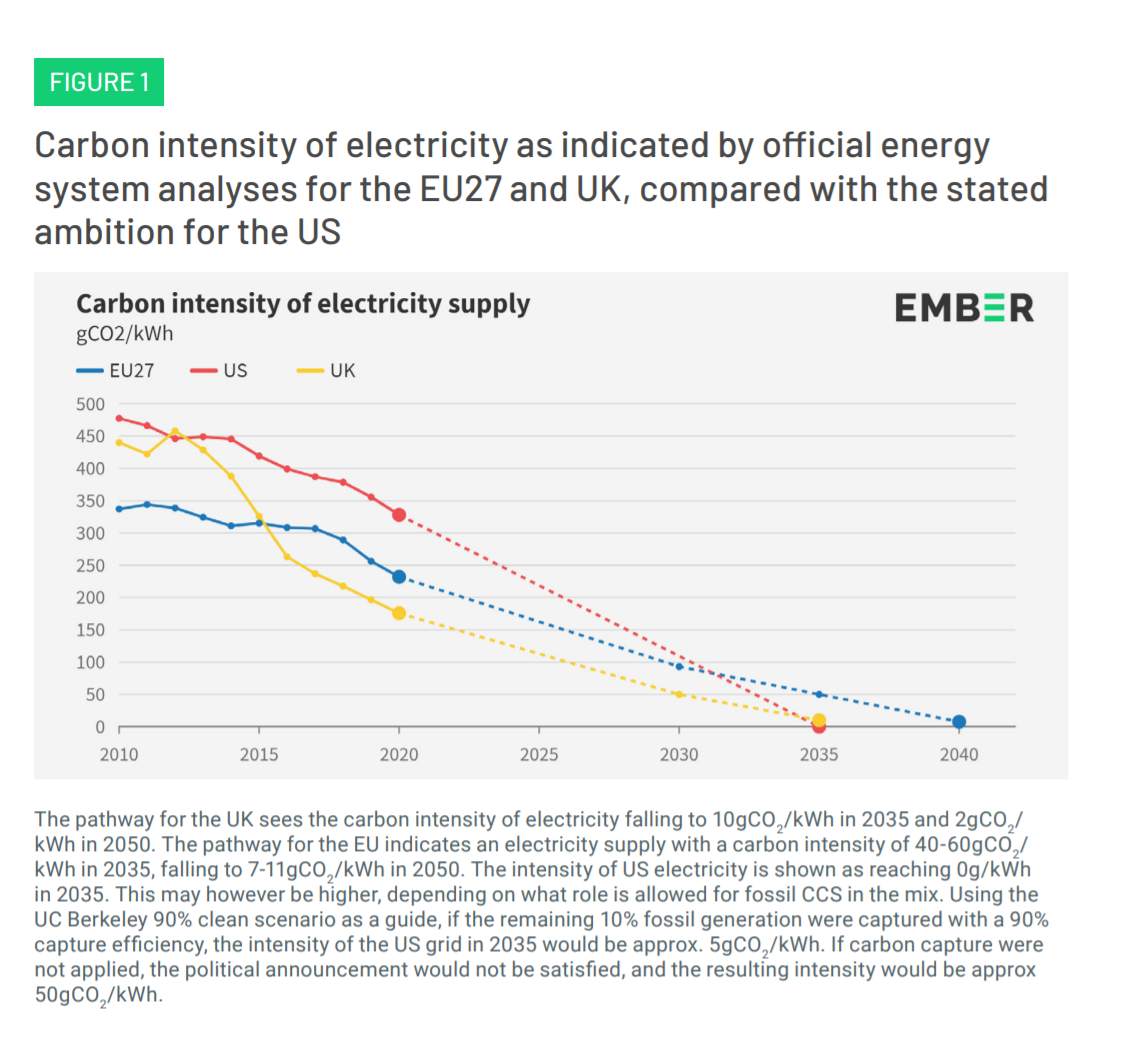
On the same day, analytics firm Ember Climate released a study examining the likely dates for the full-scale decarbonisation of power grids for several countries seen as leaders on climate action. An ‘unspoken consensus’ exists between the UK, the US and the EU that achieving a clean electricity supply in the early 2030s is critical for net zero targets, and almost all scenarios informing policymaking in the EU and UK involve feature a total phase-out of coal prior to 2035, and possibly an end to unabated fossil gas before that date too.
In the report’s various scenarios, wind and solar grow past a 50% share of electricity in 2030 in the three regions and peak at around 70 to 80% of electricity by 2050. The report also highlights that though Australia has the second highest share of coal power in 2020, it is one of 10 G7 / OECD countries with no plans to phase out coal (among 29 countries in total).
A related analysis from the UK’s government analysing the decision to legislate a 78% by 2035 climate target shows the government expects the UK to achieve a zero carbon grid by 2035, with nearly 75% of that comprised solely of wind and solar power.
The Australian arm of a French energy giant is seeking federal environmental approval to build…
Rooftop solar uptake has ridden the wave of Cheaper Home Batteries, but new data shows…
A Taiwanese offshore wind farm has experienced its second turbine blade failure in two months.
Australia's first offshore wind auction will adopt features of the UK's successful program, including longer…
Federal energy minister concedes controversy over Marinus Link project at a ceremonial sod-turning ceremony that…
First Nations group behind several giga-scale renewables projects launches DA for its latest huge wind…