AAP Image/Craig Golding.
Some of Australia’s best known sports stars have issued a joint call for greater action on climate change, following the publication of new research that shows Australia’s summers of sport is at threat from an increased likelihood of heatwaves.
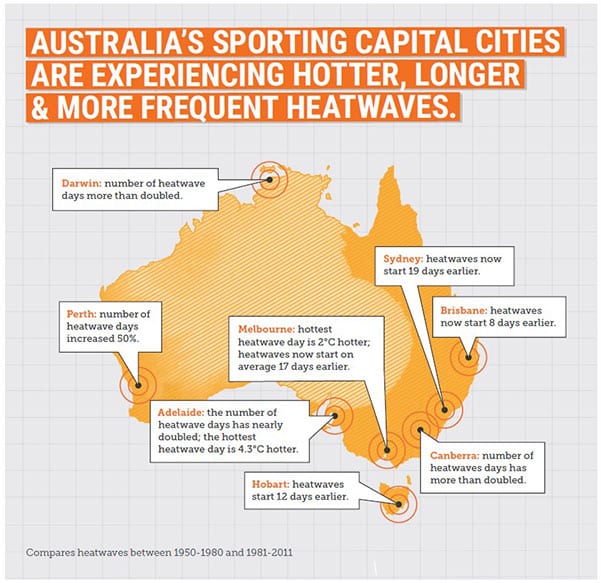
The new report published by the Climate Council on Thursday found that increasing global temperatures driven by climate change could spell the end of Australia’s summers of endless sport, as heat threatens the future of summer sports like cricket and tennis.
The report says Australia’s average temperatures have increased by an average 1.44°C since 1910, contributing to a dramatic increase in extremely hot days.
“The frequency of extreme heat events is also increasing. 2019 was Australia’s warmest year on record, with 33 days that exceeded 39°C – more than the total number observed in the entire 1960-2018 period,” the report says.
Without concerted global action to reduce greenhouse gas emissions, the report says, Australia will see further increases in the frequency and severity of high temperature days, with the prospect that heatwaves could start pushing temperatures in major cities like Sydney and Melbourne above 50 degrees – virtually making outdoor sports impossible.
Games during the Australian Open Tennis in Melbourne are already regularly being played in temperatures above 40 degrees, and athletes have suffered from exposure to air pollution during recent bushfire seasons.
“If global emissions continue to increase, Australian sports will have to make significant changes, such as playing summer games in the evening or switching schedules to spring and autumn,” lead author Dr Martin Rice said.
Former Wallabies (rugby union) captain, David Pocock, said that while Australia was a global leader on the sports field, it was lagging behind the rest of the world when it came to reducing emissions, and that Australia lacked meaningful climate change policies at a national level.
“Australia punches above its weight in sport, winning gold and topping podiums, but we’re falling behind on climate action,” Pocock said.
“We don’t have a credible climate policy. We could easily be a leader in clean technology, but our federal government is clinging to and subsidising fossil fuels, like coal and gas. It’s never been more important to take a lead on climate change, it’s time for sport to play its part.”
Pocock was joined by Australian cricketer Pat Cummins, swimmer and Olympic gold medallist Bronte Campbell, surfer Adrian Buchan and AFLW player Sharni Layton.
The joint call highlighted that sport is worth $50 billion a year to the Australian economy and employs more than 220,000 people and that the effects of more frequent heatwaves won’t just impact professional athletes, but will have an impact on community sport and everyday Australians.
Rising temperatures are already having an impact on athletes in Australia, including netball player Amy Steel, who was forced to retire from the sport in 2016 after suffering heatstroke during an indoor tournament. Steel has since become an advocate for action on climate change.
“I was physically the fittest and strongest I had ever been. I never could have imagined this would be the last game I’d play, that it would end my netball career,” Steel said.
“That incident left me with lifelong health issues, including chronic inflammation and fatigue. If this could happen to me – an elite athlete – then what are the risks for community sporting clubs, as climate change makes heat waves longer, hotter and more frequent?”
English cricket captain, Joe Root, was hospitalised in a similar incident in 2018 during the Sydney test after suffering from severe dehydration after Sydney temperatures reached 42 degrees.
“I’m used to competing in a battle between bat and ball. The battle for climate change is, of course, a lot more important than just a game of cricket,” Australian cricketer Pat Cummins said.
“We’ve seen athletes forced out of their events due to extreme heat and fire, and community cricket clubs forced to end their seasons early.”
The Climate Council report also highlights the severe impact that bushfires had on sporting events over the 2019/20 summer, when bushfire smoke was responsible for the abandonment of planned cricket matches and caused several sporting teams to change their training plans.
Bushfires are forecast to become more frequent and more extreme as global temperatures rise, and several of Australia’s largest cities ranked amongst the world’s worst for air quality during a devastating bushfire season last year, which claimed 34 lives and almost 10,000 properties across Australia’s east coast.
Panelists at energy summit in Sydney warn the impact of losing bipartisan support for big…
A four-hour big battery proposed for construction in state's south-east is seeking a federal green…
The Octopus Investments battery has approval for up to 2 GWh, making it one of…
AGL chief nixes the idea that the company would ever be building coal-fired power stations…
One of Australia’s oldest continuously working wind farms, and a vital ingredient of a world-leading…
New funding will help establish manufacturing facilities for two automated technologies – robots that install…