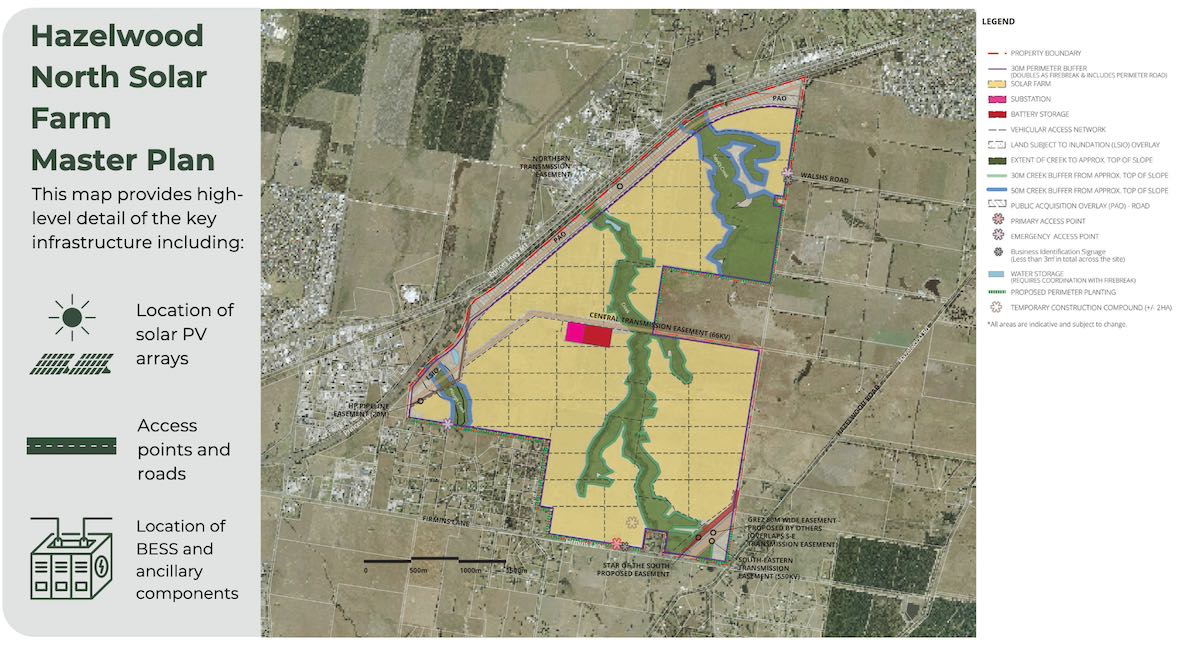
A massive landowner-led solar farm proposed for Victorian coal country has been given the green light by the state planning department, paving the way for construction of what will be the state’s biggest PV project, and an equally massive 450MW, four-hour big battery.
Victoria’s state planning minister Sonya Kilkenny said on Wednesday that the Hazelwood North Solar Farm had been granted planning permit approval for a 450 megawatt capacity solar farm that will power approximately 150,000 homes and prevent 700,000 tonnes of emissions.
The $651 million project will be built on a 1,100 hectare property between Morwell and Traralgon, “in the heart of the Latrobe Valley,” according to the project website.
It will be larger than any solar farm currently operating in the state, Kilkenny says, and includes provision for a 450MW/1800MWh battery energy storage facility – which would be one of the state’s biggest, after the huge Melbourne Renewable Energy Hub.
“The Labor government is getting on with delivering more renewable energy projects and ensuring they are built faster, thanks to recent changes permitting renewable energy projects to be eligible for an accelerated planning pathway under the Development Facilitation Program,” a statement says.
Planning documents show the project developer as Manthos Investments – a private company based in Morwell which is being represented by consultancy Robert Luxmoore Pty Ltd. But the planning, environmental, and community engagement for the project is being led by Melbourne-based consultancy, Cogency.
Cogency says the battery storage facility is an essential element of the solar proposal, “carefully considered to match the energy production capabilities of the solar panels” to allow for consistent electricity supply to the grid.
The solar farm’s panels, meanwhile, will be installed to allow for continued agricultural activity.
“The panels will not present a risk to the livestock, and farming operations will not affect the efficiency of the solar facilities,” the project website says. “Allowing agricultural activities to continue on the site represents best practice within the renewable energy industry and maximises the utility of the site.”
In a statement on Wednesday, the state government’s member for eastern Victoria, Harriet Shing, said the project would deliver 500 local jobs.
“The Latrobe Valley has been the home of Victoria’s energy generation for decades and our nation-leading targets are helping solidify its role in our renewable energy future,” Shing said.
“As our transition to renewable energy continues across the Latrobe Valley, we’re supporting another valuable project that will boost cheap energy, and support jobs and economic growth for communities across the region,” added Kilkenny.
Victoria is targeting a 65 per cent renewables share of electricity by 2030 and 95 per cent by 2035, and is currently sitting at just under 40 per cent. According to Clean Energy Council report, only four renewable energy projects were completed in Victoria in 2023 – two solar farms and two wind farms.
To help move things along, the Development Facilitation Program (DFP) was launched by the Allan Labor government in March, making proposed wind, solar and battery projects eligible for an accelerated development pathway, and removing the planning panel process and third-party appeals.
But Cogency cofounder and director Rebecca Wardle says the Hazelwood North solar farm was not assessed as part of the new fast-track program.
Rather, “robust community engagement” has been the key to the huge project’s comparatively swift journey through the approvals process – a claim that is borne out by the fact that it received only three objections.
“Community engagement is a core part of our business at Cogency. That is something my business partner and I deliberately set out to do – it and marries well with [our previous careers in] planning,” Wardle told RenewEconomy on Wednesday.
Wardle says she and Cogency cofounder Adam Terrill used to work at a planning consultancy but, inspired by working on some of Australia’s earliest wind projects, decided to turn their focus to developing projects rooted in sustainability.
“So a lot of developers send out their comms team go and speak to local community members. We understand the technical issues and we also understand the planning process so we can answer most of their questions.
“We’re not trying to pull the wool over their eyes. … We are quite honest about and upfront about how things operate and what can be expected.”
Careful design of the project and avoidance of ecologically sensitive areas also means the project is not considered a controlled action under the Environment Protection & Biodiversity Act, so does not need to join the queue for federal government approval.
“And yeah, robust community engagement programs. I think that’s been really successful in achieving the state’s largest solar farm,” Wardle says.
State quietly launches its own version of the Solar Sharer offer, giving households the option…
Latest nuclear status report details the glum state of affairs for the far right's favourite…
The new 400 MW gas peaking plant will be the first for a decade in…
Federal rooftop solar rebate officially opens to systems sized between 100 kW and 1 MW,…
Development process rolls on for 190 km transmission project as state planning minister moves to…
The renewable energy industry might be outgunned on Facebook, but community groups are fighting bot…