Screenshot from Zenith Energy video, LinkedIn
Pared back plans to develop critical offshore wind port infrastructure in Victoria’s Western Port Bay are being rebooted through a state environmental assessment process, in a fresh bid to win a green tick from the federal government.
The state Labor government-backed plans to build a base of operations at the Port of Hastings for the construction of Victoria’s pipeline of offshore wind projects hit a wall in January, after they were ruled out by the federal government for posing a “clearly unacceptable” environmental risk.
The decision, signed off by federal environment minister Tanya Plibersek, centred around the impacts the proposed Victorian Renewable Energy Terminal would have on the Western Port Ramsar wetlands, which are internationally protected.
In response, Victoria’s planning minister called on the Port of Hastings to prepare an environmental effects statement (EES) for the proposed project, to assess alternative project layouts, designs and approaches to avoid and mitigate effects on the wetlands and other habitats and species.
Draft scoping requirements were this week published for consultation, marking a start to the EES process. The documents outline a much pared back project, with the terminal proposed to take up a total of 40 hectares, compared to the 146 hectares last year referred for federal assessment under the EPBC Act.
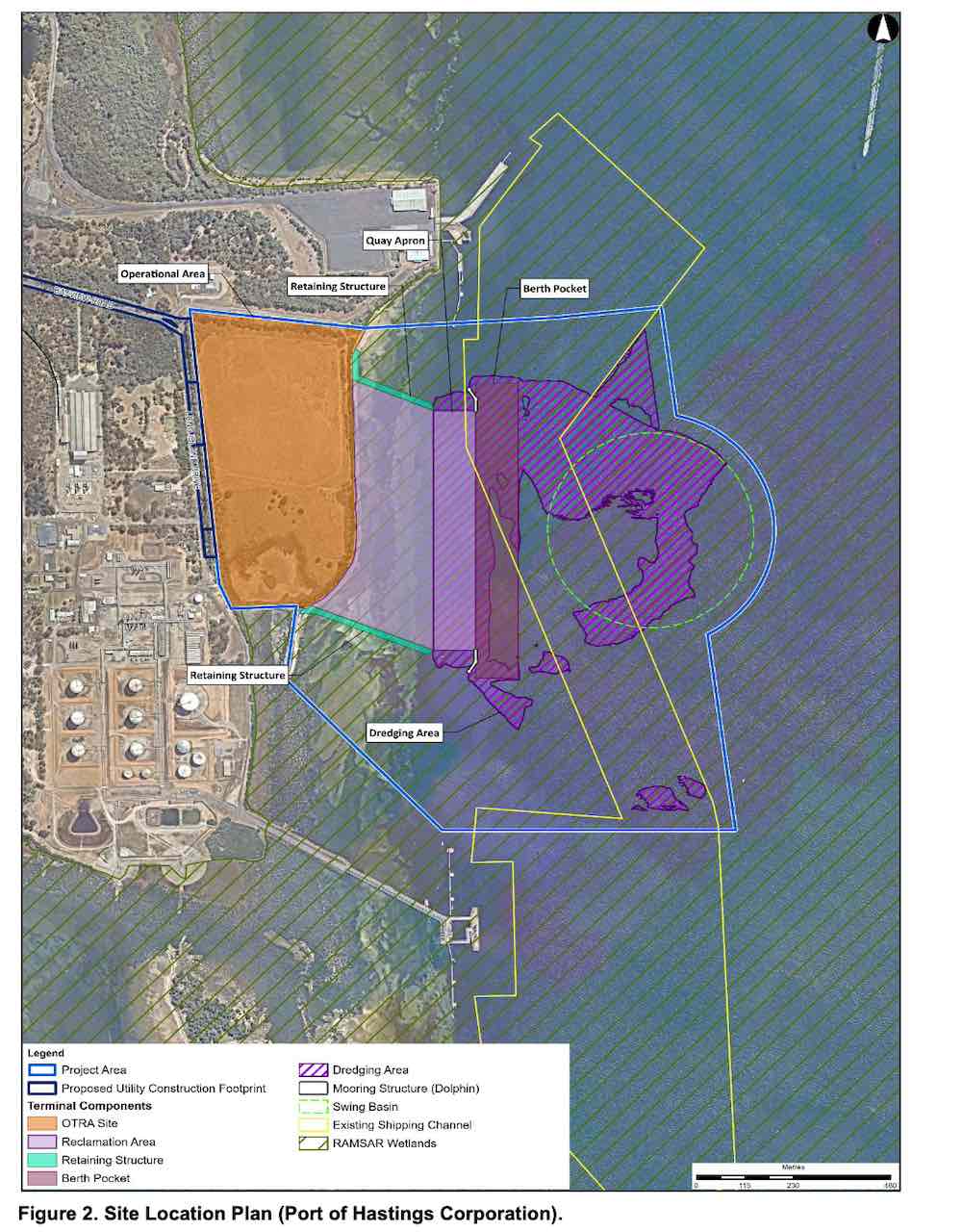
The scoping documents say the proposed terminal redesign would comprise two key areas: a quay apron or concrete wharf structure of around 6 hectares – the same size as in the original proposal; and an operational area of around 34 hectares – 22ha of which is made up of the existing Old Tyabb Reclamation Area site. A total of 18ha of “land reclamation” is required, the documents say.
In the preliminary plans submitted last year, 29 hectares of seabed was expected to be reclaimed for the wharf structure alone. But the big changes in the project’s footprint appear to come down to reductions in the total area proposed for dredging, with the original “dredging boundary” put at 92 hectares.
According to a much more detailed project map, pictured below, the amount of dredging needed to accommodate supply ships has been cut back significantly. It is unclear, however, exactly how much dredging is now being proposed.
Renew Economy has contacted Port of Hastings for comment.
For Victoria, development of the terminal at the Port of Hastings is a key part of the state renewable energy plans, which includes offshore wind targets of at least 2GW by 2032, 4GW by 2035 and 9GW by 2040.
It is the closest deep-water port to Australia’s first declared offshore wind development zone off the coast of Gippsland in Victoria’s south-east and has also been identified as the preferred primary construction port for the 2.2GW Star of the South – likely to be Australia’s first offshore wind farm.
The EES process is expected to run through to 2026 and, all things going to plan, Port of Hastings says construction activities for the Victorian Renewable Energy Terminal will commence in late 2027, with the terminal expected to be operational by 2030.
Consultation on the draft EES scoping requirements is open until December 11. Submissions can be made here.
Two solar farms have been sold for one third of their replacement cost as falling…
Senior CSIRO scientists discussed how to have an "open conversation" about the rising threats from…
New 150 MW solar farm joins the NZ grid on the South Island, matching Aotearoa's…
Pacific leader turned activist says his island nation urgently needs to start "radical adaptation measures"…
A study tested two wind forecast models and found that more accurate one does not…
Australia's biggest wind projects have mostly locked in approvals and contracts, but are still shaking…