Victoria is moving ahead with plans to connect Australia’s first offshore wind farms to the state’s electricity network, seeking federal environmental approval for a transmission project that will be crucial to the state’s target of 2GW of installed offshore wind capacity by 2032.
Plans for the Gippsland Offshore Wind Transmission 2 GW Project have this week joined the queue for a green tick through the federal government’s Environment Protection & Biodiversity Conservation Act, around six months after they were first made public by VicGrid.
The plans for a “broad study area” for the new double circuit 330 kV or 500 kV overhead transmission line were first put forward in March, when VicGrid called for feedback from local communities and landholders. VicGrid said at the time that underground lines were ruled out due to cost, engineering complexity, procurement and timing.
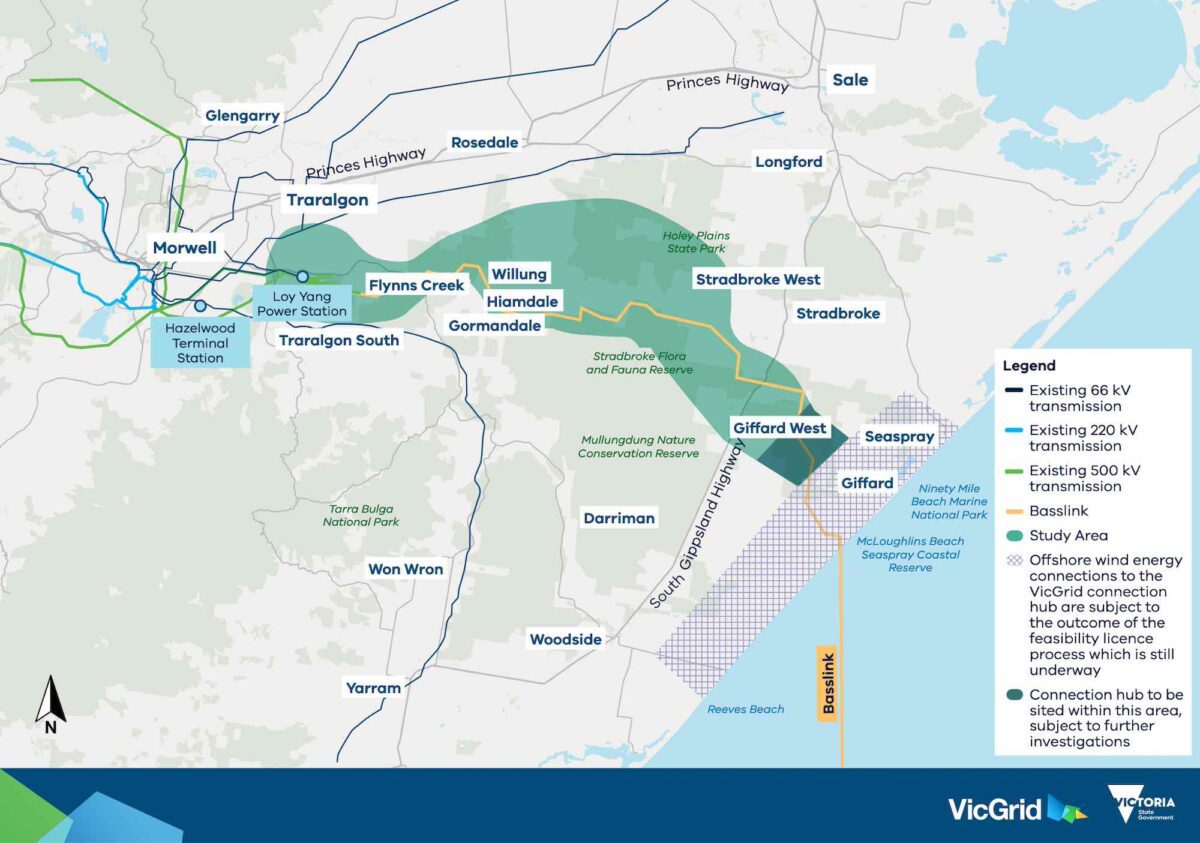
The plans submitted to the federal environment minister this week appear to be much the same, proposing a high voltage alternating current (HVAC) overhead transmission line stretching from from the Gippsland coast to a grid connection near existing coal power assets in Victoria’s Latrobe Valley.
Referral documents say the study area for the new transmission line is around 50-55 km in length and has a width varying from 3-12 km. It starts around 6km inland from the coast, in Giffard, and extends north-west past Stradbroke West to Willung, across to Flynns Creek and terminates near the Loy Yang Power Station.
“The new transmission line would become part of Victoria’s transmission network, the Declared Shared Network, and would transfer offshore wind energy generated off the coast of Gippsland to the National Electricity Market,” referral documents say.
“This shared transmission infrastructure would minimise the potential for multiple proponents developing individual transmission lines from the coast to the Latrobe Valley.”
VicGrid, which took over transmission planning from the Australian Energy Market Operator last June, has been under pressure from the renewables industry to get cracking on the infrastructure needed to connect the nation’s first lot of offshore wind farms to the grid.
Charles Rattray, CEO of the 2.2 gigawatt Star of the South project – largely expected to be Australia’s first completed offshore wind farm – has warned that no developers will start building anything until the onshore grid infrastructure plans are firm.
So far, in Australia’s first officially declared offshore wind development zone, a total of 12 projects have been granted feasibility licences by the federal government.
These licences give the companies exclusive seven-year seabed rights to develop their project – including site and environmental investigations and community consultation – and to apply for a commercial licence to build and operate a wind farm. They do not guarantee final approval.
According to the referral documents from VicGrid, the 2GW transmission plans are designed to achieve the state’s 2GW by 2032 target, only – although the assets would be designed to minimise the potential for multiple proponents developing individual transmission lines from the coast to the Latrobe Valley.
VicGrid says a a second connection hub and transmission line will likely be needed to meet the future legislated offshore wind energy targets of 4 GW by 2035 and 9 GW by 2040.
“The second connection hub would need to be in a location that can service the Gippsland declared area, however the transmission infrastructure would require a separate easement in a different location to ensure energy system security and reliability,” the documents say.
“As a consequence, it is anticipated that the infrastructure would be located outside the current study area.”
For this project, VicGrid says the exact location of the project infrastructure within the study area is not yet known, pending a “detailed refinement
process” that will minimise negative impacts at the outset of the project’s development.
“The refinement of the study area will be an iterative process that involves the analysis of technical, environmental, social and economic factors and incremental improvements to project design,” the documents say.
“It is anticipated that the final actual disturbance footprint would be less than approximately 2 per cent of the study area.”
In its draft determination on changes to the rules governing gas networks revenue recovery, the…
Arena has marked the installation of 100 community batteries and announced a further $23.2 million…
Victoria group takes wind project to court, says public servants are next if successful.
Energy market specialist Tim Ryan says retailers are gaming everything from Solar Sharer and VPPs…
Electricity retailers with their own version of Solar Sharer offer bigger power bill savings than…
Sea surface temperatures are now way ahead of previous levels at this time of the…